
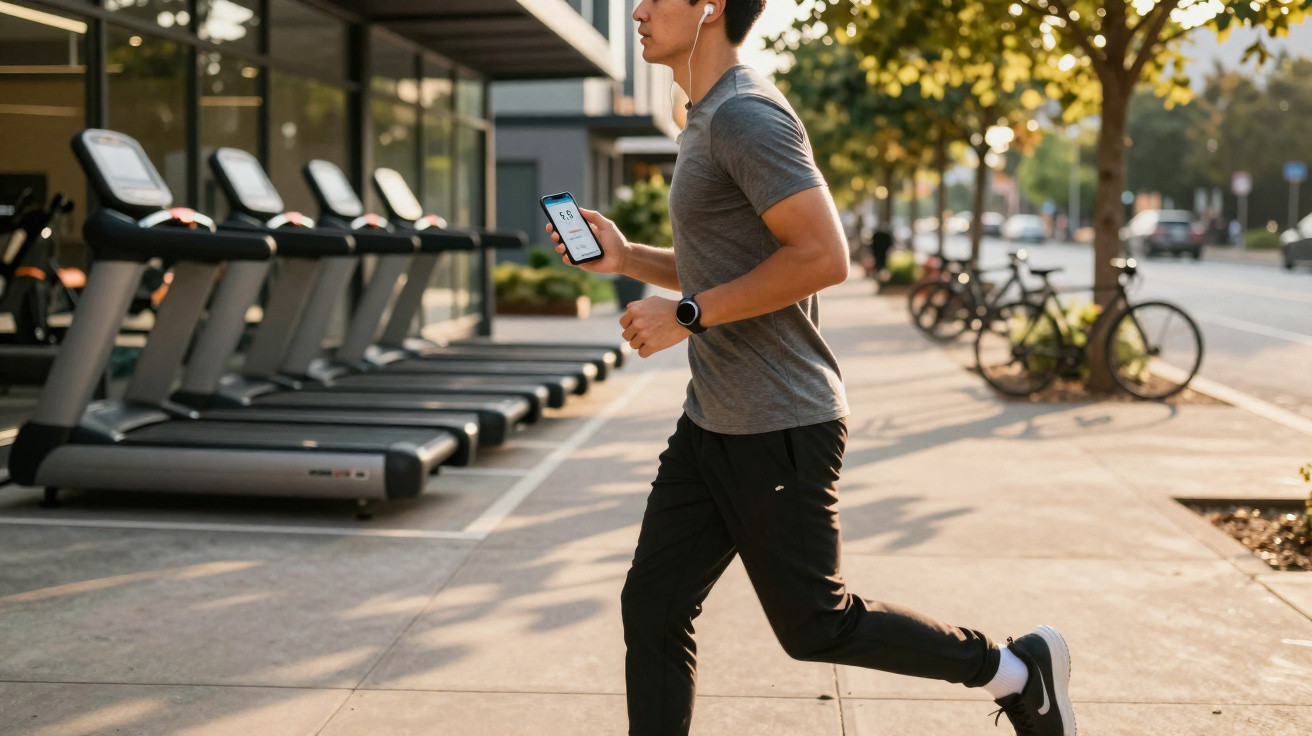
The woman in the vivid blue leggings has the look of someone doing something wrong.
Outside a busy gym, membership card in hand, she pauses before slipping it discreetly into her pocket and walking away. Rather than making for the treadmills, she checks her watch, fastens her jacket and heads briskly yet unhurriedly along the road, as though she has an appointment with herself. There is no elaborate programme or burpees involved. Only a purposeful walk, her gaze lowered, headphones on.
Half an hour later, she returns to the same spot with rosy cheeks, a steady pulse and a step counter celebrating its modest digital win. She looks from the gym entrance to her watch, seemingly wondering: “Does this really count?” Her phone shows a strangely precise figure: 5.1 km/h. It is a small number that carries a large promise.
It does: skipping the gym for walking really works - provided the walk reaches one very specific sweet spot.
Why a proper 30-minute walk can beat an uncommitted gym session
Walking is usually seen as the thing people do in between their “proper” exercise. It takes you from the sofa to the fridge, from the car to work, or from a desk to the coffee machine. It seems far too everyday to create meaningful change. So, when somebody claims that walking can replace the gym, the instinctive reaction is often a slightly sceptical eye-roll.
But watch someone maintain a 5 km/h pace for 30 minutes without stopping. Their breathing deepens, their shoulders loosen and their expression relaxes before gradually brightening. This is not an aimless dawdle. It is a calm, sustained effort that eases the body into the zone where improvements occur. No theatrics, simply rhythm.
The important factor is not merely walking, but how you walk: continuously, without breaks to scroll, without easing into a crawl, and quickly enough to demand something of your heart, lungs and legs. That is the point at which “just walking” begins to look remarkably like genuine training.
A 2023 University of Sydney study examined the effect of walking speeds on health risks. Participants who walked briskly - at roughly 5 km/h - faced a far lower risk of heart disease and early death than those walking slowly, even where their overall step totals were alike. In theory it was the same form of movement, yet the outcomes were very different.
Put more simply, 30 purposeful minutes at 5 km/h broadly equates to the moderate-intensity cardio that many gyms suggest for beginners. Depending on your body weight, you will use around 120–180 calories, while keeping your heart rate raised long enough to train it rather than merely give it a slight prompt.
Thomas, an office worker I interviewed, traded his post-work gym membership for a firm rule to “walk home fast”: 2.5 km in exactly 30 minutes. After three months, he had lost 4 kg, his blood pressure was better and the dark circles beneath his eyes had diminished. His only new piece of kit was a waterproof jacket.
Both the research and Thomas’s experience point to the same lesson: sustained intensity matters more than spectacle. For most adults, 5 km/h is a brisk speed. You can still hold a conversation, but giving a speech would be less appealing. This is the sweet spot known as “moderate intensity”. Maintained for long enough, it lifts your metabolism, conditions your heart and signals to your body that this movement has a purpose.
That is also why repeatedly stopping to read messages or slowing down to browse shop windows quietly undermines the benefit. Bodies respond well to continuity, and the heart requires prolonged effort to adapt. Thirty uninterrupted minutes at this pace turns walking from a casual activity into intentional training - the sort that can genuinely substitute for a considerable amount of gym time.
How to walk at 5 km/h for 30 minutes without hating it
Start by making “5 km/h for 30 minutes” tangible. At this speed, you will travel approximately 2.5 km in half an hour. That works out at about 12 minutes per kilometre, or 19 minutes per mile. You do not need a treadmill or laboratory to manage it: an inexpensive watch, mapping app or local distance markers will be enough.
Choose either a circular or direct route measuring around 2.5 km. Walk it once at an easy pace first, simply to understand the distance. On your next attempt, set a 30-minute timer and aim to complete that route before it sounds. You are not trying to sprint; think instead of moving as though you are late to meet somebody you respect. Let your arms swing gently, keep your stride assured and look ahead. Aim for sustained pressure, not “I regret my life choices.”
In practical terms, make this 30-minute walk a fixed appointment rather than an optional add-on. Select a slot that genuinely works in your life: before the children wake, during lunch, or straight after work before the sofa gets your attention. One particularly useful mental trick is to set off as soon as you shut the front door, before your mind has the chance to negotiate.
Here is the part many people get wrong without noticing. They begin well, then gradually drift: their speed drops, the phone emerges or a call disrupts them. Before long, the 30-minute walk has become a 42-minute wander involving three stops and a quick look at TikTok. Strictly speaking, they “went for a walk”. In practice, their body was never required to adapt to anything.
Try a different approach. Set your phone to “Do Not Disturb” and decide that walking will be the only app running for 30 minutes. If you want distraction, download a podcast beforehand or prepare a playlist lasting slightly more than half an hour. Once the episode finishes, you will know that you are nearly back home.
Let’s be honest: nobody truly manages this every day. Life is unpredictable. Some days will be missed, routes will be shortened and plans will change. The answer is not perfection but regularity. Three or four concentrated walks a week at this pace can establish a fitness foundation that most “I’ll go to the gym more this year” promises never achieve, largely because walking does not demand heroics.
“When people say they’re ‘not fit enough’ for the gym, I tell them: great, the street doesn’t charge membership,” laughs sports physician Dr. Hannah Rice. “If your walk makes you slightly breathless but still able to speak in short sentences, you’re probably around that 5 km/h effort. Do that for 30 minutes. Then repeat. That’s training.”
To make it straightforward, focus on the levers within your control:
- Distance – Target roughly 2.5 km in 30 minutes.
- Pace – You should be able to speak, but not want to chat without stopping.
- Frequency – Aim for 3–5 walks weekly, rather than “every single day forever”.
- Comfort – Wear suitable shoes, light layers and perhaps a cap; do not turn it into an expedition.
- Focus – Keep moving for 30 minutes: no scrolling, errands or detours for shopping.
The understated value of choosing pavement over a treadmill
There is something unexpectedly radical about deciding: “I’m not going to the gym. I’m just going to walk, properly.” In a world fixated on trackers, HIIT sessions and influencer-endorsed routines, it can sound too simple and low-tech. Yet for many people, and many lifestyles, this is precisely where progress lies.
By walking continuously at a 5 km/h rhythm, you are doing more than completing a fitness task. You are taking back a portion of the day from screens, obligations and expectations. It creates a moving space in which the mind can sort itself out almost as effectively as the hamstrings. This helps explain why so many people say walking improves their sleep, makes them less argumentative or enables clearer thinking, even before any physical change becomes apparent.
At a more fundamental level, this method changes your relationship with exercise. There is no longer an “all or nothing” mindset, and no need to wait for motivation. Instead, ask one simple question each day, or almost every day: “Can I walk for 30 minutes without stopping, at a pace that requires effort from me?” If the answer is yes, you are not skipping the gym. You are simply taking the gym outdoors, on your own terms.
| Key point | Detail | Benefit for the reader |
|---|---|---|
| 30 minutes non-stop | One continuous session, with no pauses or scrolling | Maximises cardiovascular impact without extending the session |
| Pace of 5 km/h | Around 2.5 km in 30 minutes, with slightly quicker breathing | Reaches the genuine intensity of moderate exercise |
| 3–5 times each week | A realistic routine that fits around a busy life | Creates lasting benefits without pursuing perfection |
FAQ:
- Is walking 30 minutes at 5 km/h really enough to replace the gym? For basic cardio, weight management and health indicators, yes - provided you walk continuously and several times each week. It will not take the place of heavy strength training, but it certainly qualifies as real exercise.
- How do I know whether I’m actually walking at 5 km/h without a treadmill? Time yourself over a mapped 2.5 km route. Completing it in about 30 minutes means you are on target. If not, alter your speed next time until the figures align.
- What if I have to stop at roads or to catch my breath? A handful of brief, necessary pauses is fine. Just avoid lengthy breaks that allow you to cool down or transform the walk into a stroll. The objective is one largely continuous effort.
- Can I split it into two 15-minute walks instead? Two brisk 15-minute walks are beneficial for health, but they do not deliver quite the same training effect as 30 uninterrupted minutes. Treat the half-hour session as the gold standard.
- Will I lose weight by doing only this kind of walking? You may, particularly if your diet is not working against you. Regular walking at this pace burns additional calories and improves the way your body uses energy, although fat loss still depends on the overall balance between your food intake and energy expenditure.






Comments
No comments yet. Be the first to comment!
Leave a Comment