
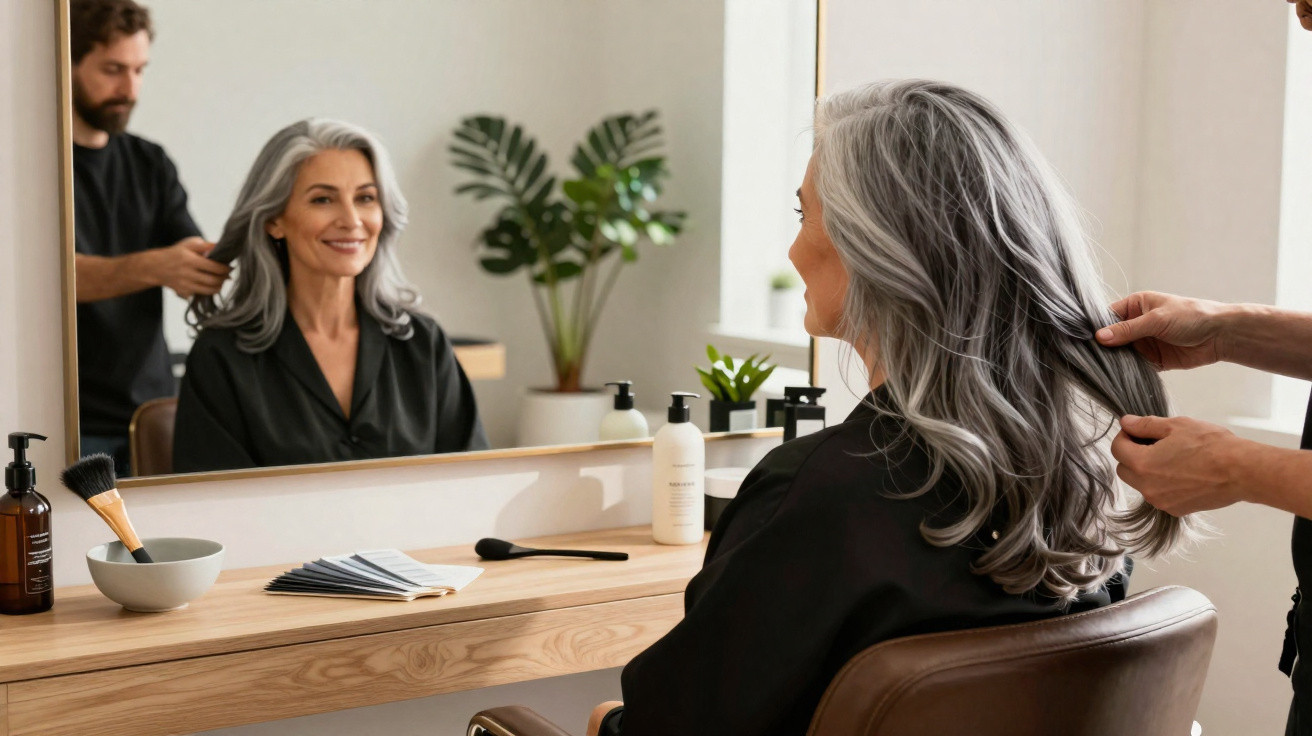
The woman in the salon chair studies her reflection as though it belongs to somebody else.
Silver roots show at her scalp, while the ends are an uninspiring, flat brown, divided by a stark line where the colour begins. Behind her, the stylist holds a tube of dye and waits for the familiar signal. Cover it. Conceal it. Wipe it away.
This time, though, she pauses.
Beside her, another client is having her hair gently “smoked” – a blend of silver, beige and pearl that makes grey appear deliberate, luxurious and full of life. There is no severe regrowth line. No battle against nature. Simply… a different narrative.
Something is changing in salons and across social media. Severe colouring now feels rather like that old pair of skinny jeans you can hardly believe you once wore. People are doing more than simply going grey: they are redefining what grey represents.
The end of the battle against roots
Spend time on Instagram and the change becomes clear: the ultra-even helmet of colour is gradually fading away. It is being replaced by a softer, diffused way of handling grey. Colourists refer to it as “grey blending”, “smoky lights” or “salt-and-pepper melting”. The point is not so much to disguise what is coming through, but to merge it with the hair you already have.
The overall effect? Relaxed. Light. Luxurious without demanding attention.
This change was not born from nowhere. During the pandemic, months of visible roots forced people to look at their natural hair, watching silver strands emerge like small acts of rebellion. Plenty of them did not return to complete coverage. They wanted to escape the timetable of regular salon appointments. They wanted hair that could grow out without exposing them every time they looked in the bathroom mirror.
On a Tuesday afternoon in London, colourist Ayesha tells me that, five years ago, perhaps one client a month wanted to “work with” their grey. Today, it is one in three. Her chair is occupied by women in their 30s, 40s, 50s and beyond, cautiously passing over screenshots on their phones: blended silver bobs, smoky balayage and striking grey pixie cuts that look more like fashion-editorial styling than surrender.
They are not always prepared to go entirely natural. That step can still feel huge, emotionally charged and irreversible. What they want instead is a gentler transition: a way to stop feeling as if one missed appointment will make them “look old”. Ayesha says some clients arrive almost apologetically, quietly saying: “I think I want to see what my real hair is like.” They leave feeling lighter, and not only because of their hair colour.
The figures reflect what is taking place in salon chairs. Searches for “grey blending” and “embracing grey hair” have surged over the past three years, whereas blunt “cover my grey” searches have levelled off. There is a clear generational divide, too. Generation X and older millennials, brought up on home dye kits and glossy brunette advertising campaigns, are making the most significant shift. They are weary of pursuing a shade that, after 45, does not naturally exist without relentless maintenance.
The reasoning is straightforward. If every 2-millimetre root feels like a failure, then something is wrong. Blended grey changes the benchmark. Rather than being a secret that needs constant upkeep, hair becomes a story you can reshape, soften and allow to change alongside you.
How grey blending works in everyday life
This modern approach to grey is not magic; it comes down to technique and timing. Colourists first map where your natural silver appears, almost as if contouring the scalp. They then create a “bridge” between coloured lengths and new roots with ultra-fine highlights, lowlights and toners in cool, smoky shades.
The objective is to remove the stark divide. Think mist rather than a line. Your natural grey becomes the palest tone within a wider palette, instead of standing apart from it.
For some people, this involves icy babylights around the face and disrupting old dark dye through the back sections. For others, it means softening only the upper layers, allowing them to “test-drive” a more natural appearance without stripping away years of colour all at once. The gradual nature of the process is intentional. This is not a transformation you reverse the following weekend.
That does not mean there are no pitfalls. One of the most frequent errors is moving directly from years of black or dark-brown home dye to wanting “silver in one session”. Hair does not forget. It clings to pigment like a grudge, and lightening it too quickly can cause breakage or the notorious uneven orange result.
Another mistake is holding on to precisely the shade you wore at 25. Skin tone, eye colour and even eyebrow density change over time. A blue-black or cherry-red shade that once felt dramatic may suddenly pull the face down. A gentler ash, mushroom or beige tone around the greys can lift your features more effectively than a full-coverage colour treatment.
Let’s be honest: nobody really does all of that every day. You will not flawlessly gloss, tone, mask and massage your scalp to schedule. This is why the newer approach embraces flexibility. Hair can grow a little, fade slightly and develop dimension between appointments. The aim is not “no roots ever again”. It is “roots that don’t ruin your day”.
“I stopped trying to look like my old photo ID,” laughs 56-year-old Claire, who spent two years transitioning from chestnut brown to a smoked silver bob. “Once the harsh line was gone, the grey just looked like… mine. Not a problem to solve, just part of my face now.”
There is also a subtle emotional change taking place in the chair. Choosing to soften your colour instead of fighting it can feel, on some level, like making peace with your reflection. It is not about giving in. It is about deciding which battles deserve 3-hour salon appointments and which do not.
- Ask for “grey blending” or a “soft transition”, rather than “cover my grey”. The language you choose establishes the mood.
- Take photographs of people with a natural base similar to yours, rather than only aspirational white bobs from Pinterest.
- Expect a process lasting 6–18 months rather than one appointment, particularly if you have used dark dye for years.
Grey hair as a modern status symbol
An unexpected social change is happening, too. Where grey hair once suggested someone was “tired” or had “let themselves go”, the new blended and intentional grey is beginning to communicate something different: independence, discernment and even a form of quiet luxury. A polished silver crop with sharply cut ends and glass-like shine does not say “I don’t care”. It conveys the reverse.
It has already appeared in fashion circles. Editors and creative directors are growing out their roots, then making them part of their signature style. Influencers are swapping filters and balayage for close-up selfies showing temple streaks, paired with good skincare and red lipstick. In more everyday settings, it is the colleague who returns from holiday slightly greyer yet somehow looking fresher.
The real appeal is that this approach provides something social media seldom offers: relief. You are allowed to exist in the middle – between shades, decades, old photographs of yourself and new ones. Severe colouring belonged to a time when you were either “done” or “letting yourself go”. Grey blending occupies the nuanced space between those extremes: the awkward territory where most real life takes place.
You can spot it now on a packed train: the shimmering silver bob with darker lowlights; long hair scattered with bright white sections catching the light like jewellery; the salt-and-pepper crop on a man who looks more like an architect than a grandfather. You may even find yourself looking for a moment too long, not from judgement but from curiosity.
That is where the discussion is heading. Less “Should I hide my grey?” and more “What version of my hair feels most like me right now?”
| Key point | Detail | Why it matters to the reader |
|---|---|---|
| Grey blending vs full coverage | Soft highlights, lowlights and toners merge natural grey with existing colour | Provides a low-pressure transition with less noticeable roots |
| A timeline, not a quick fix | The transition usually takes 6–18 months, especially from dark dye | Sets realistic expectations and helps prevent hair damage |
| Grey as a style choice | Polished, intentional grey appears modern and confident | Reframes ageing as something to design rather than conceal |
FAQ:
- Will grey blending make me look older? Not necessarily. Severe, flat colour can age the face just as much as grey hair. A softer, cooler blend suited to your skin tone often appears fresher than a heavy block colour.
- How often will I need salon appointments with this new approach? Most people can extend appointments to every 8–12 weeks. As the regrowth line is softened, you can tolerate some new growth without panic-booking.
- Can I go from dark home dye to soft grey in one session? Realistically, no. Years of pigment must be lifted gradually to prevent breakage and patchy colour. Expect several appointments and a longer-term plan.
- Must I cut my hair short to embrace my grey? Not at all. Blending methods work for long, medium-length and short hair. Some people opt for a dramatic cut to speed up the process, while others retain their length and transition gradually.
- What if I try it and hate the result? You can always reintroduce carefully placed lowlights or a softer all-over tint. Grey blending is more adaptable than becoming fully silver in one go, which is why so many people use it as a test-drive stage.



Comments
No comments yet. Be the first to comment!
Leave a Comment