
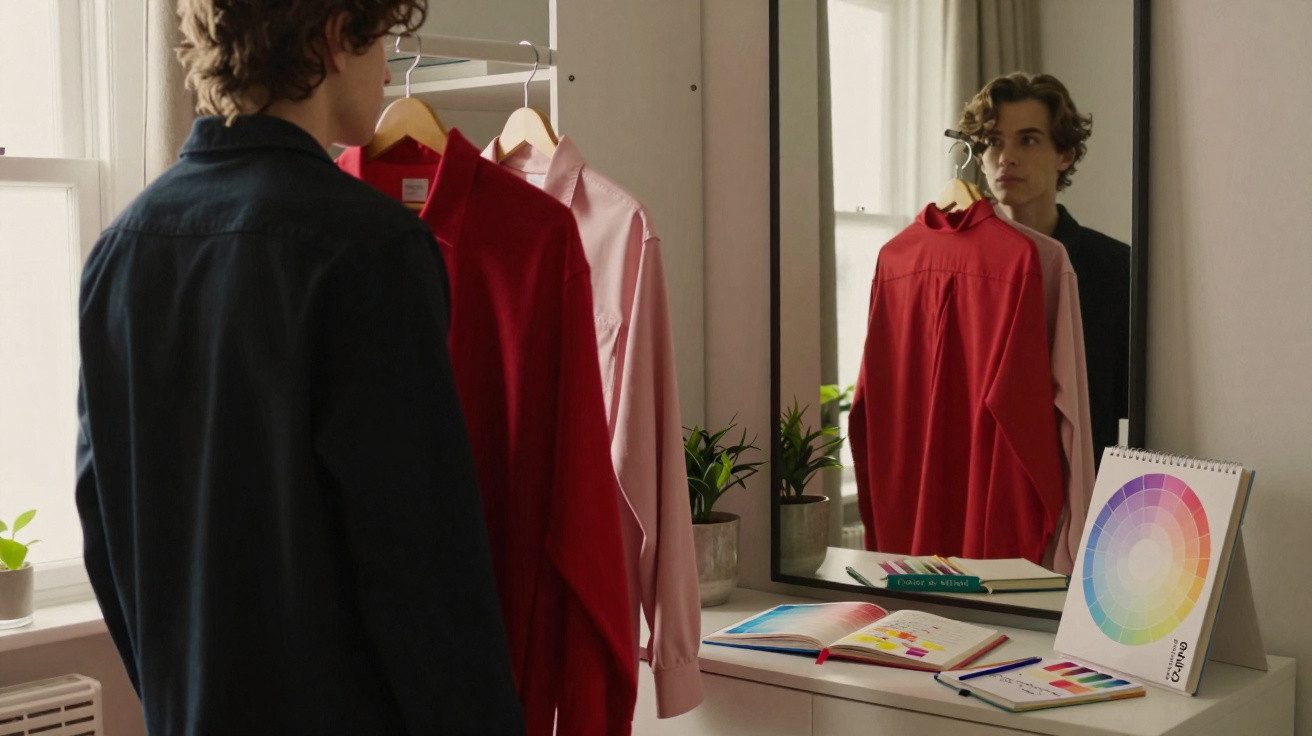
Her choice is not driven by cost, but by colour. Her hand reaches automatically for the muted beige she always chooses, pauses over a striking cobalt blue, then pulls away at the final moment. She makes a joke about it to her friend, yet her shoulders remain faintly rigid as they move away from the rail.
Elsewhere in town, a manager browses paint swatches to “refresh” his home office. Every vivid option is dismissed, while he repeatedly returns to one particular deep grey. “Serious, professional,” he says under his breath. His partner asks whether he is certain. Before she can complete the question, he presses “order”.
Psychologists have begun to pay attention to these small, habitual colour decisions. Some now suggest that three recurring choices may reveal more about self-confidence than people would prefer to acknowledge.
The three recurring colours some psychologists are quietly side-eyeing
A small but expanding group of researchers continues to encounter the same three colour families: plain beige and “nude” shades, intensely dark charcoal or black, and heavily filtered pastels that seem lifted directly from a social-media preset. No single colour, on its own, announces “fragile self-confidence”. Worn on one occasion, they are simply clothing choices or wall paint. But when they are selected repeatedly, in every setting, they can begin to resemble a protective shield.
Psychologists are less interested in the shade than in the repeated behaviour. It is the person whose clothes, lounge, phone case, notebook and even water bottle all fall within one restricted range of safe tones. It is the woman who admires red on other people but never purchases it for herself. Or the man who says bright colours are “not for people like him”. Repeated patterns of this kind are difficult to overlook.
In a recent series of interviews presented at a European psychology conference, clinicians spoke about clients who arrived “wrapped in neutrality”. One therapist recalled a 29-year-old marketing executive dressed exclusively in beige, greige and light camel. The same rigid palette extended throughout her flat: an oatmeal sofa, an off-white rug and sand-coloured bedding. She described it as “calming minimalism”. Beneath that explanation, she quietly conceded that she did not “feel like someone who could pull off” bolder colours.
A different clinician referred to young men who retreat into entirely black outfits, not as an act of rebellion but because they fear making the wrong choice. One man explained that he wore black because “it makes me invisible if I need to be”. A colour consultant working with retail brands observed that shoppers giving themselves the lowest self-confidence ratings in short questionnaires were twice as likely to choose safe greys or faded pastels for “everyday” items. The figures remain small, but the accounts are uncannily alike across different cities and cultures.
What might sit behind these habitual choices? Some psychologists believe that, when self-confidence is delicate, people instinctively steer clear of colours that could invite notice or judgement. Beige and “nude” shades recede into the background. They are flattering without being loud. All-black or dark-charcoal looks may act as emotional armour: crisp, restrained and difficult to interpret. The excessively curated pastels that appear suited to a lifestyle influencer’s feed offer another kind of reassurance - they present a polished, inoffensive, “on-brand” self that is difficult to criticise.
Seen this way, colour is less a matter of preference than a form of risk management. If you privately feel you are “too much” or “not enough”, you might depend on shades that help you vanish or look faultlessly acceptable. Critics of this idea argue that it reads far too deeply into ordinary trends. Even so, they tend to agree on one point: when people feel inwardly free, their colour choices often appear freer too.
How to use your colour habits as a gentle mirror without panicking
Colour psychologists who work more directly with the public do not advise people to throw away half their wardrobe. Instead, they recommend something more modest: a colour audit. Spend ten minutes reviewing the choices you made over the past month - clothing, nail colour, screens, notebooks and even the mug on your desk. Look for what keeps returning. Do so with curiosity rather than guilt.
If those three categories occur everywhere - beige/nude, all-black or near-black, and washed-out pastels - try asking a softer question: where do you permit yourself to choose something else? It may be no more than a pair of socks, a phone wallpaper or a T-shirt reserved for wearing at home. That is the first small crack in the wall. You don’t have to “fix” your colours. Simply try the boundaries and observe how your body responds when you leave your familiar territory for an hour.
Many people fall into the trap of making colour another scorecard for self-criticism. They see a viral post claiming “if you wear too much beige, you secretly hate yourself” and begin to spiral. Let us be honest: nobody really does this every day, this calm and nuanced work of stepping back from fashionable psychological trends. We click, swipe and identify too strongly. Then we feel exposed because our wardrobe seems a little too close to the “fragile” category.
A compassionate approach begins by distinguishing comfort from fear. Ask yourself: am I selecting this shade because it truly feels like me today, or because I fear how I would be perceived in anything different? Everyone has low-effort days when black jeans and a grey sweatshirt are simply convenient. That alone says very little about your inner life. The important element is the internal rule: “I can’t pull off colours” or “I’d look ridiculous in that”. More than the T-shirt itself, those statements are where cracks in self-confidence become visible.
Some specialists caution against making colour psychology into another dogma.
“You can’t diagnose a personality from a paint chart,” says London-based psychologist Dr. Hana Field. “Color is one tiny thread in a very complex fabric. At best, it’s a conversation starter with yourself, not a verdict.”
A handful of simple boundaries can nevertheless prevent that conversation from becoming unkind:
- Recognise patterns without calling them “good” or “bad”.
- Start experimenting in low-stakes situations: pyjamas, stationery or digital backgrounds.
- Take colour inspiration from people you admire rather than people you envy.
- Stop if your body truly becomes tense - this is not a style competition.
- Treat colour as play, not as a performance for strangers online.
The most grounded therapists present colours as invitations rather than prescriptions. If beige makes you feel peaceful, continue wearing it. If black helps you feel elegant and strong, it is not the enemy. The more meaningful warning sign comes when you say “I always” or “I never” about colour. That may be where you are shielding a more vulnerable part of yourself from view.
Why experts disagree - and what that means for you
Within academic psychology, colour has long occupied an unusual and disputed position. Certain classic studies did identify connections between colour and mood - red raising arousal, blue reducing heart rate, and green aiding recovery after visual stress. Yet those trials took place under tightly managed conditions, a long way from the untidy reality of what you wore to work last Tuesday.
More recent attempts to link long-term colour preferences with personality traits often rest on uncertain ground. Samples are limited. Cultural context matters enormously. A preference for black clothing has a different meaning in Tokyo, Berlin and Lagos. For this reason, many specialists dismiss sweeping social-media claims such as “People who wear pink are more confident in love”. They argue that such messages reduce a complicated story to a slogan designed for clicks.
Conversely, clinicians and coaches who meet clients each week say they cannot disregard what they observe. When somebody spends ten minutes apologising for a brighter shirt before describing themselves as “too loud” or “too needy” in relationships, the parallels are difficult to miss. One camp wants hard numbers; the other trusts lived patterns. Each is partly correct. Colour preferences by themselves can never offer the depth of a proper self-esteem assessment. However, they may draw attention to places where someone is hiding or working hard to seem “acceptable” at every moment.
The friction between these two viewpoints may actually offer good news to everyone else. You do not need to regard your wardrobe as medical evidence, but you may use it as a gentle mirror. You might think: “Maybe my all-pastel, always-filtered aesthetic is less about taste and more about trying to look harmless.” You can equally decide: “Or maybe I just like it, and that’s fine.” The disagreement between experts leaves room to breathe, experiment and reconsider.
If this debate raises anything, it is a quieter and deeper question: in which parts of your life do you still feel that you require a costume to be acceptable? At meetings? On dates? Around your own family? On an ordinary Monday in the supermarket? On a screen filled with strangers, curated squares and highlight reels?
Colour is only one way in which we respond to that question, but it is among the most visible. A safe beige sofa, a sharp black blazer and a soft pastel phone case each say, “Here is how much space I’m willing to take up today.” When your hand pauses over that familiar safe shade again, you could stop briefly, not to judge yourself but to ask: “Do I want protection right now, or expression?”
That small pause is where self-confidence quietly begins to learn a new vocabulary of colour.
| Key point | Detail | Why it matters to the reader |
|---|---|---|
| Recurring “safe” colours | Beige/nude, all-black/charcoal and hyper-curated pastels often appear as repeated default choices | Helps you recognise patterns in your own wardrobe and surroundings |
| Colour as emotional armour | Some psychologists interpret these shades as ways to blend in, appear “proper” or avoid criticism | Encourages you to consider whether your choices arise from comfort or fear |
| Debate among experts | Researchers disagree about how much colour genuinely reveals about self-confidence | Encourages you to treat colour as a gentle mirror rather than a fixed diagnosis |
FAQ:
- Does wearing a lot of beige mean I have low self-confidence? Not necessarily. You may simply prefer quiet, neutral shades, or it may reflect a desire to blend in. What matters is whether you feel able to select something different when you want to, or privately think you “can’t pull off” other colours.
- Is black clothing really a sign of insecurity? For plenty of people, black feels powerful, uncomplicated and stylish. For others, it provides a way to feel less visible or less “wrong”. Context is important: the way you describe your choices often reveals more than the colour alone.
- What about people who love bright colours - are they always confident? No. Vivid colours may reflect joy, culture, personality or fashion trends. Some very anxious people also dress boldly as a form of overcompensation. Colour is one clue among many, not a shortcut to understanding somebody’s inner life.
- Can changing my colour palette really boost my self-confidence? It can complement other work you do on yourself. Trying a slightly bolder shade and getting through the day may gently challenge beliefs such as “I’ll look ridiculous” or “People will judge me”. Deeper confidence, however, often requires deeper work than buying a new shirt.
- How do I explore colour without feeling fake or silly? Begin with small, private choices: socks, pyjamas, phone wallpapers or a mug. Pay attention to how you feel rather than how you appear. If a shade gives you a slight sense of relief or aliveness, keep it nearby. If it feels like a costume you are performing in, you can leave it behind.

Comments
No comments yet. Be the first to comment!
Leave a Comment