
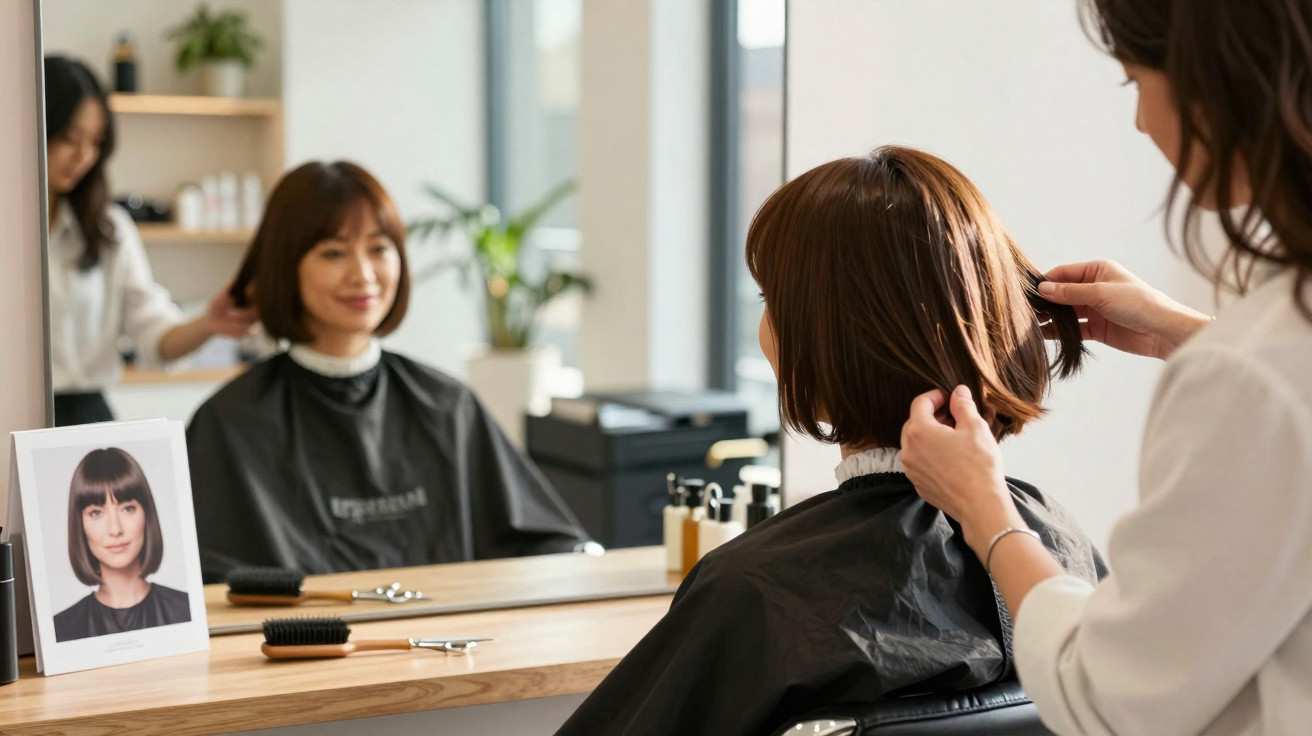
At 9.15am the salon is already humming. A woman in a camel coat settles into the chair, sweeps her fringe aside and exhales: “I want a bob. Fresh. Chic. But I’m over 40 now… I don’t want to look harder, or older.” The stylist, scissors poised, gives the kind of smile that says he’s heard that line three times since opening.
All around them, clients with foils and warm towels tilt their heads in quiet agreement. You can sense it straight away: this is never only about hair. It’s about ageing, confidence, and the awkward expectation to “stay young” without seeming as though you’re trying.
The client flicks through her phone, holding up pictures of immaculate jawlines and glossy bobs. The hairdresser looks once and replies, evenly: “Some of these are your friends. Some are your enemies.”
The room briefly falls silent.
The 5 bob cuts that secretly age your face after 40
The professional I spoke to - a Paris-trained hairdresser with 20 years behind the chair - didn’t pause when I asked which bobs he steers away from for women over 40. “There are five that are repeat offenders,” he said, comb hovering mid‑air. “They look stunning on Instagram, and then in real life… they harden everything.”
He wasn’t being unkind; he was being precise. These are the shapes that can pull features down, underline fatigue, or freeze the face into a line that no longer moves with you. At 25, they can read as edgy. After 40, they can shout “I’m trying too hard” - or worse, “I’ve stopped trying.”
The catch is that they’re often the very cuts that pop up first when you search “chic bob haircut” on Google.
Top of his blacklist: the ultra-straight, jaw-length bob with no layers - the perfect geometric rectangle that gets saved on Pinterest. On a round, youthful face it can look crisp and modern. On a more mature face, especially where the jawline has softened slightly, it lands exactly where you least want attention.
Second: the bob that finishes right at mid‑neck and turns under like a helmet. “That one,” he says, “adds ten years and three kilos on camera.” The edge meets the thickest part of the neck, and in profile the whole outline can appear heavier.
Third: the very short bob that exposes the nape, paired with a dense, full fringe. It can look wonderfully chic on a young Parisian student; it’s far less forgiving when the skin is beginning to lose volume.
He names two more usual suspects: the bob that’s too asymmetrical (one side long, the other almost pixie-short), and the razor-thin, ultra-blunt bob on fragile hair. Both can be breathtaking on a runway. Both can draw the eye to drooping mouth corners, or make fine hair look even flatter when it already struggles for volume.
So why do these styles age us so quickly? Because after 40, the face shifts: cheeks deflate a touch, the jaw becomes softer, and the neck tells its own story. A flattering cut should counterbalance that - lifting the gaze and softening the “fault lines”. These bobs tend to do the reverse.
They outline the exact areas you’re starting to renegotiate with the mirror. And they’re merciless on a tired day, in harsh lighting, or when you’ve had to do a rushed blow‑dry.
What to ask for instead: the “soft‑lift” bob explained
For women over 40, this hairdresser relies on one rule above all: nothing should look stiff. “Ask for movement,” he insists. Think a bob that skims the collarbone rather than slicing at the jaw. Think a front line that’s only slightly longer - by a centimetre or two, not more.
He describes what he calls “soft‑lift” bobs: light layers around the face, and a gentle diagonal that guides the eye upwards towards the cheekbones instead of down towards the neck. The ends are texturised rather than cut into a hard, straight edge, so the hair doesn’t sit as a single solid block. Light can pass through it.
Side partings can become your quiet helpers too. A very severe middle part can spotlight asymmetry and make expression lines look deeper. A soft off‑centre part, plus a few face-framing strands, often makes the whole face look calmer and less tense.
He says plenty of women arrive with a screenshot of a celebrity in her 20s and announce, “This bob, exactly this one.” His response is always the same question: “Do you want the photo, or do you want to look like you?” That small sentence tends to shift the whole atmosphere.
Often, the kinder alternative to a strict, jaw-cutting bob is a “lob” - a long bob finishing somewhere between the collarbone and the top of the chest. It visually slims the neck, lengthens the silhouette, and leaves room for a slight wave or bend that forgives a bad night’s sleep.
Most of us know the feeling: you get a haircut and, somehow, you look as if you’ve aged five years overnight. Sometimes the fix is simply a touch more length - just enough to flip the effect.
And let’s be honest: hardly anyone does this perfectly every day. Nobody wakes up and spends 45 minutes making a bob sit exactly right. That’s why razor-precise, high‑maintenance shapes can be such a gamble after 40.
He tells me about Claire, 47, who demanded a bone-straight, chin-length bob after seeing it on a young influencer. “Two weeks later she came back with a headband and tears in her eyes. The cut was great on day one, then brutal on every other morning.” They softened the edge, added layers to release the jaw area, and nudged the length down to the collarbone. “She walked out and said, ‘I feel like myself again.’”
Those five “enemy” bobs aren’t offences. They’re simply not built for a face that’s already lived a little. Hair should echo that story, not battle it.
How to talk to your hairdresser (and avoid a regret haircut)
His first tip is surprisingly simple: explain the feeling you’re after, rather than dictating a precise shape. Instead of “I want this razor bob,” try “I want to look fresher, softer, less tired.” That gives your hairdresser space to tailor the cut properly.
Bring two or three photos, not twenty. Point to what you’re drawn to: the length, the crown volume, the curtain fringe. Then be equally clear about what you don’t want: hair sitting on the neck, a heavy fringe, daily straightening. That’s where the real conversation begins.
Never hold back from saying, “I’m afraid of hard lines around my jaw” or “I don’t want to highlight my neck.” Those sentences are invaluable. They let the professional guide you away from the five least flattering bob cuts without bruising your confidence.
It’s also worth remembering that hairdressers have an ego too. Some adore sculptural shapes that photograph beautifully - that’s their craft. Your craft is living with the result every day, at 7am, under unforgiving bathroom lighting.
If you sense you’re being nudged towards a very sharp, straight, jaw-level bob, take a beat. Ask: “What will this cut do to my face in profile?” If you get a vague response, ask for a quick test: they can hold the hair at the intended length and show you in a hand mirror. Turn your head. Check your neck, your jaw, your expression.
And if your instincts tell you, “this will age me,” say so. A good professional will adapt. A stubborn one isn’t on your side.
“Past 40, I don’t cut ‘fashion bobs’,” the hairdresser told me. “I cut ‘lighting bobs’. The question is always: where do we want to put the light - on the eyes, the cheekbones, the smile? The rest, I adapt.”
- Soft layers around the face: lift the features and blur hard angles.
- Length at or below the collarbone: slims the neck and softens the profile.
- Light, airy ends: avoid the “helmet” effect that adds years.
- Side or soft off-centre part: relaxes the expression and deepens the gaze.
- Discrete asymmetry only: a subtle lift, not a dramatic slope that drags the face down.
A bob cut that grows with you, not against you
After 40, it’s not really about asking, “Am I too old for a bob?” The better question is: “Which bob will flatter my face on a Monday morning, in bad bathroom light, after a short night?” That’s the test no Instagram post can take for you.
The bobs that tend to be “least flattering” are often rigid, weighty, or overly graphic. They leave no room for real life: humidity, grey roots, stress, and less time to style. A softer outline, slightly more length, and a hint of movement might not scream “trend”, but they can completely change how the face sits in the world.
There’s another layer to it, too: the right bob after 40 brings a sense of alignment. You stop trying to rewind time and start refining who you are now. When a haircut respects both your bone structure and your day-to-day pace, a quiet confidence tends to show up.
The “perfect bob” doesn’t exist; the bob that suits your reality does. And, oddly enough, that version often breaks a few social-media rules.
You might walk out with a line your younger self would never have picked. Then, a fortnight later, you catch yourself in the mirror and think: “Ah. There you are.”
| Key point | Detail | Value for the reader |
|---|---|---|
| Avoid hard jaw-length cuts | Ultra-straight, chin-level bobs emphasise sagging and neck volume | Reduces the risk of looking older or “hardened” after the cut |
| Prefer soft, collarbone-grazing bobs | Subtle layers, airy ends, light asymmetry, side parting | Gives a lifting effect, slims the silhouette, easier daily styling |
| Communicate feelings, not just photos | Say how you want to feel and what you refuse (neck, heavy fringe, daily straightening) | Helps the hairdresser create a tailored bob that suits your real life |
FAQ:
- Which bob length is most flattering after 40? Often a lob that ends between the collarbone and the top of the chest. It lengthens the neck, softens the jawline, and allows for easy waves or a quick blow‑dry.
- Can I still wear a short bob if I’m over 40? Yes, but ask for softness: light layers, textured ends, and avoid a razor‑straight line at the jaw. A slightly longer front section can balance features.
- Are bangs a good idea with a bob after 40? Light, curtain-style bangs can be very flattering, as they soften the forehead and highlight the eyes. Dense, straight fringes tend to harden the expression.
- How often should I trim my bob to keep it flattering? Every 6 to 8 weeks is ideal. Beyond that, the shape collapses, and even a good cut can start to weigh down the face.
- My hair is thinning - can I still get a bob? Yes, as long as you avoid ultra-blunt, ultra-short bobs. A slightly longer, layered bob adds movement and volume, instead of exposing thin areas.






Comments
No comments yet. Be the first to comment!
Leave a Comment