
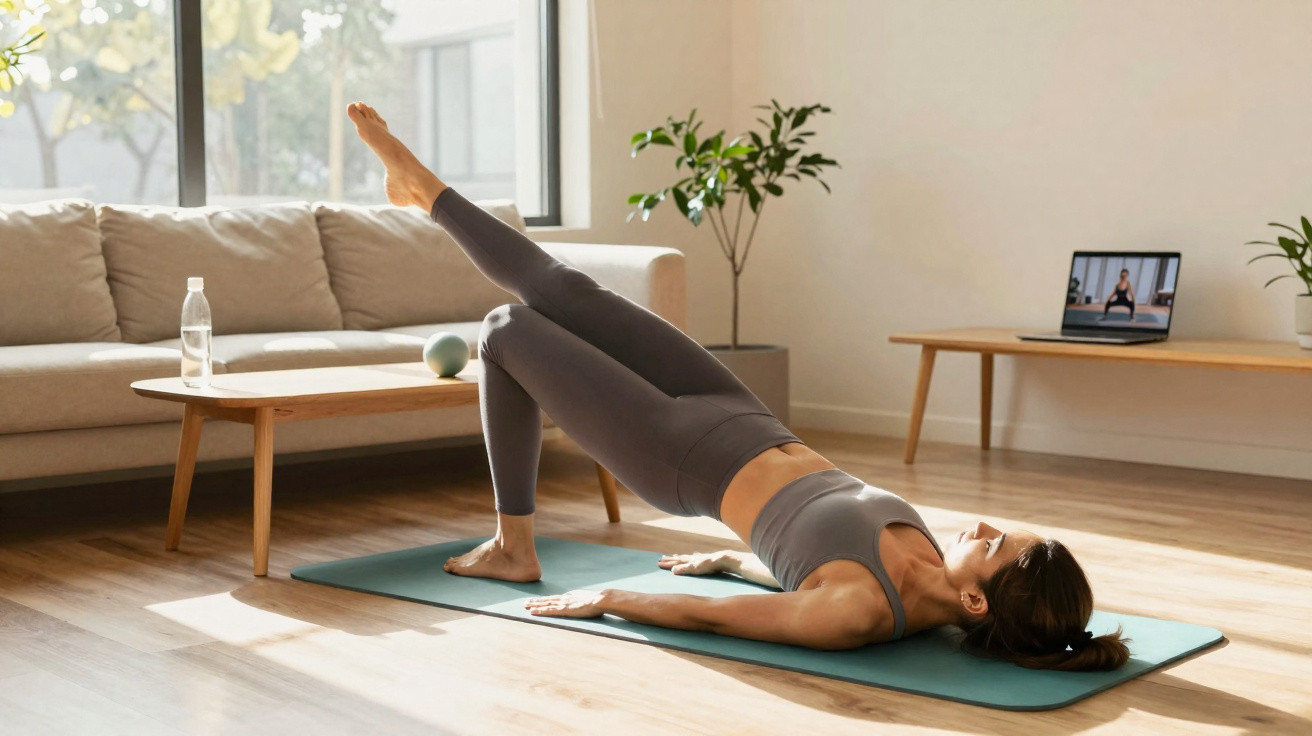
An experienced Pilates instructor is championing a short routine you can do at home - with the emphasis on the deep abdominal muscles.
If you can barely do up your jeans, feel bloated after eating and end up with a stiff neck from sit-ups, you’ll eventually look for a gentler option. That is exactly where Pilates comes in: less sweaty spectacle, more precise activation of your core. One coach has shared an easy sequence for home that is said to deliver a noticeably flatter belly in around three weeks - no gym, no equipment.
Why Pilates firms your belly without wrecking your back
At the heart of the method is understanding the difference between the abs you can see and the deeper layer underneath. Most people think “ab training” means the rectus abdominis and the obliques - the muscles you see in six-pack photos. But the key muscle for a slimmer waist sits further in: the transverse abdominis, often referred to simply as the “deep core”.
“Pilates combines breathing and body alignment in a way that primarily switches on the deep muscles of the abdomen and trunk - like an internal corset.”
This “internal corset” supports the spine, takes pressure off the lower back and can help reduce a slight bulge in the lower belly. When you consciously exhale on each movement and gently draw the abdomen inwards, you’re not only working towards a narrower waist - you’re also improving posture and body awareness.
Coaches repeatedly stress three fundamentals:
- exhale first, then gently draw your belly button towards your spine
- only start the movement once your centre is engaged
- choose a smaller range of motion rather than an over-arched lower back or neck pain
Those principles underpin the home routine a Pilates expert recommends, built around five key exercises.
The 5-step routine for a flatter belly
The trainer relies on a consistent set of five Pilates classics that appear again and again in her abdominal programme. You can do every exercise on a mat in your living room.
1. Single Leg Stretch – an entry point for the deep core
In Pilates, this move is one of the go-to exercises for learning to feel your centre working. It targets the transverse abdominis in particular, along with the oblique muscles.
The basic idea: lie on your back and lift both legs. Draw one knee closer towards your torso while the other leg reaches forwards. With each breath you switch legs, keeping your abdomen flat and allowing your lower back to feel heavy against the mat.
Many people notice within just a few reps how hard the deep core has to work to keep the pelvis steady.
2. Double Leg Stretch – whole-body control instead of ab burnout
Double Leg Stretch follows on directly from the first exercise, but raises the challenge. This time both legs move together, and you also involve the arms and shoulder girdle.
The task: extend arms and legs away from your body, then bring them back to centre with control. Your breathing stays calm, the abdomen remains drawn in, and your lumbar spine stays, quite literally, glued to the floor. Done this way, you’re working the abs while also improving mobility through the shoulders and hips.
3. Double Leg Lower Lifts – lower-belly focus
This one puts the much-discussed area below the belly button centre stage. Many people know it as that “stubborn little belly” that seems to ignore everything you do.
“Double Leg Lower Lifts are considered one of the most effective Pilates exercises for the lower-abdominal area - provided the back stays stable.”
Start lying on your back with both legs straight up in the air in a typical “V” shape. As you exhale, lower the legs slowly a short distance - only as far as you can while keeping a neutral spine. Then lift them back up with control. A handful of clean repetitions is far more valuable here than lots of fast, swinging ones.
4. Shoulder Bridge with Kick – glutes, trunk and abs working together
At first glance, the shoulder bridge with a leg kick looks like a glute exercise, but it places strong demands on the entire trunk. Lift your pelvis until knees, hips and shoulders form a straight line. Then extend one leg up towards the ceiling and lower it again to the height of the opposite knee.
While the standing leg and glutes hold you steady, the abdominals have to constantly adjust so the pelvis doesn’t tip or rotate. That means you train the back of the body, the abdominals and the spinal extensors at the same time - a useful combination if you tend to over-arch your lower back or feel your core is weak.
5. Scissors – mobile hips, switched-on core
To finish, you move into the classic “scissors”. Return to lying on your back with both legs straight up. One leg reaches upwards while the other lowers forwards and down - without the back peeling off the floor. Using small, quick pulses, you draw the top leg slightly closer, then switch.
Your hips get a mobility boost, and your abdomen stays under continuous tension throughout. That’s why it often feels tougher than it looks.
How to fit the routine into everyday life
The coach recommends keeping a set order for a short home session. The sequence can look like this:
- Single Leg Stretch
- Double Leg Stretch
- Double Leg Lower Lifts
- Shoulder Bridge with Kick
- Scissors
To begin with, around eight to ten repetitions per exercise at a steady pace are enough. If you’re returning after a long break or you’re familiar with back issues, keep the movement smaller and start with six repetitions.
| Exercise | Area | Tip for beginners |
|---|---|---|
| Single Leg Stretch | Deep abdominals, posture | Keep your head on the floor if your neck tightens |
| Double Leg Stretch | Whole abdominal wall | Only reach the arms halfway to maintain control |
| Double Leg Lower Lifts | Lower abdominals | Lower the legs only within a pain-free range |
| Shoulder Bridge with Kick | Glutes, posterior chain, trunk | Practise without the kick first - hold the bridge |
| Scissors | Abdomen, hips | Slow the tempo and keep the breath deliberate |
Many women report seeing the first visible changes after roughly three weeks if they practise two to three times a week and keep their day-to-day habits reasonably balanced. A flatter belly doesn’t come from the mat alone - sleep, stress levels and diet also play a part.
Living room instead of studio: how Pilates works without equipment
One approach Pilates coaches increasingly suggest is simply turning your living room into a studio. If you have a smooth floor, you can use basic socks or a small sliding pad to mimic Reformer-style work. That lets you add sliding movements for the arms and legs, making the session more intense without expensive kit.
What matters is a non-slip surface for the supporting foot, bare feet for better grip, and a clear rule for stopping: if you feel unusual, sharp pain in your back, knees or neck, you stop. Pilates should challenge you, not hurt you.
How often to train, from what age - and what to watch out for?
Most experts suggest doing this routine two to three times a week. The priority isn’t racking up the highest number of reps, but performing each movement well. If you forget the breathing, fail to set the core before moving or drop into an over-arched lower back, you reduce the benefit and risk tension building up.
People over 60 can also benefit from this approach, as long as they keep movements smaller and, if needed, get medical advice - particularly with heart problems or chronic back pain. A gentler version using shorter levers (for example, bent knees instead of straight legs) is often a sensible starting point.
What “deep abdominal muscles” actually do for everyday life
A flatter belly may be the motivation boost, but the real payoff goes much further. A strong, deeply engaged core can:
- ease back pain by keeping the spine more stable
- improve posture - shoulders dropping away from the ears and the chest feeling more open
- make everyday movement safer, such as lifting shopping boxes
- support the pelvic floor, which can be especially important after pregnancy or with age
If you already do cardio training, such as running or cycling, you can add the Pilates routine two to three times a week. The mix of a stable trunk and an active cardiovascular system often has a bigger impact on both shape and wellbeing than any diet. The key is consistency - not perfect form or a long session.

Comments
No comments yet. Be the first to comment!
Leave a Comment