
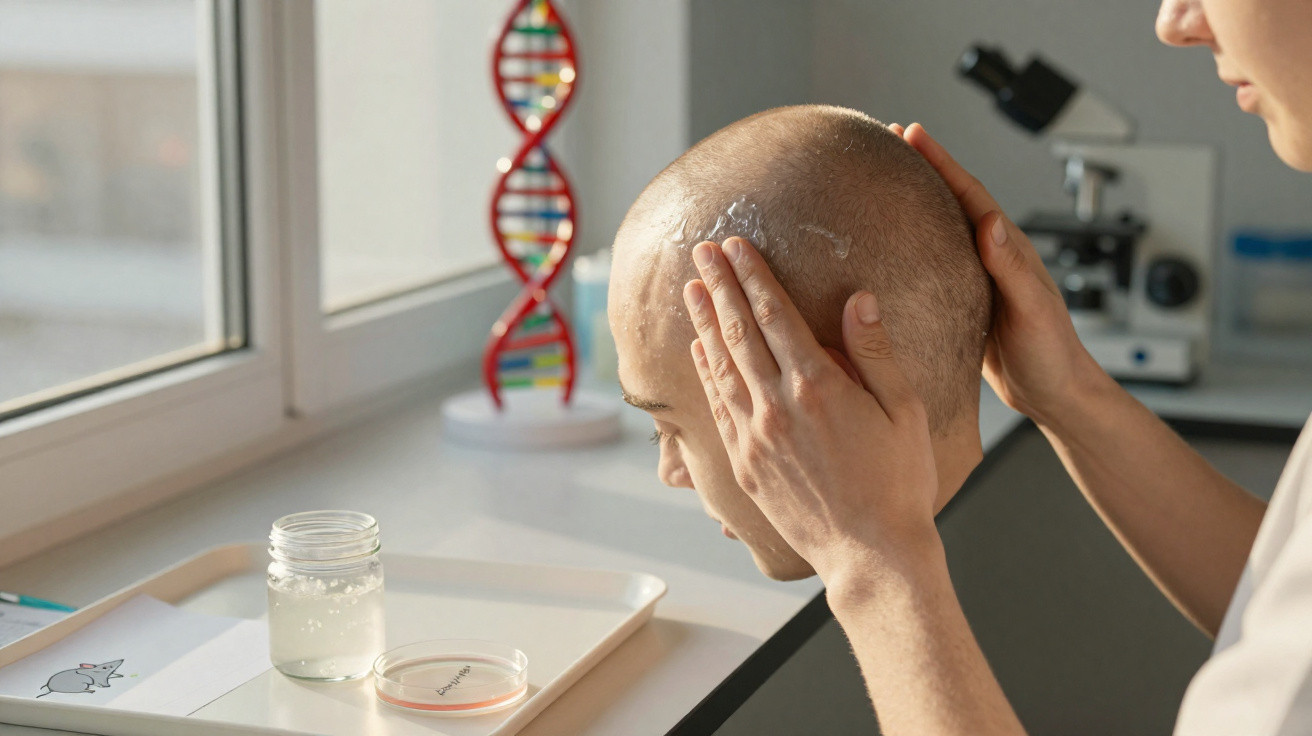
Hair loss is often treated as an unavoidable fate - whether it shows up as a receding hairline, a thinning crown or a sparse parting. Now research from the United Kingdom and Pakistan has attracted attention: in mice, a gel made with a simple body sugar restored a dense coat surprisingly quickly, delivering results comparable to minoxidil, the active ingredient in Rogaine.
How a DNA sugar unexpectedly became a hair-loss hopeful
The discovery did not begin with hair loss at all, but with wound healing. Researchers at the University of Sheffield and the COMSATS University in Islamabad were studying deoxyribose, a sugar that forms part of DNA.
Their original aim was to see whether the sugar could help skin injuries heal. To test this, they applied a deoxyribose gel to small wounds in the fur of laboratory mice. After a few days, an unexpected effect stood out: the fur around the treated areas grew back noticeably faster and denser than in untreated patches.
"The hair around the wounds treated with deoxyribose seemed to shoot back in front of the researchers’ eyes - faster and stronger than in the control zones."
That “side finding” quickly turned into a new question: could this sugar stimulate not just healing, but hair growth itself?
Mouse testing: sugar gel versus minoxidil
To find out, the team used a well-established model for hereditary hair loss. Male mice with testosterone-driven coat loss served as the test animals - comparable to androgenetic alopecia in people.
An area on the animals’ backs was shaved. Different groups then received a daily gel treatment:
- neutral gel with no active ingredient
- gel containing deoxyribose
- gel containing minoxidil
- a combination of deoxyribose and minoxidil
- no treatment
What happened in the mice
Clear differences were visible after just 20 days:
- Fast regrowth: in the deoxyribose group, long, thick hairs returned in the treated area. The bare patch on the back visibly filled in.
- Comparison with minoxidil: the sugar gel performed similarly to minoxidil gel, which is treated as a gold standard in mouse research.
- Little added value from combining: anyone expecting the sugar–minoxidil mix to produce dramatically heavier coats was disappointed. The combination was not noticeably better than either treatment alone.
Photos of the groups showed bald control animals, thin-coated mice given placebo gel, and much fuller-looking backs in the deoxyribose and minoxidil groups. For the researchers, it was evident that this was more than a minor placebo-type effect.
How the sugar might act on the hair root
It is not yet fully established why deoxyribose appears to boost hair growth so strongly. However, analysis of the treated skin provides clues.
In tissue samples, the researchers observed:
- an increased number of blood vessels
- more active skin cells around the hair follicles
Both findings point towards improved support for the hair root. The hair bulb - the thickened, lowest part of the hair - depends on oxygen and nutrients delivered by blood. When blood supply improves in that area, hair typically grows more robustly.
"The stronger the blood supply at the hairline, the thicker each hair becomes and the more securely the hair root remains in its growth phase."
In other words, deoxyribose may work indirectly: not as a classic hormone-based treatment, but as a growth boost for vessels and cells in the scalp.
Why the study is generating so much hope for hair loss
Hereditary hair loss - medically, androgenetic alopecia - is estimated (depending on the source) to affect up to 40% of the world’s population. Men often develop a receding hairline and baldness, while women more commonly notice thinning along the parting.
Only a small number of established therapies are currently available. A brief overview:
| Treatment | Effect | Limitations |
|---|---|---|
| Minoxidil | promotes hair growth, slows shedding | does not work for everyone, possible scalp irritation, effects can fluctuate |
| Finasteride | clearly reduces hair loss in many male users | risks such as erectile dysfunction, reduced libido, low mood; not approved for women |
Many people avoid finasteride due to concerns about side effects, or stop taking it after starting. Minoxidil is generally better tolerated, but it requires patience and does not produce visible results for everyone.
A gel based on a naturally occurring sugar - without major interference in hormone balance - could fill the gap that exists here. No one yet knows how deoxyribose behaves on the human scalp, but the mouse data suggest the underlying principle can work.
Where else a sugar gel could prove useful
The researchers are already thinking beyond the classic scenario of “hereditary baldness”. Potential uses include situations where hair needs to return after major loss.
- After chemotherapy: many cancer patients lose most of their hair while receiving cytotoxic drugs. If a harmless gel could speed up regrowth after treatment ends, the psychological relief could be considerable.
- Alopecia areata: in this condition, the immune system attacks the body’s own hair follicles. A product that strengthens follicles and improves nutrient supply could support recovery - ideally alongside immune-modulating treatments.
Whether deoxyribose works in these settings remains for future research to determine. Even so, the approach opens the door to new combinations, particularly with existing medicines.
What needs to happen next
As striking as the images of newly furred mouse backs may be, this is still very early-stage foundational research. So far, the evidence comes exclusively from male mouse models.
Next steps the team and other groups are planning include:
- tests in female mice to better account for hormonal influences
- safety studies to clarify whether deoxyribose gel carries long-term risks, such as uncontrolled formation of new blood vessels
- small, controlled human studies in people with androgenetic alopecia - starting with low doses and careful monitoring
- comparisons using different minoxidil concentrations and combination regimens
Only if human studies produce similarly convincing data would a cosmetic or medical product become a realistic prospect. In practice, that typically takes years.
What people affected should know already
When hair starts to thin, many people - out of frustration - try dubious products. Several practical takeaways can be drawn from the current study:
- Early intervention helps: the sooner you respond to initial hair loss, the more follicles can typically be preserved.
- Blood supply matters: whether it is minoxidil, microneedling, or perhaps a future sugar gel, many effective approaches improve support for the hair root.
- Do not neglect scalp care: an inflamed, irritated scalp weakens any hair. Gentle shampoos, avoiding aggressive styling, and UV protection can support any treatment.
One point remains important: do-it-yourself experiments with home-mixed sugar blends are not a good idea. The researchers used defined concentrations under controlled conditions. What works on mouse skin can trigger unexpected reactions in people - from allergies to scarring.
Why sugar, of all things, is so intriguing
One reason deoxyribose appeals to many experts is that it already exists in the body as part of DNA. That increases the likelihood it could be well tolerated when applied locally in small amounts.
At the same time, the study reflects a wider medical trend: taking familiar molecules and testing them in completely new contexts. A DNA sugar as a hair-growth treatment may sound odd at first, but it fits the logic of so-called “drug repurposing” approaches - even if deoxyribose, strictly speaking, is not a conventional medicine.
For millions of people with hair loss, the message is that the pipeline is widening. Alongside transplants, established active ingredients and expensive specialist clinics, there could one day be an unassuming gel in which a small sugar plays a big part.


Comments
No comments yet. Be the first to comment!
Leave a Comment