
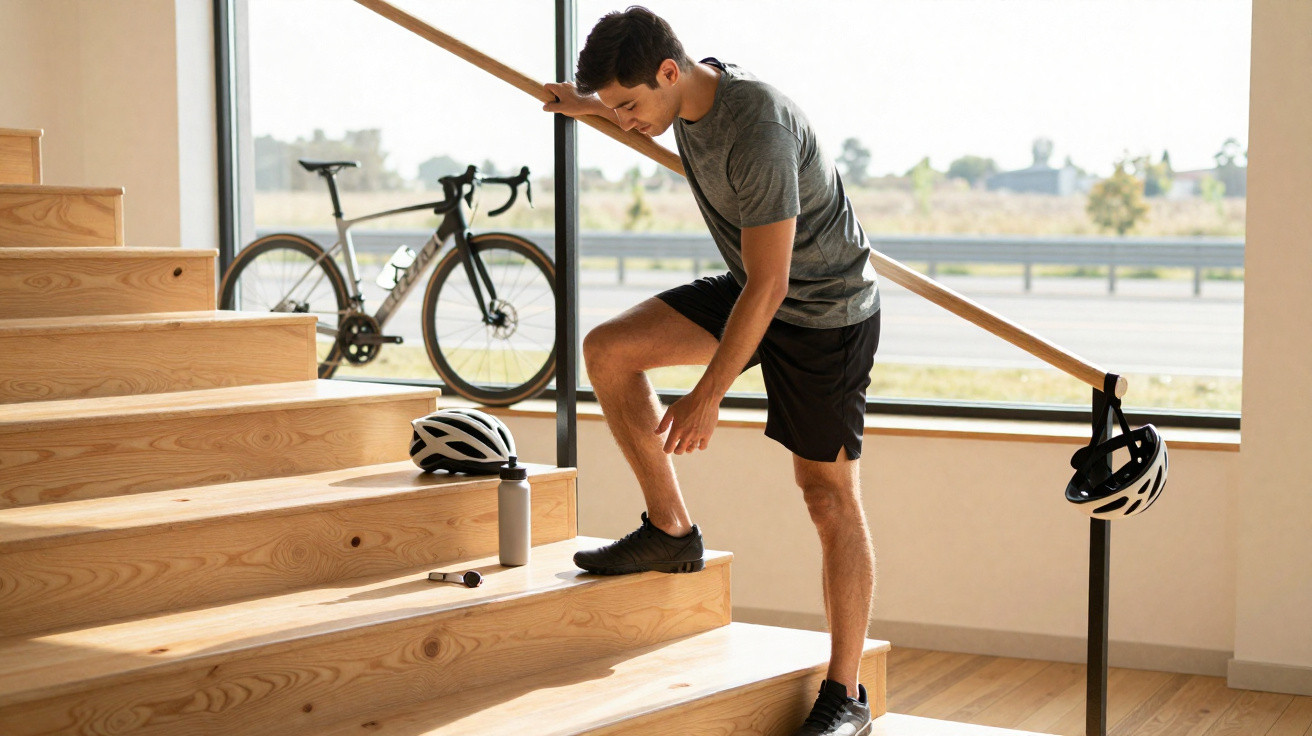
Many people who exercise encounter a curious situation in everyday life. They can cycle long distances with ease, yet become breathless after climbing only a few flights of stairs. This familiar contrast is connected to neuromuscular conditioning and the body’s immediate response to different stimuli.
Why does cycling for kilometres feel easier?
Cycling uses a continuous movement pattern in which the bicycle supports body weight. In this dynamic setting, exertion is spread evenly, allowing muscular endurance to control the pace without suddenly placing excessive strain on the athlete’s cardiovascular system.
Regular training on two wheels also creates highly specific motor adaptations. The body learns to make every pedal stroke metabolically efficient, preserving energy and keeping oxygenation steady even when overall physical fatigue lasts for hours.
What is the minimum time needed for stair climbing to have an effect?
Experts reveal that swapping the lift for the stairs only produces profound metabolic results when the activity reaches… Read more
What is the effect of gravity when climbing stairs?
When facing a staircase, the movement pattern changes dramatically within seconds. With every step, a person must lift their entire body mass, creating vertical mechanical loading that works against gravity and demands explosive strength.
This vigorous movement abruptly recruits powerful muscle groups. Unlike the smooth rhythm of cycling, vertical steps require forceful contractions that sharply raise internal blood pressure and increase the rate of heartbeats almost immediately.
Below is a video from the Bustle YouTube channel that explores the points discussed in this topic:
How do muscle fibres respond to each activity?
Long-distance cycling mainly relies on slow-twitch fibres, which are known for their strong aerobic efficiency. These units work continuously while using oxygen economically, providing excellent motor capacity without an early build-up of metabolic by-products during the ride.
By comparison, climbing stairs quickly activates fast-twitch fibres in the glutes and quadriceps. These structures produce immediate energy through anaerobic pathways, causing intense local muscular fatigue and rapidly intensifying the feeling of breathlessness.
Factors behind rapid fatigue
Key causes of sudden tiredness
Elements that explain the loss of breath on stairs:
- Mechanical overload against gravity;
- No initial warm-up;
- A sudden peak in cardiac effort.
Why does a lack of warm-up worsen the sensation?
People usually climb stairs during routine moments with no prior preparation. The body moves from complete rest to vigorous exertion, creating an abrupt circulatory demand that strains breathing before the blood vessels have fully dilated.
During a planned cycling session, a gradual start warms the muscles and stabilises blood flow. Without this initial period of thermal adaptation, the body responds with immediate respiratory discomfort, restricting motor performance and reducing tolerance for sudden physical exertion.
Several physiological factors explain why this abrupt transition affects the body:
- An instant increase in cardiac output without enough time for vascular adjustment;
- A sudden accumulation of metabolites in the lower-body muscles responsible for movement;
- An immediate deficit in cellular oxygenation during the first seconds of climbing.
What does the principle of specificity teach athletes?
Training specificity shows that fitness gained in one activity does not transfer fully to another. Having excellent breathing capacity while pedalling reflects an exclusive neuromuscular adaptation, different from the postural demands and mechanical stress involved in climbing stairs.
Therefore, becoming breathless after climbing a few flights does not mean that someone lacks overall conditioning. It is simply a normal physiological response to a different neuromuscular stimulus, reinforcing the importance of varying stimuli to improve health comprehensively.




Comments
No comments yet. Be the first to comment!
Leave a Comment