
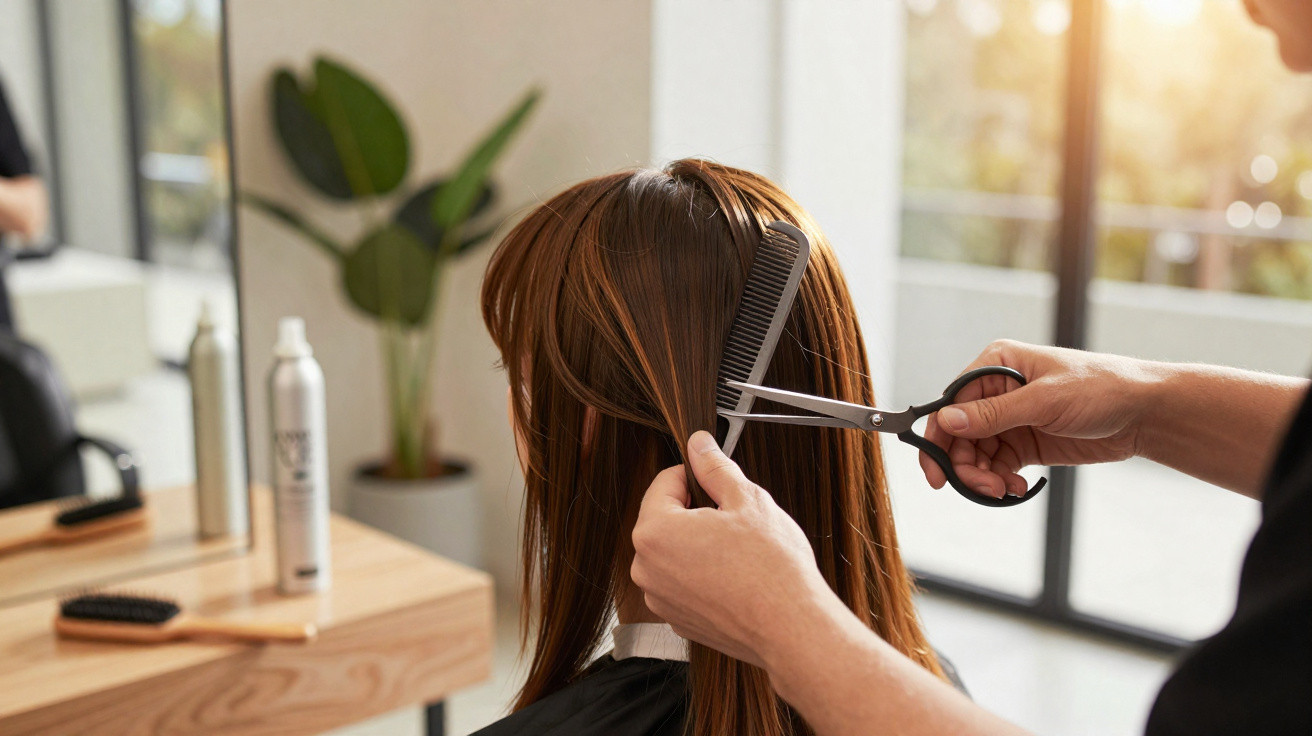
She smiled at her reflection, gave a polite nod… then, 24 hours later in the cramped bathroom at home, her “Pinterest bob” had fallen apart into three limp, unhappy sections pressed against her scalp.
The WhatsApp messages soon arrived: “What does it look like in real life?”, “Send a photo!” She took pictures from the front and the side, tried adding a clip and reached for dry shampoo. None of it changed the reality: after the cut, her fine hair appeared even thinner.
When she returned to the salon, her hairdresser sighed, passed his fingers through her hair and delivered the line nobody wants to hear: “This style fights against your hair, not with it.”
That is precisely what many of the most fashionable cuts of 2026 are doing right now.
The “worst hairstyles” for fine hair, according to hairdressers
Ask three stylists which looks concern them most for fine hair and they will often mention the same inspiration photo: a weighty, blunt cut with no layers, meant to appear deliberately “French”. Rather than looking chic, however, it can collapse like wet spaghetti. It may seem glossy and full on Instagram, but on fine hair in everyday life it sticks to the face and makes every gap in density more noticeable.
Another repeat offender is the extra-long, pin-straight look that never quite goes away. Growing fine hair longer and longer can sound like the safer choice. It feels romantic, feminine and easy to maintain. Yet the final 10–15 centimetres can become wispy, translucent and worn-looking, rather like the frayed end of an old ribbon.
Then there is the overly layered “Rachel reboot”, which returns to fashion every few seasons. It can look lively and sweet on thicker hair. With fine hair, though, every additional layer takes away some of the little weight that remains, leaving fluff around the crown and very little substance at the ends.
A London colourist recently told me that more than half of her clients with fine hair arrive with screenshots of cuts designed for dense, coarse manes. They are disappointed when the salon result appears smaller, flatter and less lively. One client, Emma, had put money aside for months for a major “glow-up” appointment before starting a new job. She brought images of long face-framing layers and thick curtain bangs worn by models who plainly had a huge amount of hair.
Emma’s own hair was naturally straight and as fine as a baby’s. Once it had been cut, the front looked empty, almost as though sections were missing. Her stylist had copied the image instead of responding to the texture in the chair. For three months, Emma pinned back the front pieces in an effort to disguise a cut that had unintentionally drawn attention to how little hair she had.
Surveys support this experience. Salon chains in the UK and US say that “flatness” and “see-through ends” are the leading complaints among people with fine hair. Even so, those same clients continue to request the heavy, blunt and strongly layered styles circulating on social media. There is a disconnect between an aspirational image and what is realistic for a particular hair type.
Hairdressers are clear: the worst hairstyle for fine hair is one that attempts to copy thickness, rather than create the appearance of it.
There is straightforward reasoning behind this. Fine hair is not solely about the number of hairs on your head; it also concerns the diameter of every strand. Someone may have plenty of fine hairs, but each strand is slimmer, lighter and less able to keep its shape. Adding excessive length or breaking it up with aggressive layers removes the few elements that help: enough weight to give structure, plus enough bulk in the places where volume is needed.
A long, heavy shape on fine hair is like a curtain pulled too taut: the material gathers at the bottom while the top appears bare. Too many layers create the reverse problem, thinning the bottom so severely that the entire outline looks delicate. Neither approach produces the soft, full silhouette that most people are hoping for.
The looks stylists are urging people to leave behind in 2026 are not necessarily unattractive. They are cuts that repeatedly reveal the scalp, magnify sparse areas, require heat styling every day and make humid weather feel like a minor personal emergency.
What to stop doing in 2026 – and what to try instead
The first practice hairdressers would like to see disappear next year is pursuing length at any price. If your ponytail is already as narrow as a shoelace, adding another 10 centimetres will not make it thicker. It simply spreads the same quantity of hair over a larger area. Stylists advise settling on a length at which the ends still look substantial from behind rather than transparent. For many people with fine hair, the ideal range is between the chin and collarbone.
Within that range, close-set, soft and nearly invisible layers can introduce movement without giving up density. Think of it as delicate sculpting, rather than cutting away large pieces. A subtly rounded outline may also persuade the eye that there is more hair, rather than less. The goal is a shape that still works when you are not styling it with professional skill.
Fine hair cuts that protect density
The second major pitfall is using thick, blunt fringes or heavy curtain bangs to “hide” a fine hairline. Hairdressers say this frequently has the opposite effect. A dense fringe takes valuable fullness away from the rest of the head. On fine hair, the crown can consequently look almost empty, particularly for anyone who already finds it difficult to create lift at the roots.
A lighter, wispy fringe is usually a more helpful option, as are gentle face-framing sections beginning below the cheekbone. These shape the face without taking too much hair from the top. Many stylists also favour a fringe that is a little longer and more airy, allowing it to be swept aside on flat-hair days instead of sitting across the forehead like a helmet.
Most of us have experienced arriving at a party, catching our reflection in a window and discovering that our carefully styled fringe has become a small greasy strip on the face. That is what fine hair can do when paired with the wrong cut: it lets you down quickly.
The third “worst hairstyle” regularly seen in salon chairs at present is the ultra-straight, glass-hair finish on hair that is already fine. To achieve it, many people use straighteners at high temperatures every day. Eventually, the cuticle lifts, the ends break and the hair becomes even finer. A look intended to seem sleek instead becomes limp.
Stylists recommend embracing a little bend instead. This does not mean full curls, but gentle, uneven movement made with a large-barrel curling iron or even overnight plaits. Imperfect texture creates an impression of body and volume. And, let’s be honest: nobody truly re-curls their whole head perfectly every morning before work.
As Paris-based stylist Anaïs Laurent told me in the salon one rainy afternoon:
“Fine hair is like delicate fabric. You don’t force it into a stiff shape and expect it to behave. You choose a cut that lets it fall how it wants to, just slightly improved.”
She repeatedly sees the same damaging habits: too much product build-up, vigorous towel-drying, brushing wet hair from root to tip and excessive bleaching. Each of these can break strands that are already fragile, making any unsuitable haircut appear even worse. A candid stylist may occasionally decline the photo you show them and recommend another approach.
To put this into clearer terms, here is what hairdressers are quietly hoping their fine-haired clients will do differently in 2026:
- Replace weighty, blunt, one-length cuts with softly layered bobs or lobs finished with a rounded outline.
- Exchange extremely long, transparent ends for a slightly shorter and denser shape that looks fuller from all angles.
- Avoid the thick curtain-fringe trend in favour of lighter, airier face-framing sections that do not deplete the crown.
Fine hair in 2026: a new way to look at “bad” hairstyles
When stylists refer to the “worst hairstyles” for fine hair, they are really describing the worst relationship with your hair. A style becomes “bad” when you leave the salon already aware that it will require three tools, two products and complete concentration just to look half as good at home. That expectation accumulates over time, and many people eventually give up without saying much.
The alternative may be less glamorous on Instagram, but it is far kinder when you face the mirror at 7 a.m. It involves accepting that your hair will not resemble an influencer’s hair when they have three times your density – and recognising that this is not a personal failure. It means selecting a cut that makes you look like yourself on a good day, rather than somebody else on their most heavily filtered day.
Hairdressers say that their most satisfied clients with fine hair are not those with the “perfect” blow-dry. They are the people who return three months later and say: “Honestly, I barely did anything and it still looked decent.” That is the real opposite of a “worst hairstyle” – not a trend, but a small, quiet sense of relief.
As more people become honest about how their hair actually appears away from the screen, the meaning of a “bad” haircut may change. Perhaps the severe, poker-straight sheet of hair will finally start to feel dated. Perhaps the overly layered wolf cut will lose its hold on social feeds because people are exhausted by pursuing volume that continually disappears.
And perhaps the next trend will not be a particular haircut at all, but a different question asked from the salon chair: not “Can you make my hair thicker?” but “Can you make it easier to live with?” That is the conversation hairdressers are quietly hoping to have in 2026.
| Key point | Detail | Why it matters to the reader |
|---|---|---|
| Avoid extreme lengths | Fine hair can look flatter and more sparse when it is too long | Understand why cutting it can create an immediate impression of density |
| Be wary of thick fringes | A full fringe removes bulk from the top of the head | Choose a light fringe that does not leave the rest of the hair looking depleted |
| Limit ultra-straight styling | Repeated heat use weakens hair that is already fine | Protect the hair fibre and gain visual volume with a softer texture |
FAQ:
- What is the absolute worst haircut for fine hair? A very long, blunt, all-one-length cut with see-through ends is often the most unforgiving. It drags the hair down, exposes the scalp, and makes the lengths look thinner than they really are.
- Are layers always bad for fine hair? No. Harsh, disconnected layers can be disastrous, but soft, subtle layers placed close together can create movement and volume without sacrificing density at the ends.
- Can a fringe work on very fine hair? Yes, if it’s light, airy and slightly longer, so it can be worn to the side. Thick, heavy fringes tend to steal too much hair from the crown and make the rest look sparse.
- How often should fine hair be cut to avoid “bad” styles? Most hairdressers suggest every 6–8 weeks for shorter cuts, and 8–10 weeks for bobs and lobs. Keeping the outline clean helps the hair look fuller.
- Is it possible to get “glass hair” if my hair is fine? You can get a smooth, shiny finish occasionally, but wearing it ultra-straight every day usually means heat damage over time. A softer, slightly wavy version is kinder to fine strands and often more flattering.




Comments
No comments yet. Be the first to comment!
Leave a Comment