
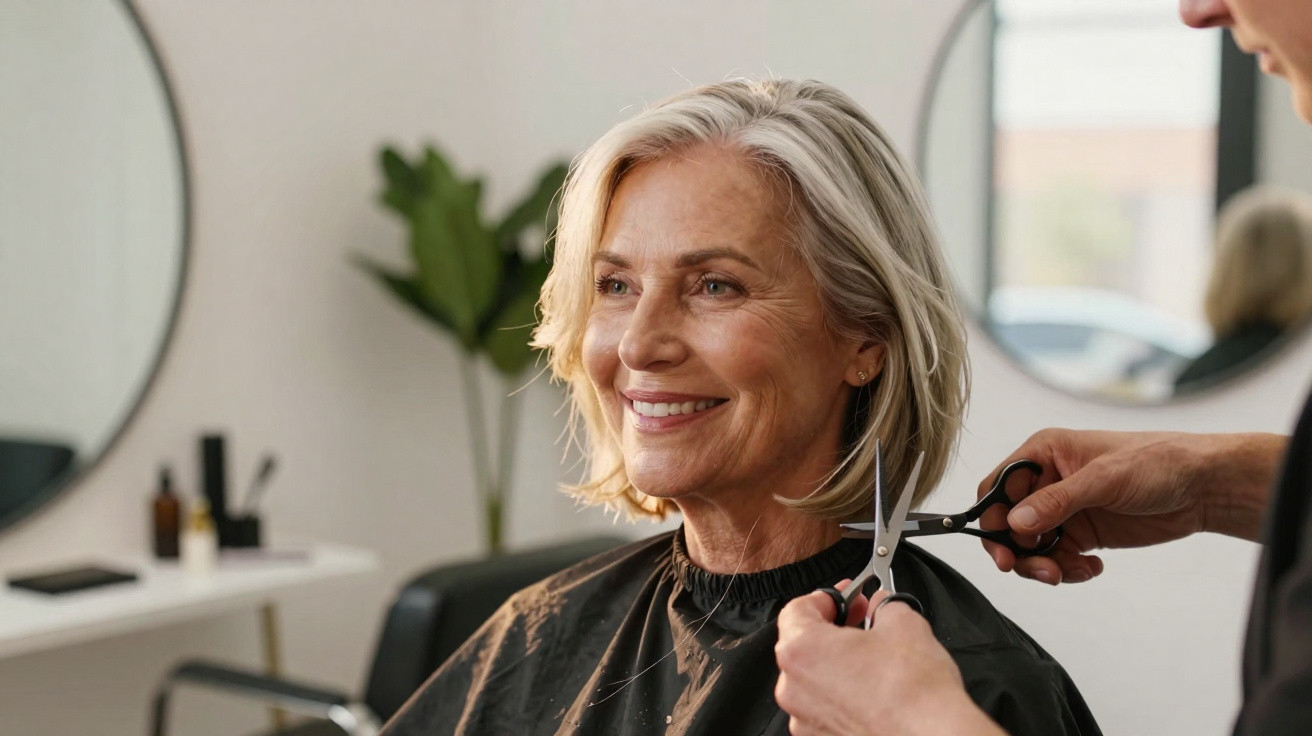
The salon carried that gentle, well-known energy: hairdryers murmuring, scissors tapping like tiny castanets, and the sweet haze of hairspray settling above magazines that were three months out of date.
In the centre chair sat Claire, 67, twisting the strap of her handbag while studying her reflection. “I don’t recognize this woman anymore,” she said softly to her stylist. “Inside I still feel 40.”
Ten minutes on, the first sections dropped. Nothing as drastic as a pixie, and not the long, mermaid-style waves either - but a in-between length that felt light, a little cheeky.
When the hairdryer finally clicked off, Claire tilted forwards.
Her jawline looked defined again. Her eyes seemed clearer.
She didn’t look young-young.
She looked switched on.
Her stylist simply smiled and said: “Welcome back.”
The cut hairstylists swear by after 60
Ask five hairstylists what they’d suggest after 60 and you’ll be given a handful of fashionable labels: long bob, soft shag, modern crop. Yet as the conversation goes on, the same recommendation keeps resurfacing - a slightly layered, face-framing bob that falls somewhere between the chin and the collarbone.
It stays airy at the neck and moves gently around the face.
It’s neither the shortest choice nor the longest. It sort of hovers - and that’s exactly what creates the “lifted” effect people describe.
The secret is understated: the length lands where the jaw and collarbones naturally provide structure. In other words, the cut works with your bone structure rather than fighting it.
Stylists often talk about a familiar moment. A woman over 60 sits down holding photos from two decades earlier. More often than not, she points to long, thick hair - hair that no longer suits her current texture or daily routine. The stylist listens, nods, and then gently angles the mirror a little closer.
They propose taking the length up. “Just to the collarbone,” they’ll say, drawing an invisible line with the comb. Perhaps a soft side fringe, plus a few almost-undetectable layers at the front.
Then there’s that brief pause of doubt, followed by: “Alright, let’s do it.” Many professionals say this is when the biggest change happens - not when someone goes extremely short, but when the hair stops weighing the face down.
There’s a straightforward reason it works so reliably. As we get older, two things tend to show up: hair often becomes finer (especially through the ends), and facial features generally soften. Heavy length can underline that softness and visually pull everything down.
A mid-length, face-framing bob pushes in the other direction. It removes weight from the bottom and draws attention back up towards the cheeks and eyes. Subtle layers soften harsher lines without covering the face.
It’s less about chopping off years and more about removing what drags you down. That’s why many stylists call it the most rejuvenating option after 60 - not because it’s a trend, but because it’s forgiving.
How to ask for this “rejuvenating” bob at the salon
Most hairstylists will tell you the same thing: don’t arrive asking for a celebrity cut by name. Come in explaining how you want to feel. Ask for a bob that sits between the chin and the collarbone, with soft layers mainly around the face rather than throughout. Say you want movement, not helmet-like volume.
Request a back that’s slightly shorter with the front left a touch longer - it opens up the neck and helps avoid a chunky, “square” outline.
If your hair is very fine, your stylist may recommend more blunt ends with only the faintest layering around the cheekbones. If it’s thick, they may add discreet texture so it doesn’t balloon.
Where people often end up disappointed is when the image in their head never matches what appears in the mirror. You bring in a photo of a 30-year-old with dense, highlighted hair and expect that outcome on white, delicate strands. Your stylist feels the pressure and either removes too much or too little. Nobody leaves happy.
Start by being clear about what your hair is actually doing. Is it thinning at the crown? Frizzing at the back? Are there cowlicks at the front? Once those realities are out in the open, this bob can be shaped quietly to suit you.
And let’s be realistic: hardly anyone does a full round-brush blow-dry every day. So ask how the cut will sit when you simply wash it and let it air-dry.
“People think rejuvenation is about length,” explains Sophie, a Paris-trained stylist now working in Miami. “It’s rarely about that. It’s about where the eye is drawn. A collarbone bob with light face framing pulls attention to the eyes, the smile, the expression. That’s what reads as ‘alive’ on someone’s face, not an extra five centimeters of hair.”
- Ask for: “a collarbone or slightly shorter bob with soft face-framing layers”
- Bring one or two reference photos that match your hair texture and colour - not only the vibe you’re aiming for
- Decide together whether you want a fringe: curtain bangs tend to look softer than a full, straight fringe
- Talk about upkeep: trims every 6–8 weeks keep it crisp without growing out awkwardly
- Plan the styling approach: a large round brush, a paddle brush, or just your fingers - the cut should suit your habits
What really makes a haircut feel “younger”
What’s amusing about this so-called rejuvenating cut is that it isn’t mysterious at all. On paper it’s simply a bob: a mid-length shape with gentle layers. The difference is how well it fits the person you are today - drying it in five minutes instead of twenty, or feeling your neck is lighter when you do up your coat.
Many women say the real glow-up isn’t only what they notice in the mirror, but what they stop doing: hiding behind long, tired hair; apologising for going shorter; waiting for “after I lose 5 kg” or “after the next big event”.
A collarbone-skimming cut can be unexpectedly liberating. You can tuck it behind your ears for a clean outline. You can mess it up with a touch of styling cream to keep it soft. You can clip back the front sections on days you need to focus.
Old photos don’t become a benchmark you’re failing to meet; they become earlier chapters. This new length isn’t trying to replicate them - it responds to them. You’re not acting as though you’re 42 again. You’re saying: this is 62, and it comes with its own style code.
Some readers will feel an instant yes. Others will notice a small, stubborn resistance in their stomach. That’s understandable. Hair holds stories: childhood plaits, a partner who loved your ponytail, a mother who never wore her hair short.
There’s no rule that says you have to go mid-length at 60. There’s only one question: does your current haircut reflect the person you’ve grown into?
If the answer is yes, keep it. If the answer is no - or “I’m not sure any more” - that’s when the mid-length, face-framing bob quietly earns a place on your shortlist. It’s a gentle trial rather than a dramatic statement. And sometimes, that’s exactly the amount of bravery you need.
| Key point | Detail | Value for the reader |
|---|---|---|
| Mid-length, face-framing bob | Hits between chin and collarbone with soft layers around the face | Visually lifts features and lightens the silhouette without feeling extreme |
| Adapted to your texture | Blunter ends for fine hair, discreet texturising for thicker hair | Gives movement and fullness while staying easy to style at home |
| Conversation with your stylist | Describe how you want to feel, not just a celebrity photo | Leads to a cut you can actually live in, not just admire on salon day |
FAQ:
- Question 1 Isn’t short hair always more rejuvenating after 60?
- Answer 1 Not necessarily. Very short cuts can look incredible, but they’re also less forgiving: every angle is on show. A mid-length bob still shows the neck and jaw while keeping a soft frame around the face, which many people find gentler on mature features.
- Question 2 What if my hair is very thin and flat?
- Answer 2 A collarbone bob with mostly blunt ends and only light layering at the front can help it appear thicker. Ask for minimal thinning, and think about a soft side part or a curtain fringe so sparse areas at the crown aren’t emphasised.
- Question 3 Can I keep my grey and still look “fresh” with this cut?
- Answer 3 Yes. This length can look striking with natural grey, particularly if the shade is slightly brightened with a toner or gloss. The clean shape stops grey from reading as “washed out” and makes it feel like a deliberate style decision.
- Question 4 How much styling time does this haircut really need?
- Answer 4 For most hair types: 5–10 minutes. Towel-dry, work in a lightweight styling cream or mousse, then rough-dry with your fingers or a brush. On low-effort days, let it air-dry and simply neaten the front with a brush or a quick blast of the dryer.
- Question 5 What if I regret going shorter?
- Answer 5 Take it slowly: choose the longest version of the bob (right at the collarbone) and add more layers at your next appointment if you like it. Hair at this length grows back fairly quickly, and the shape still looks intentional as it grows out.






Comments
No comments yet. Be the first to comment!
Leave a Comment