
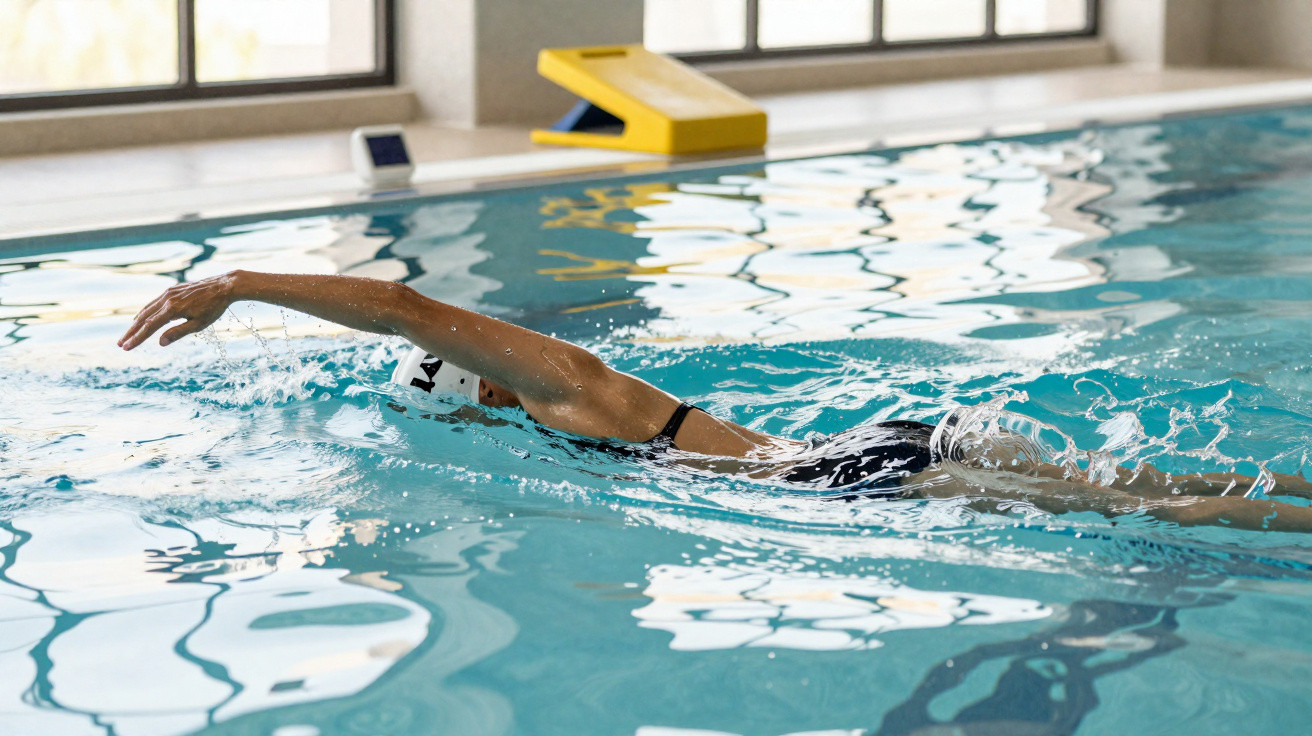
If you watch a typical public pool session, the scene is often the same: people thrash up and down the lanes at pace, stop at the wall out of breath, and quietly hope speed alone will carve out a six-pack. A seasoned fitness coach argues the opposite. In her experience, swimming slowly with clean technique can do more for your abs and trunk than any frantic, all-out power session.
Why slow swimming challenges your core so much
In the water, your body needs to stay horizontal. Buoyancy supports you, but water resists every movement. To make any forward progress, your arms and legs have to work while your trunk stays steady. That is where the deep stabilisers come in: the transverse abdominals, obliques, spinal erectors and glutes.
These muscles function like a natural corset, keeping your ribcage, abdomen and pelvis aligned. When you simply try to go faster, that stability often disappears. The head lifts too high, the hips drop, and the legs start flapping. At that point, the shoulders and thighs do most of the work - and the core effectively switches off.
“Slow, controlled strokes force the trunk to stay under tension continuously - that’s pure core training in the water.”
When you swim calmly, you have time to pay attention to each phase: hand entry, the pull, the arm path and the kick. If you deliberately keep the line from head to back to pelvis, you use your abdominal and back muscles much like an isometric plank hold - just gentler and kinder to your joints.
The method: more calm, targeted sprints
The fitness coach, who has worked with recreational athletes for more than 15 years, recommends a straightforward structure for swim sessions. Her principle is simple: spend most of the workout swimming steadily with solid technique, then add brief sections at a quicker pace - not to chase records, but to nudge the body out of its comfort zone.
What a 30–40 minute session could look like
- 5–10 minutes easy to start: settle into the water, find your breathing rhythm, feel your body position.
- Main set with intervals: 5 to 10 rounds of 100 metres, each made up of 75 metres slow and 25 metres slightly faster.
- Easy swim down: 5 minutes very relaxed, focusing on lengthening out and long strokes.
The emphasis is clearly on the slower lengths. That’s where you build technique, balance and core tension. The short faster bursts add a cardiovascular stimulus and keep the session varied, without your form falling apart.
If you swim like this two to three times per week, you can train your core hard without punishing yourself with crunches or jump-heavy workouts. This blend of strengthening and relief is especially useful for anyone with sensitive knees or back issues.
Technique before speed: what ideal body position looks like
For slow swimming to really target the core, the details of your posture matter. The moment your body “folds” or loses alignment, part of the training effect shifts away from the trunk.
Many leisure swimmers don’t pay enough attention to the following:
- Head position: look diagonally down, not forwards. This keeps the neck relaxed and the upper body in line.
- Back: lengthen through the spine and avoid arching the lower back. Imagine someone gently drawing you forwards from the back of your head.
- Pelvis: keep it level with shoulders and ribcage - neither sinking nor sticking up too high.
- Kick: stay loose from the hips with small, tidy beats; don’t bicycle from the knees.
- Arms: keep the stroke controlled rather than “yanking”. Apply force smoothly, not in jerky bursts.
“As soon as the head lifts too far out of the water or the legs kick wildly, the tension in the abs collapses - and with it the most important training effect.”
Simple in-water drills for more core tension
To sharpen your awareness of the core in the water, a few very simple variations can be slotted into almost any session.
With a kickboard: control through pelvis and abs
Hold a kickboard in front of you with straight arms. Kick very slowly. Gently draw your stomach in and aim to keep the pelvis completely still. If your hips wobble or your lower back starts to arch, reduce the pace even further.
On your back: stable trunk, active legs
Lie on your back, arms by your sides or slightly out. Kick using only the legs - again, small and calm. The task is to keep the ribcage and abdomen as still as possible, with the trunk held like a plank. This drill quickly reveals whether your abdominals are truly doing their job.
Gentle wave motion for the whole body
Stretch your arms forwards with your face in the water, then create small wave-like movements initiated from the trunk. The motion begins in the core and travels down through the legs to the feet. The aim is not to shoot through the water like a dolphin, but to feel the connection between upper and lower body.
Which stroke is best for the core?
In principle, every stroke works the trunk muscles when technique is sound. At an easy pace, some styles lend themselves particularly well to core training.
| Stroke | Benefit for the core | Who is it suitable for? |
|---|---|---|
| Front crawl | High demand on rotation and hip stability | Anyone who already feels reasonably confident in the water |
| Backstroke | Very joint-friendly; back and abs work continuously | People with neck issues or strain in the lower back |
| Breaststroke | Easy to control, but risky with poor head position | Beginners who swim deliberately slowly and cleanly |
Many coaches advise using front crawl and backstroke in a relaxed tempo. If you swim breaststroke while constantly lifting your head out of the water, you can overload the neck, and your core tension tends to suffer.
How often should you swim to see results?
With one to two gentle pool sessions per week, most people notice after a few weeks that their core feels more stable. More obvious changes in posture and abdominal firmness typically show up after around two to three months, provided you stay consistent.
That pays off in everyday life: climbing stairs, carrying shopping bags, or sitting at a desk for long periods. A stronger core often means the back complains less and movement feels easier.
Common mistakes that reduce the core effect
If you simply grind out lengths, it’s easy to undermine your own progress. The most frequent issues include:
- Too much pace-driven ambition: if you’re constantly racing the clock, posture and breathing get neglected.
- Keeping the head out of the water: the neck tightens, the lower back arches, and the abs switch off.
- Pausing for too long: chatting for several minutes after every length removes the training stimulus.
- No structure: “just swimming whatever” usually does less than a planned alternation between slow and slightly quicker sections.
Why slow swimming is so joint-friendly
Compared with many land-based sports, swimming places minimal load on the joints. Buoyancy reduces effective body weight and there’s no impact. For people with osteoarthritis, excess weight or knee problems, the pool is often a safer place to train hard without being left in pain for days afterwards.
The combination of slow technical work and short faster segments challenges the cardiovascular system while keeping bones and joints protected. Throughout, the core keeps working in the background to maintain balance and alignment.
How to combine swimming with other training sensibly
For many people, water sessions fit neatly into a mixed weekly routine. For example:
- Day 1: strength training with machines or bodyweight
- Day 2: a swim session focused on calm technique and core control
- Day 3: walking, an easy jog, or cycling
- Day 4: swimming again, or a short core workout at home
That way you stay active without hammering the body with the same type of stress every day. If you’re prone to tightness, or you feel drained by high-impact classes, a few controlled, unhurried lengths can do a great deal for the abs and back.
What matters in the end isn’t how fast you reach the wall, but how deliberately you move through the water. Slow swimming with technically clean form can become a quiet secret weapon for a strong core - far from workout hype and gym noise.






Comments
No comments yet. Be the first to comment!
Leave a Comment