
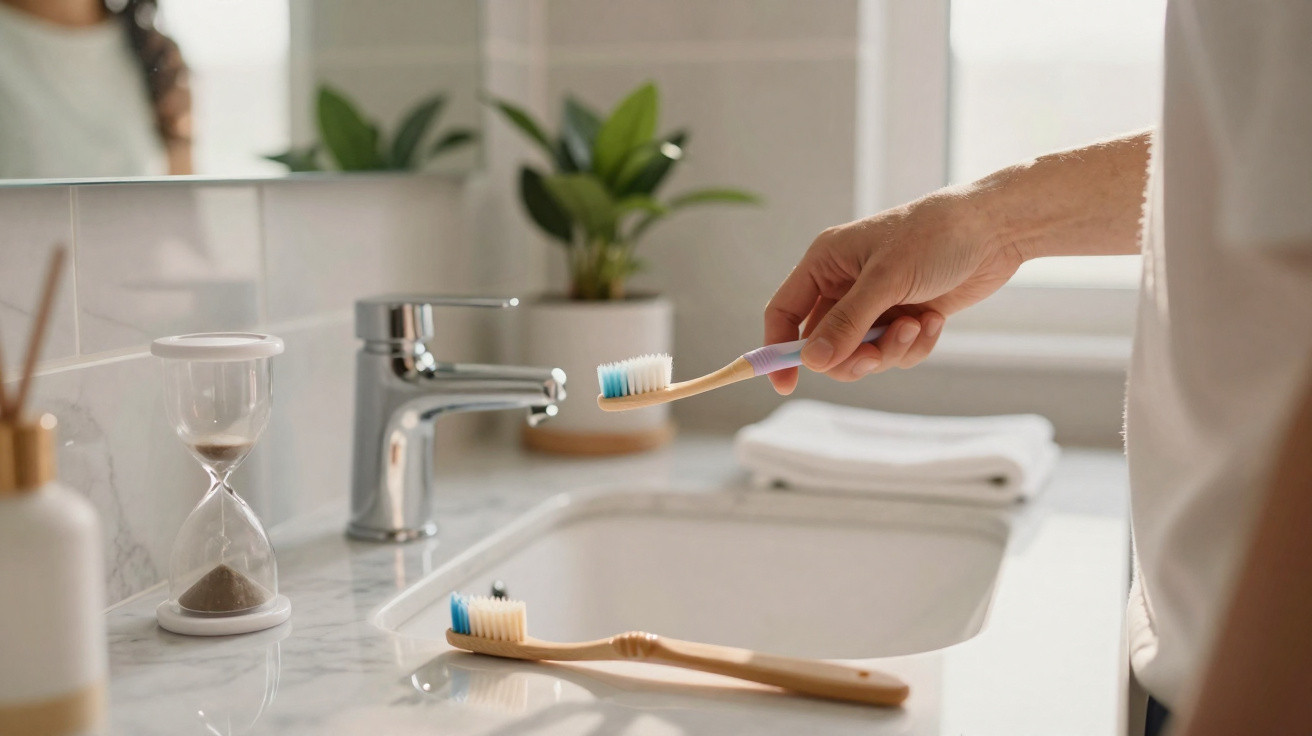
My toothbrush used to perch by the basin like a miniature engine of guilt.
Each morning I’d clock it - bristles stiff and sticking out at odd angles like a bad hair day - and I’d think, “I really should replace that.” Then life would do what it does: work, kids, doom-scrolling, late-night snacks. I’d move on, and the thought would vanish. The same brush stayed put. The bristles split a bit more. My mouth still felt clean enough, so I assumed it couldn’t be that serious.
The problem, it turns out, was right there in front of me. I didn’t learn it from a jump-scare TikTok; I learned it from a dentist who looked quietly appalled, staring at my toothbrush as though it had personally disrespected her qualifications. She didn’t lecture me about whitening kits or designer mouthwash. Instead, she focused on the plain, dull, unglamorous thing loads of us mess up every single day: how we actually use a toothbrush. The infuriating bit is that the mistake feels virtuous - like you’re being extra thorough.
The Day The Dentist Looked At My Toothbrush And Winced
It began with an ordinary check-up - the sort you postpone once, then again, then eventually book out of guilt. I was in the cold vinyl chair with a paper bib clipped to my neck, trying not to pay attention to the polisher whining somewhere in the background. The dentist came in, did the usual small talk, and then asked, “Did you bring your toothbrush?”
I had, because they’d offered a “brushing technique review,” which sounded mildly patronising but harmless enough.
When I fished it out of my bag, she went quiet for a beat. She tilted her head and examined it. The bristles were blown outwards, a few almost flattened - like a tiny plastic palm tree after rough weather. At last she said, “This brush is telling me you brush really hard.” It definitely wasn’t praise.
It’s that awkward moment when someone reflects a lifelong habit back at you and suddenly it’s obvious. I’d always linked “harder” with “cleaner”. I scrubbed as if I were scouring a saucepan, convinced effort equalled hygiene. She checked my gums, looked back at the brush, and calmly delivered the bad news: my “enthusiastic” brushing was gradually harming my teeth.
The Toothbrush Mistake Almost Everyone Makes
The error is almost laughably straightforward: many of us brush as though we’re attacking grout. We do big horizontal strokes, sawing backwards and forwards, pushing until the bristles buckle - chasing that squeaky-clean resistance that feels so satisfying. It feels efficient. It feels diligent. It also slowly wears down what you’re trying to protect.
If you bear down too much - particularly with medium or hard bristles - you don’t just shift plaque. You can grind away enamel (the protective outer layer) and encourage your gums to creep back. Over time, that can mean sensitivity - those sharp jolts when you drink something cold - plus small notches at the gumline where the tooth surface has literally been rubbed away. You think you’re being conscientious. Your mouth experiences it as an assault.
There’s a further catch: that forceful scrubbing often isn’t even as effective as you assume. Plaque is soft - closer to yoghurt than concrete. You don’t need brute force; you need regularity and the right technique. Yet plenty of us treat brushing as a two-minute workout, as though our teeth are a stubborn stain that needs to be bullied into submission.
From the chair, my dentist called it “the overachiever’s disease.” The people who try the hardest - the ones brushing with real determination - can end up doing the most harm. It’s the kind of irony that makes you sit up.
What Your Teeth And Gums Go Through When You Scrub
The Slow Burn Of Enamel Wear
Enamel doesn’t complain in obvious ways. It doesn’t swell or go visibly red. It just wears down, fraction by fraction, until one day an ice cube makes your teeth react as if they’ve been personally offended. Some people spot a yellowish tone close to the gumline where the dentine beneath starts showing through. Others notice tiny grooves - little scooped-out patches that weren’t there before.
Heavy brushing, particularly straight after acidic foods or fizzy drinks, is like sanding damp wood: the acid has already softened the surface, and vigorous scrubbing is the last thing it needs. You might hear that pleasing squeak and think, “Yes, spotless.” The reality is much less triumphant.
And once enamel has gone, it doesn’t come back. There’s no cream, serum or miracle paste that fully rebuilds it. Dentists can shield, reinforce and protect what remains, but they can’t wind the clock back. That’s why they get oddly passionate about brushing technique - they see the consequences all day.
Your Gums Aren’t Built For Battle
Gums might look sturdy, but they’re delicate tissue, not a strip of tough rubber. If you brush like you’re scraping burnt toast off a tray, the gums can gradually recede, pulling away from the teeth. You may realise your teeth look “longer” compared with older photos, or you might notice a dark triangle between teeth where gum used to fill the gap.
Receding gums aren’t only a cosmetic issue; they expose the root surface, which is far less protected than enamel and much more sensitive. That’s why some people get a sudden bolt of pain when cold air hits their teeth, or when they bite into something sweet. Overly aggressive brushing is one of the quiet contributors.
No one stands at the sink pondering the microscopic structure of gum tissue. You’re half-awake, the mirror’s streaky, the tap’s dripping, and you just want your mouth to feel fresh before the day starts. That’s exactly when bad habits cement themselves.
The Dentist-Approved Fix (That Feels Too Gentle To Work)
This is the part that initially feels backwards: the solution isn’t a new gadget, a special foam or a whitening claim wrapped in glossy packaging. The solution is less pressure, a softer brush and a different motion - essentially undoing what your “work harder” instincts have trained you to do.
My dentist gave me a fresh brush with soft bristles and a small head, then told me to hold it like a pen rather than a tool. “If you grip it tighter than this,” she said, “you’re probably brushing too hard.” I tried, and immediately felt a bit ridiculous, as if I were doing a pretend version of brushing. It didn’t feel powerful enough. It felt almost…pointless.
Then she demonstrated the technique: small, gentle circles, angled slightly towards the gumline - not the long, aggressive scrubs across every tooth. Barely any pressure, letting the bristle tips do the work. It looked like nothing at all. Yet this “nothing” is what dental textbooks have been recommending for ages.
She told me to do that for a full two minutes, twice daily. No heavy pushing, no sawing action. Just light circles and short strokes, working tooth by tooth. It felt like easing off on a motorway and realising you still arrive - just with far less stress.
Electric Toothbrushes: Helper Or Hidden Villain?
If you’re already holding your electric toothbrush and feeling quietly pleased with yourself, don’t tune out. Those buzzing, rotating devices can be excellent - provided you use them properly. They’re meant to do the work for you, which is why they can also amplify damage if you don’t let them.
The common electric-brush error is adding manual effort on top: pressing down hard while scrubbing back and forth as the head vibrates or rotates. That’s essentially double abrasion. Dentists will usually advise you to place the head on the tooth, angle it towards the gum, and move it slowly along, pausing on each tooth. No extra pressure, no energetic scouring.
Plenty of newer electric brushes include a pressure sensor that lights up or beeps when you’re pushing too hard. Most people ignore it. The light flashes and they think, “Yes yes, I know,” and carry on. Treat that warning like a speed camera: when it triggers, you need to change what you’re doing.
And if you’re forgetful - which, honestly, is most of us - an electric brush with a built-in timer and pressure sensor can be a real ally. It’s like having a small, slightly naggy dental nurse in your bathroom, only without the awkward small talk.
How Often You Change Your Brush Matters More Than You Think
There’s another low-key culprit at the sink: the old, tired toothbrush you keep promising you’ll swap “next week.” Once bristles are frayed, cleaning becomes less effective - and the brush can actually be rougher on your gums because the bristles no longer flex and glide properly. Instead, they kink and scrape.
Most dentists suggest replacing a toothbrush - or an electric brush head - every three months. If the bristles start splaying earlier, it’s usually a sign you’re brushing too hard. That fan-shaped burst of plastic is your brush silently begging for mercy. At three months, it should look broadly similar to how it looked at one month, just a touch less perky.
A simple, practical trick helps: write the start date on the handle with a marker, or set a repeating reminder on your phone. It’s a tiny, slightly nerdy system that stops you relying on memory - which is already busy with school runs, passwords and birthdays.
What A “Good” Brushing Session Really Feels Like
Less Scrub, More Ritual
The first time I tried the new method at home, the bathroom was almost silent - just the soft hiss of the tap and the faint, steady rasp of bristles. It felt ridiculously gentle, like I was brushing a child’s teeth rather than my own. I had to actively resist the urge to press harder, to “do it properly.” My brain kept arguing, “This can’t be enough.”
Then, gradually, things changed. After a week of keeping at it, my gums felt less sore. That occasional metallic taste after an overzealous brush disappeared. The foam stopped turning pink when I spat. My teeth still felt clean, but the whole routine felt calmer - less like an attack and more like a small act of care.
A genuinely good brushing session shouldn’t leave your mouth feeling battered. You shouldn’t be seeing blood in the sink as a regular thing, no matter what old adverts implied. Your brush shouldn’t look like it’s been through a minor traffic accident. It should feel almost boringly gentle, yet intentional - like wiping dust off a screen, not chiselling barnacles off a boat.
The Two Things Dentists Secretly Wish You’d Do
If you ask dentists what they really want patients to do daily, the answer is usually the same two basics: brush gently twice a day, and clean between your teeth. Not glamorous whitening strips. Not coconut oil swishing. Just the unremarkable habits that rarely go viral.
Floss or interdental brushes matter because even perfect brushing can’t reach every sticky bit wedged between teeth. Think of brushing as the broad strokes and flossing as the detail work. Do both with a light touch and your dentist is more likely to see less inflammation - and fewer quiet problems building under the surface.
You don’t need to turn into a dental saint overnight. Begin with one improvement: a softer brush, a lighter grip, slower movements. Once that becomes your normal, you can take on the rest. Real change often looks underwhelming from the outside.
The Quiet Relief Of Getting It Right
At my next appointment, my dentist checked my teeth, then my gums, and then - with almost playful curiosity - asked, “How’s the brushing going?” I admitted it still felt too gentle, as if I were somehow cheating. She laughed and said that’s exactly how it should feel at the start - like you’re not putting in enough effort.
She noted that my gums looked calmer and less inflamed. The sensitive patch near one canine wasn’t reacting as sharply. No dramatic interventions, no scary drilling - just less force and a newer brush head. It was almost irritatingly straightforward, like realising you’ve been pushing a door marked “pull” for years.
The truth is your mouth doesn’t need a battle twice a day. It needs steady, kind attention: a soft brush, a lighter hand, and a couple of minutes when you’re not punishing your teeth for every coffee, snack and late-night biscuit.
The “toothbrush mistake” isn’t that we don’t care. It’s that we care in the wrong way. And the fix is gloriously un-dramatic: stop scrubbing like you’re cleaning a burnt pan, and start brushing like you’re looking after something you’d really rather not lose.



Comments
No comments yet. Be the first to comment!
Leave a Comment