
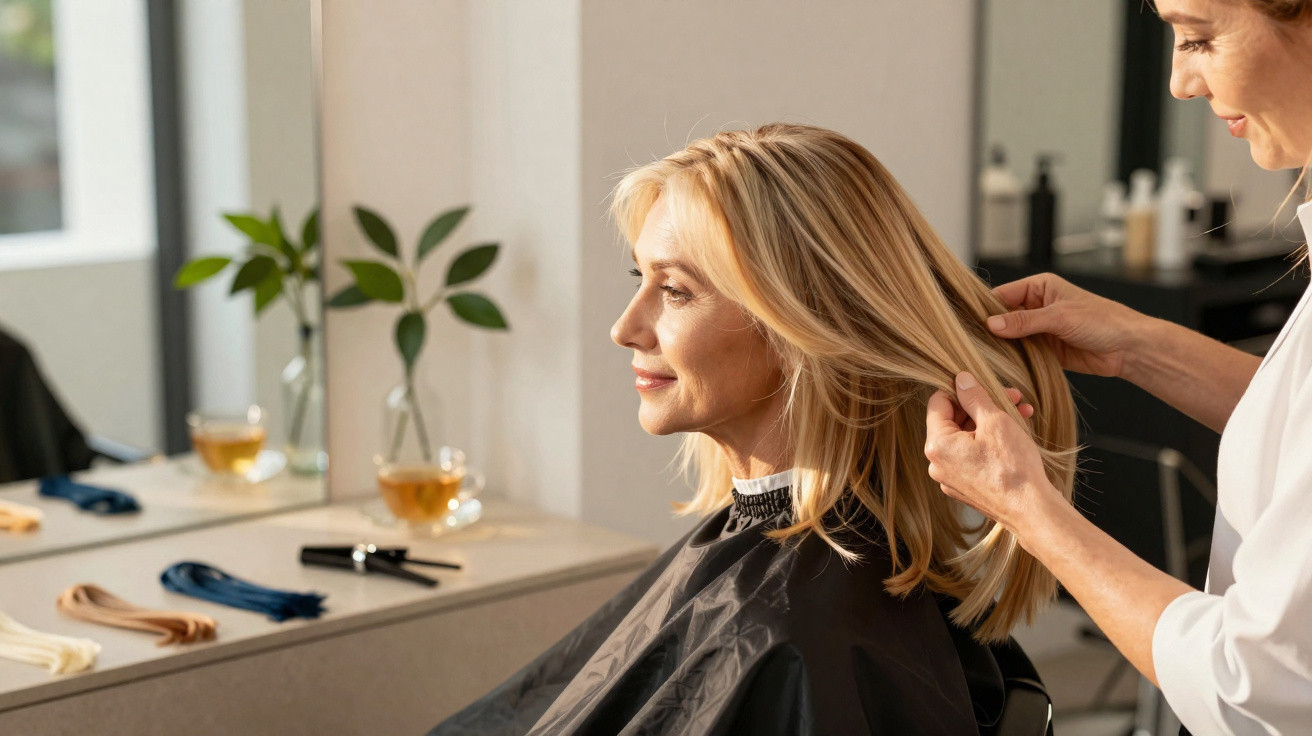
The hairdresser had only just fastened the cape when Claire, 67, tipped her chin towards the mirror and murmured, “I just don’t want to look… tired.”
Her hair was feather-fine, shaped into a neat little bob she’d worn for two decades. On her phone sat dozens of screenshots: icy blondes, dark brunettes, sweeping silver manes. She’d experimented with almost everything. And each appointment ended the same way: “Next time will be better.”
The stylist studied her reflection, then the washed-out colour. He offered a kind smile.
“Your hair isn’t the problem,” he said. “It’s the shades that are dragging your face down.”
That was when he named the three colours that age fine hair after 60 more than any wrinkle ever could.
Why some colours suddenly make us look older after 60
Spend a Tuesday morning in any salon and you’ll spot the pattern. Women over 60 arrive asking for the same thing: “I don’t want to go too dark, but not too light either. Just something that doesn’t age me.”
The twist is that many are already wearing the very tones that sharpen their features, flatten their hair and draw attention to every line.
Fine hair is not forgiving.
With the wrong colour, every hint of scalp shadow shows, volume looks reduced, and any tiredness in the skin appears amplified. When the pigment is even slightly off, the whole face can seem to lose its spark.
Take Marie, 71, who walked into a Paris salon with a deep, box-dye brunette she’d relied on for years. Her hair was fine, thinning at the crown, and her skin had mellowed into a peachy-beige tone.
That overly dark brown created a stark, helmet-like result: no movement, no light. Her under-eye shadows looked heavier, and her jawline appeared more severe.
Once the colourist softened the shade, layered in warm, translucent highlights and allowed a little natural grey to blend through, the effect changed.
Her eyes seemed brighter and her cheeks less hollow. Same woman, same wrinkles-simply a different halo of colour.
It boils down to one straightforward reason: after 60, pigment shifts everywhere. Skin contrast reduces, eyebrows lose intensity, and lips look less defined.
A colour that felt stylish at 45 can read harsh or lifeless at 65.
Fine hair magnifies the effect.
Because the strands are thinner and more see-through, they can’t “hold” depth in the same way without swallowing the face. A poor shade either fades you out or outlines you too strongly-like a thick marker on delicate tissue paper.
The 3 shades that age fine hair after 60, according to a hairdresser
The first enemy, many experienced colourists agree, is uniform jet black on fine, mature hair. On younger, thicker hair it can look striking; on fine hair after 60 it often appears flat and severe.
Black soaks up light around the face, creates an artificial “wig” look, and makes scalp transparency more obvious.
The stylist’s check is straightforward: if the hair reads as one solid block rather than individual strands, and if you suddenly need far more make-up to “balance” the colour, it’s gone too dark.
On softer skin tones and delicate features, jet black hardens everything-especially alongside a very blunt cut.
The second ageing pitfall is the very cold, ultra-ash blonde on fine hair. Online, icy blondes can seem clean and contemporary. In real life, on a 65-year-old with translucent skin, it can feel unforgiving.
An ashy blonde without any gentle warmth can make the complexion look as though it’s turned grey, like a veil has dropped over the face.
Hairdressers regularly meet women who went lighter to “soften” their look, only to end up with a shade that drains them.
Fine, icy strands cling to the scalp, can throw bluish tones in certain lighting, and tend to emphasise under-eye circles and cheek redness.
The third shade that dates the most is the flat, beige “one-size-fits-all” medium brown-neither dark nor light, often sold as the safe at-home box option.
On fine hair, this neutral brown frequently oxidises quickly, turning slightly khaki or orange through the ends. The outcome is a dull, lifeless colour that doesn’t sit well with the warmth of the skin or the softness of grey regrowth.
This in-between tone may feel sensible, but it removes contrast just where we actually benefit from a little controlled light.
Let’s be honest: no one truly wants a colour that can only be described as “meh”.
How to choose shades that lift the face instead of ageing it
For fine hair after 60, the best colour is rarely a single, uniform shade. The real secret is working with transparency, reflection and subtle variation.
Colourists often refer to “soft contrast”: a base close to your natural depth, then slightly lighter pieces around the face and across the top to create the impression of volume.
Picture hair as a sheer fabric.
You want light to pass through it, catch on certain strands, soften on others, and gently frame your features. Small touches of gold, honey or soft caramel can create lift without shouting “highlights”.
One useful approach a hairdresser shared is the “one shade lighter” rule. If you’ve always been a deep brunette, you don’t need to jump to platinum. Move one or two tones softer and add warm reflections that echo your skin.
And stop battling every single grey. Blending greys with lighter strands often looks fresher than a solid block of pigment.
A common misunderstanding is thinking coverage equals uniformity.
What most faces need is light placed thoughtfully: around the eyes, along the cheekbones, and near the fringe area if you wear one.
“Past 60, my goal is simple,” explains Antoine, a Paris hairdresser specialized in fine hair. “I don’t try to make women look 20. I try to make them look rested. The wrong color makes them say ‘I look tired.’ The right shade makes them say ‘I look like myself again.’”
- Soft chocolate browns with warm, subtle highlights
- Golden or honey blondes, slightly lighter around the face
- Salt-and-pepper blends enhanced with very fine, luminous streaks
- Warm chestnut tones instead of flat medium beige
- Delicate copper or rose-gold glows for naturally warm complexions
Letting your hair colour evolve with you
There’s a calm sense of relief in stopping the chase for the exact shade you wore at 30. Hair shifts, skin shifts, and pretending it hasn’t can be tiring.
Rather than asking, “How do I hide my age?”, many women now ask, “Which colour makes me look alive, with the hair I have today?”
The solution isn’t one fashionable tone-it’s an honest look at your reflection.
That might mean allowing a little silver at the temples, softening a much-loved dark brown, or warming up a blonde that’s gone too icy. Sometimes a small adjustment is the change that transforms everything.
Most of us recognise that moment when a selfie or a shop-window reflection prompts, “Why do I look so stern?” Often, it’s your hair colour doing the talking.
Updating it won’t turn back time, but it can change the mood around your face.
Ask your hairdresser to show you pictures of women your age with a similar hair texture and skin tone, in a range of shades. Look beyond the hair itself and focus on their eyes: which colours make them seem cheerful, alert, relaxed?
The aim isn’t “younger at all costs”. It’s something quieter-and more meaningful: looking like yourself, on a very good day.
| Key point | Detail | Value for the reader |
|---|---|---|
| Avoid ultra-dark, jet black on fine hair | Absorbs light, reveals scalp, hardens facial features | Helps prevent that “helmet” effect and tired-looking face |
| Be wary of very cold, ashy blondes | Can gray the complexion and accentuate shadows | Guides you toward softer, warmer blondes that lift the skin tone |
| Prefer soft, multi-dimensional shades | Use warm reflections and subtle highlights around the face | Creates the illusion of volume and a more rested, luminous appearance |
FAQ:
- Which hair colour is most flattering for fine hair after 60? A soft, warm tone that’s close to your natural level, with lighter, delicate highlights around the face. Honey blondes, warm chestnuts and light chocolate browns tend to be very forgiving on fine hair.
- Should I go lighter or darker as I get older? Neither extreme works well on fine hair. Going one or two shades lighter than your old natural colour, with warmth and dimension, usually looks fresher than very dark or ultra-light tones.
- Do highlights damage fine hair too much at my age? Aggressive bleaching can, but very fine, well-dosed highlights with bond-protecting products can be gentle. Ask for soft, low-volume lightening rather than thick, heavy streaks.
- Can I keep my grey and still look modern? Yes, by refining it. A gloss, a soft beige or pearly toner, or a few luminous streaks can make natural grey look intentional and chic, instead of dull or yellowish.
- How often should I recolour fine hair after 60? Every 6–8 weeks for soft root maintenance, and every 3–4 months for highlights is often enough. Spacing out strong procedures protects fragile hair while keeping the colour fresh.

Comments
No comments yet. Be the first to comment!
Leave a Comment