
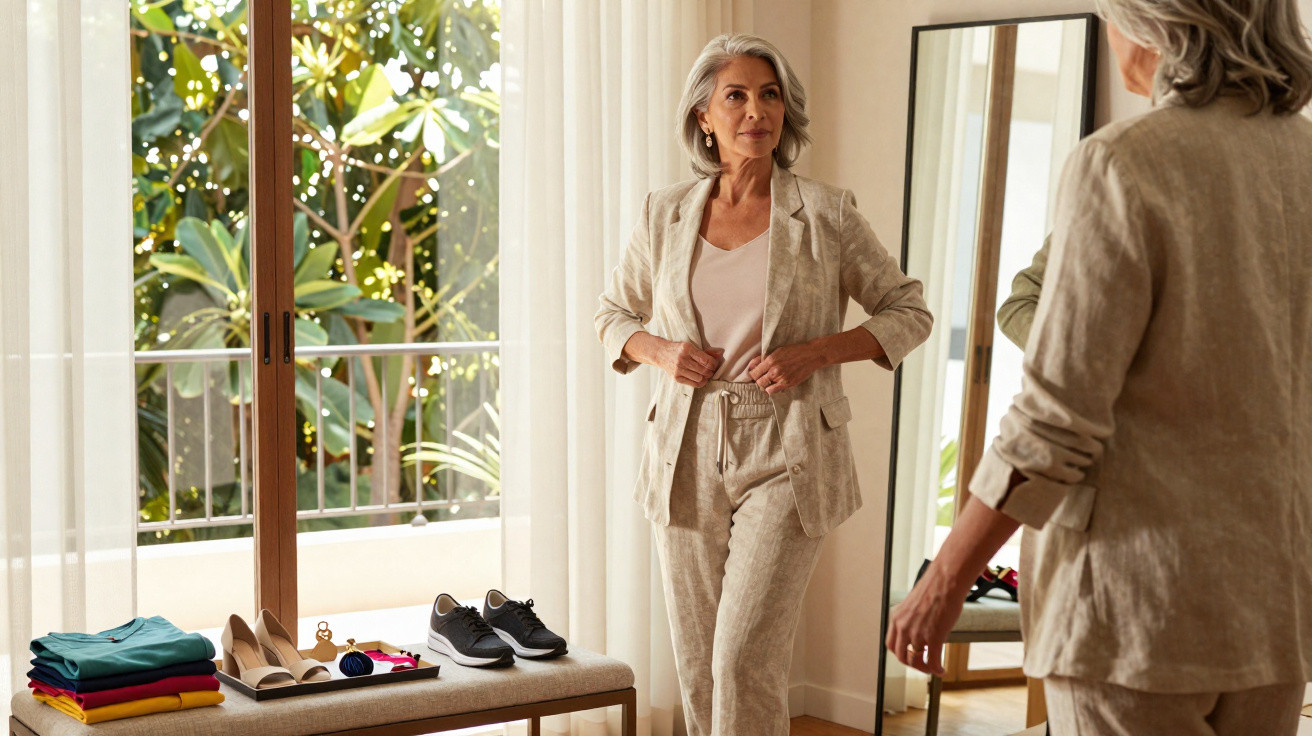
Plenty of women over 65 still enjoy putting an outfit together, but they are not looking for clothes that demand constant effort. What they want are items that are easy to pull on, flattering within seconds and practical for everyday life: buses, grandchildren, appointments, travel, and the occasional lunch out. The ten low-effort style ideas below are aimed at that sweet spot - put-together, straightforward and gentle on a body that’s changing.
Why low-effort style matters after 65
It’s easy to feel that fashion is for somebody else - office life, influencers, and twenty-somethings on social media. Yet clothing continues to communicate long after retirement, shaping not only how people read you, but more importantly how you experience yourself.
Style after 65 isn’t about looking younger at any cost; it is about looking fully alive with as little fuss as possible.
In practice, low-effort style is about outfits that are simple to build, comfortable all day and easy to repeat. The goal isn’t to become a new version of you; it’s to make the current you feel a little more polished, with far less hassle.
1. Start with structure, not tightness
When your shape shifts, very fitted pieces can feel harsh and revealing. Structure is something else entirely: a jacket with a defined shoulder, a shirt with a proper collar, or a dress with seams placed well can create form without pinching.
Soft tailoring skims the body, creates a cleaner outline and instantly makes even leggings look deliberate.
Look out for:
- Light blazers made in stretch fabrics
- Shirts with some substance (avoid flimsy polyester that collapses)
- Dresses with a seam at the natural shoulder and an under-bust seam
2. Choose forgiving fabrics that move with you
Rigid fabrics can bite at the waist or strain over the chest. Newer blends often deliver comfort, shape and breathability in one.
Three fabric options tend to suit women over 65 with minimal effort:
| Fabric | Why it works | Best for |
|---|---|---|
| Viscose or modal blends | Soft drape, not clingy, falls smoothly over curves | Dresses, blouses, wide-leg trousers |
| Cotton with a bit of stretch | Breathable, keeps its shape, offers gentle structure | Jeans, chinos, shirts |
| Ponte knit | A thicker knit that disguises bumps while staying comfortable | Pull-on trousers, jackets, skirts |
3. Let colour lift your face, not overwhelm it
One well-chosen colour close to your face can do more than any complicated outfit “rule”. As hair becomes lighter and skin tone softens, stark black can sometimes feel heavy - though you can still keep richness and depth.
Think “soft strength” in colour: deep navy instead of black, cranberry instead of fire-engine red, teal instead of neon.
A simple approach is to keep three reliable “face colours” in tops or scarves - one light, one mid and one deep. Swap them in with neutral bottoms and your wardrobe starts to look considered, without adding extra effort.
4. Use vertical lines to lengthen gently
Most women over 65 aren’t necessarily chasing thinness; they simply want clothes that don’t slice the body in unhelpful places. Vertical lines encourage the eye to travel up and down, creating a calmer, more elegant effect.
Simple ways to add length
- Wear an open cardigan or blazer over a top in a similar shade
- Choose a long necklace that ends around the mid-torso
- Look for vertical seams or pintucks on dresses and shirts
None of these depend on control underwear or aggressive tailoring. They just redirect attention in a more forgiving way.
5. Soften the neckline, frame the face
Once the neck and jawline start to change, necklines matter more than most people realise. High, tight crew necks can look severe, while a deep V can feel too exposed.
A soft V, scoop or boat neck opens the face, shows a little collarbone and balances the upper body.
If you like more coverage, try a higher neckline in a fluid fabric, or add a light scarf that’s draped rather than tied tightly around your neck.
6. Embrace pull-on bottoms that still look smart
For women managing arthritis, reduced mobility, or simply a full day, fiddly buttons and zips rarely feel appealing.
- Choose wide elastic waistbands that lie smooth at the front.
- Go for straight legs or a gentle wide leg rather than ultra-skinny cuts.
- Pick dark denim, navy, charcoal or chocolate brown to look instantly neater.
From a distance, well-made pull-on trousers can read like tailored trousers rather than loungewear, particularly in ponte knit or a structured jersey.
7. Make shoes do more work with less effort
After 65, feet can change quickly - bunions, swelling and balance concerns are common. Style does not have to disappear because comfort is needed.
Low block heels, sleek trainers and well-designed loafers lengthen the leg line and steady your step at the same time.
An ankle boot that’s close in colour to your trousers can subtly extend the look of the leg. A clean white or neutral trainer (without shouty logos) pairs easily with dresses, jeans and smart-casual looks.
8. Rely on a small set of “uniforms”
Decision fatigue is genuine. Many well-dressed older women simplify life by repeating two or three dependable outfit formulas and varying the details.
Three straightforward uniforms that suit most body types over 65:
- Dark trousers + a softly coloured top + a structured jacket
- A knee-length or mid-calf dress + low block heels or smart flats
- Slim jeans + a longer cardigan or tunic + a simple necklace
Once you’ve found the combination that feels both sharp and comfortable, buy versions that stay within that template. It tends to cut down on shopping regrets and make mornings easier.
9. Use accessories as gentle “spotlights”
Accessories shouldn’t feel heavy or fussy; they should guide the eye to where you want the focus.
Think of a scarf, brooch or necklace as a spotlight: you place it where you feel most confident.
If your eyes are your favourite feature, choose earrings that pick up their colour. If you like your hands, a simple ring or bangle brings attention there. A patterned scarf can also draw the gaze away from areas you feel unsure about - without hiding you.
10. Prioritise comfort that looks intentional
Comfort used to be treated as a sign you’d “given up”. That thinking has shifted, and many brands now design genuinely comfortable pieces with clear style - particularly for older customers.
Clues that comfort still looks polished:
- Seams are neatly finished and sit flat.
- The fabric keeps its colour and doesn’t look faded after a few wears.
- Waistbands stretch but don’t twist or buckle when you sit.
When clothes move with you instead of resisting you, your posture often improves - and that alone can make an outfit look more flattering.
Understanding proportion: the quiet styling trick
A principle stylists frequently use with older clients is “proportion” - in other words, how garment lengths relate to your body.
A quick rule of thumb: if your top is longer, keep the trousers slimmer; if the trousers are wider, keep the top shorter.
This helps prevent an outfit from reading as boxy or overwhelming. A longer cardigan, for instance, is usually best with straight or slim trousers. Wide-leg trousers tend to look strongest with a top that finishes near the hip bone rather than at mid-thigh.
Real-life scenarios that show these tips in action
Picture a normal Tuesday: coffee with a friend, a supermarket shop, then a quick stop at the GP. A low-effort option could be dark pull-on trousers, a teal top to brighten your face, a soft grey cardigan and supportive trainers. Add a long necklace and you look put together, without needing to change anything all day.
For something more formal - a grandchild’s graduation, perhaps - you could choose a navy knee-length dress in a fabric that drapes well, a light jacket with some shoulder definition, and nude-toned shoes. The jacket provides shape, the dress allows movement, and the lighter layer keeps attention near your face in photographs.
Extra gains: confidence, budgets and sustainability
Low-effort style saves more than time. It can help avoid costly shopping mistakes and make a smaller budget go further. When you buy fewer items that earn their place, you create less waste and end up with outfits that feel more consistent - a gentle sustainability win without a full lifestyle overhaul.
There’s also a subtle psychological benefit. When your clothes suit the life you actually live - comfortable, mobile and quietly elegant - you’re more likely to accept invitations. You get out of the house more. Social contact supports mood and cognitive health, and researchers connect it with better ageing outcomes. Style won’t fix everything, but it can nudge day-to-day life in a kinder direction.
Comments
No comments yet. Be the first to comment!
Leave a Comment