
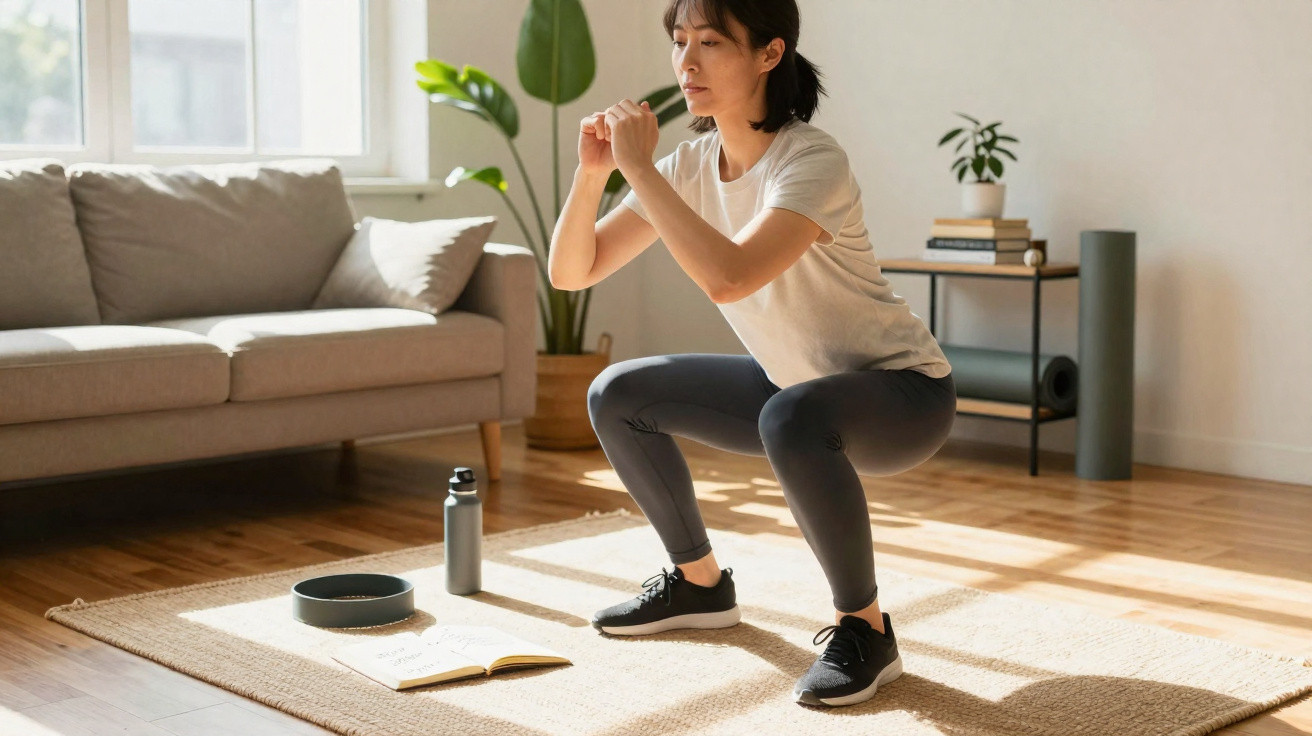
New data suggests that even straightforward strength exercises can massively change your life.
For years, the internet has been full of complicated training plans that feel more like maths than movement: sets, reps, timed rests - and if you do not speak fluent gym jargon, it is easy to give up before you start. A major scientific review now cuts through that noise with a surprisingly relaxed message: simple strength exercises, repeated consistently, are entirely enough to build muscle, improve health, and cope far better with everyday tasks.
What the new mega-study actually shows
Today’s strength training recommendations are based on an evaluation of 137 systematic studies involving more than 30,000 participants. This is not a small trial - it is a robust overall picture drawn from 15 years of research.
The key takeaway is that many people have made strength training far more complicated than it needs to be. In real life, the “perfect programme” matters less than one basic question: can you manage to challenge your muscles on a regular basis?
"Consistency beats perfection - if you train all the main muscle groups twice a week, you’re already doing a huge amount right for your health."
The experts emphasise that you do not need to be a fitness fanatic. It is enough to choose a realistic, minimal routine that fits your day-to-day life - and that you actually stick with.
Why simple strength exercises work so well
For a long time, the assumption was: if you want results, you need heavy weights, complex machines and finely tuned plans. The newer findings point in a different direction. What counts is not a flawless set-up, but the stimulus you give the muscle.
Broadly speaking, three things are enough to produce measurable effects:
- work all the major muscle groups (legs, glutes, back, chest, shoulders, abdominals)
- schedule at least two sessions per week
- push each exercise so the final repetitions feel noticeably difficult
Whether you do this with dumbbells, resistance bands or only your body weight is secondary. Your muscles respond primarily to resistance and effort - not a fancy gym or the brand name on the kit.
The biggest leap: from doing nothing to doing a little
One especially interesting point in the new guidelines is this: the largest health benefit often comes from people who did nothing before and then start with just a small amount. Tiny steps can deliver surprisingly large returns here.
Typical effects for beginners who begin a simple routine include:
- a noticeable strength increase in the first few weeks
- everyday tasks such as climbing stairs or carrying shopping bags feel easier
- more stability while walking and a lower risk of tripping
- many report a better mood and less fatigue
"The jump from zero to a little is often bigger for health than the jump from a lot to extreme."
So you do not need to sprint into the gym five times a week. Moving from a fully sedentary routine to two short strength sessions per week already brings a substantial boost to health and quality of life.
More than muscle: what strength training triggers in the body
When people hear “strength training”, they often picture bodybuilders. The study review shows something else: for most people, it is not about appearance, but function - how well your body performs in everyday life.
Regular strength training can:
- reduce the risk of cardiovascular disease
- improve insulin sensitivity and help prevent type 2 diabetes
- reduce back pain by strengthening the core and postural muscles
- support bone strength and help prevent osteoporosis
- significantly lower the risk of falls in older age
Many people also notice very practical gains: standing up from an armchair feels easier, kneeling down feels more secure, lifting children or crates of drinks becomes less of a struggle. Even a brisk walk can feel smoother because the muscles contribute more effectively.
No gym required: how to train without equipment
One barrier stands out clearly: according to the new guidelines, nobody strictly needs a gym. For many people, that alone makes getting started much easier - no contract, no changing rooms, no awkwardness on machines you do not understand.
These simple options are more than sufficient, provided you use them consistently:
- Bodyweight exercises: squats, press-ups (if needed, against a wall), lunges, planks
- Resistance bands: pulling movements for the back and shoulders, leg work with a band around the thighs
- Everyday objects: water bottles as weights, a sturdy chair for step-ups or triceps dips
With just a few building blocks, you can put together a small weekly plan. Here is one example of two minimal sessions:
| Day | Exercises | Duration |
|---|---|---|
| Tuesday | Squats, wall press-ups, band rows, plank | 15–20 minutes |
| Friday | Lunges, overhead press with bottles, glute bridge, side plank | 15–20 minutes |
To begin with, two sets per exercise are enough, at around 8–15 repetitions. Once you notice it is getting easier, increase gradually - not frantically - by nudging up the difficulty or adding a few reps.
Why sticking with it matters more than the perfect plan
Many people do not fail because they lack motivation, but because their expectations are unrealistic. If you start with a professional-level plan, train in a highly complex way and have to juggle five training apps, you often burn out after a fortnight.
"The crucial question isn’t: ‘Is this the best plan?’ but: ‘Will I still be doing this in three months?’"
The review highlights that a mediocre programme you can maintain steadily for months or years beats any “high-end plan” you abandon after ten days. That is why specialists advise starting small:
- begin with two fixed days per week and treat them like appointments
- choose fewer exercises rather than too many
- deliberately plan short sessions (10–20 minutes) instead of unrealistic marathon workouts
- only increase when your current level clearly feels too easy
Approaching it this way brings progress without overload - and that balance is what turns training into a habit rather than a chore.
How to fit strength training into a busy life
Many people assume exercise has to take a lot of time. The guidelines show that a handful of well-planned minutes each week can make a difference - as long as they happen regularly.
A few simple, realistic strategies include:
- five-minute mini-session after brushing your teeth (for example, squats and wall press-ups)
- doing one exercise during ad breaks or between video calls
- using stairs as “training equipment” on purpose, adding a few extra trips
- fixed “family workout” times where everyone joins in, even in a playful way
Older adults benefit in particular. Strength training helps you stay independent for longer: doing the shopping without help, getting dressed, standing up from the floor - all of that depends on muscle more than many people realise.
What beginners often misunderstand - and how to make it easier
Two misconceptions appear again and again. First, that you must completely exhaust yourself. Second, that without muscle soreness the session was pointless. Neither is true.
For health benefits, it is enough to work at an effort level where, towards the end of a set, you can clearly feel you are working hard while still moving with good form. If you push to absolute muscular failure every time, you are more likely to end up frustrated, overloaded and forced into longer breaks.
A helpful tool is a simple self-rating on a scale of 1 to 10 for how hard a set feels. The target range for most people is about 6 to 8: challenging, but controlled. This teaches you to listen to your body instead of blindly chasing a number from a plan.
Practical add-ons: combinations, risks and smart routines
If you want to get more out of your training, you can pair strength exercises with short bouts of endurance work - for example brisk walking, cycling or stair climbing. This combination supports the heart and circulation, while the muscles handle the rest. For most people, a simple alternating pattern is enough: strength exercises twice a week, plus two to three short movement sessions where your pulse rises moderately.
No sport is entirely risk-free. If you have not exercised for a long time, are significantly overweight, have heart issues or other pre-existing conditions, you should discuss getting started with a doctor beforehand. Typical warning signs such as sharp chest pain, severe breathlessness or dizziness during training are signals to stop.
One point experts repeat frequently is this: you will never do it perfectly anyway. But your body responds gratefully to any reasonably consistent effort to challenge it a little. A few squats in the living room are still better than an expensive gym membership that never gets used.
That is the liberating message of the latest research: if you make simple strength exercises a regular part of your life, you can relax about many complicated rules - and still gain more strength, more confidence in everyday movement, and much better odds of healthy ageing over the long term.





Comments
No comments yet. Be the first to comment!
Leave a Comment