
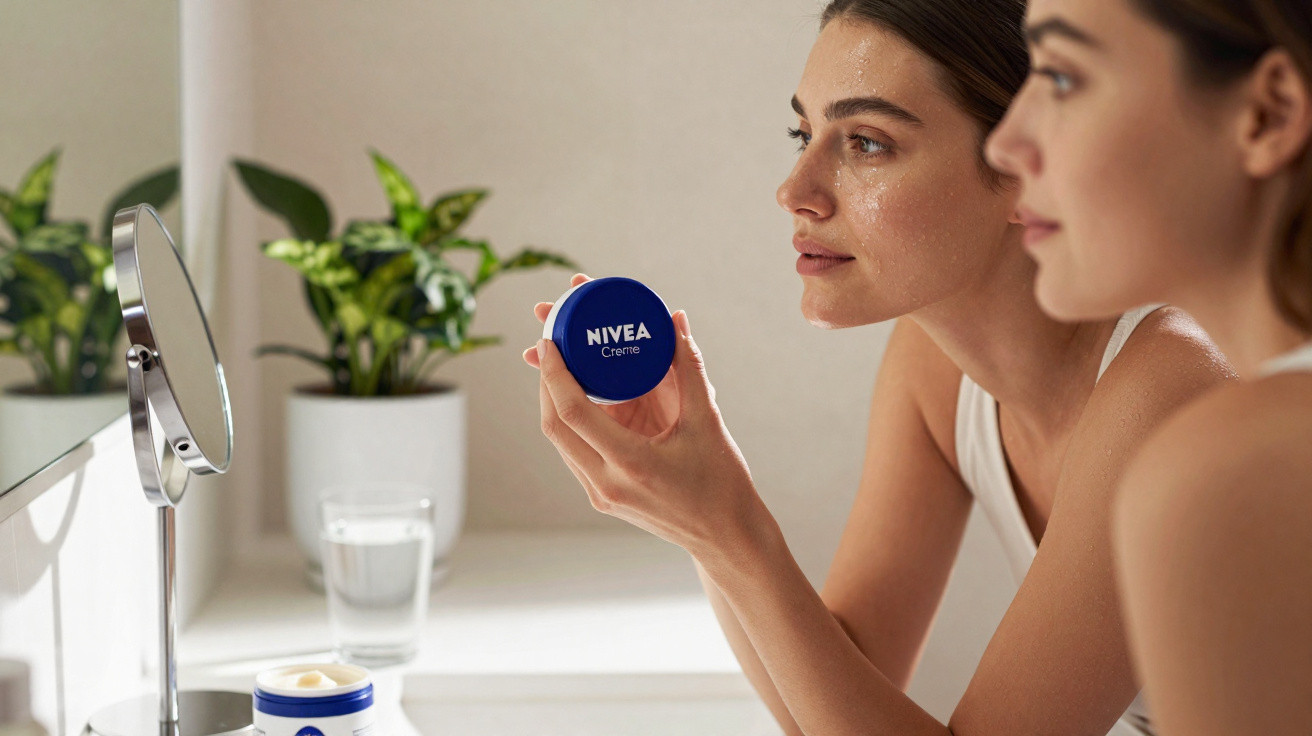
The cult cream in the blue tin can be found in countless bathrooms, used on elbows, hands and dry shins. But how does it hold up as facial skincare when put through a truly unforgiving test? One beauty writer did exactly that, applying a thick layer of Nivea to just one side of her face for a week.
Blue Nivea Cream: a classic with many uses
Classic Nivea Cream has been a permanent fixture on beauty shelves for decades. Its fragrance is instantly recognisable, as is the tin, and almost every family has some memory connected to it. What is striking is just how many everyday uses people find for the cream.
- as after-sun care for mildly dry, tight-feeling skin
- as a mask for dry hair ends
- as soothing care after shaving or epilation
- as a protective layer against friction to help prevent blisters
- as an SOS cream for rough hands or heels
Many people already treat it like a Swiss Army knife for the body – but expectations around facial skincare have risen considerably. Modern serums, acids, retinol and niacinamide: the market is packed with high-tech products. This raises the question: can a cream with a fundamentally very old formula still keep up when used on the face?
The experiment: Nivea on only one side of the face
That was precisely what a beauty editor wanted to find out. Her plan was to apply a thick layer of Nivea every evening for one week, like an overnight mask – but to only one half of her face. This would allow for a direct comparison.
The rest of her routine remained unchanged: thorough cleansing, a serum, eye cream and a standard moisturiser. Nivea was applied only at the end, as an extra top layer – effectively an occlusive seal.
“After just the first few nights, the moisturised side of my face looked noticeably smoother and plumper in the morning.”
After a few days, the writer says she began to notice several differences:
- Skin on the Nivea side felt more thoroughly moisturised.
- Fine dehydration lines appeared slightly plumped up.
- The surface looked smoother and less flaky.
There is a straightforward explanation for the result: the rich texture forms a type of protective layer. It limits moisture loss overnight – the period when skin is already regenerating and renewing its cells. Less water escapes from the skin, leaving it softer and making it look fresher by morning.
Slugging with Nivea: a trend technique with an oily film
The technique of applying a thick, occlusive layer of cream or ointment over a regular skincare routine already has a well-known online name: slugging. Vaseline or similar products are usually chosen for this, but the writer used the familiar Nivea Cream instead.
The principle is that the cream itself is not expected to perform “miracles”; rather, it is meant to lock in the products applied underneath more effectively. The oily film helps stop the skin from drying out overnight.
For dry, dehydrated skin, this can work like comprehensive insurance. Particularly in winter, or after days spent in heavily heated indoor air, skin can feel more comfortable in the morning when it has been so well protected from moisture loss.
When the method can become problematic
There is a downside, however. The writer reports that daily slugging with Nivea would be too much for her in the long term. After several days, small blemishes appeared in her T-zone – the area where her skin becomes oily more quickly and is already more prone to blocked pores.
“Anyone prone to combination skin or spots should use Nivea as an overnight mask sparingly rather than every day.”
If skin is not cleansed perfectly, or is prone to a build-up of dead skin cells, the dense oily film can trap sebum and dirt more easily. This can make small clogged bumps or spots more likely to develop.
How often does Nivea work as an overnight mask?
The writer reached one clear conclusion from her self-test: the method works – but only in moderation.
Suitable frequency according to skin type:
| Skin type | Nivea as an overnight mask |
|---|---|
| very dry skin | 1–2 times a week during the colder months |
| normal skin | every 1–2 weeks as a “moisture boost” |
| combination skin | rarely, only on dry areas such as the cheeks |
| oily, acne-prone skin | best avoided, or used only on extremely dry patches |
Rather than coating the entire face in a thick layer every night, a more targeted approach makes sense. Especially dry areas – such as around the nose, on the cheeks or on the neck – usually benefit more than an already oily forehead.
How to use blue Nivea Cream on the face effectively
Anyone wishing to recreate the effect seen in the experiment can follow a few straightforward rules:
- Cleanse the face thoroughly and remove all make-up.
- Apply a light serum and a standard moisturiser.
- Use Nivea only as the final layer, starting with a thin application.
- Do not apply it directly to inflamed spots or active acne.
- Increase use gradually and monitor how the skin reacts.
Many dermatologists view rich, traditional creams primarily as a protective barrier, rather than as high-tech active-ingredient powerhouses. Anyone using ingredients such as retinol, vitamin C or acids should apply these products first as directed, then use Nivea as a “lid” over them – provided their skin tolerates it.
Why this classic remains relevant
Although modern formulas containing high-tech ingredients are currently attracting plenty of hype, the test shows that a simple, dense oily film can do a surprising amount for dry skin. The blue cream provides exactly that – and has done so for generations.
It is not a replacement for a specifically formulated serum targeting pigmentation marks, wrinkles or redness. However, it can serve as an affordable, fuss-free addition that supports an existing routine and guards against moisture loss. For those without a large budget, it offers sturdy, uncomplicated basic skincare.
When lighter products are the better choice
For all its nostalgia, the cream will not suit everyone. Oily or very blemish-prone skin often fares better with light gel textures or non-comedogenic creams that put less strain on pores. Those with sensitive skin should check the ingredients: anyone unable to tolerate fragrance may experience irritation.
The combination of old and new is particularly interesting: many people use modern, lightweight skincare with antioxidants and sun protection during the day, then occasionally reach for the blue tin in the evening when their skin feels tight or looks extremely dry. This makes it possible to benefit from its protective qualities without overwhelming the skin permanently.
The one-sided Nivea test demonstrates one thing above all: the classic cream is far from outdated – it simply needs to be used strategically. Anyone who knows their skin and pays attention to how it responds can use the cult tin very deliberately, rather than leaving it in the cupboard as nothing more than a nostalgic reminder.






Comments
No comments yet. Be the first to comment!
Leave a Comment