
The morning rush is louder than your alarm, and you’re already running behind. You reach for your favourite perfume - the bottle you keep for “when it matters” - and mist your wrists, your neck, and maybe your scarf too, because today needs to smell like confidence. But an hour later, in the office lift, you lean forward to grab a file and… nothing. Your fragrance has disappeared, like it clocked off before you even got in. You discreetly smell your wrist and feel that tiny, slightly ridiculous let-down. How can a perfume that cost half a month’s pay vanish quicker than your morning coffee?
You tuck a strand of hair behind your ear and pick up a faint trace of yesterday’s scent.
That’s when the real question lands.
Why your perfume disappears from your skin so fast
Wearing perfume on skin feels obvious - almost automatic. We’ve watched mums and friends dab fragrance onto pulse points, trusting that warmth will keep it going. Yet for many of us, the spell doesn’t last. Skin soaks it in, clothes seem to swallow it, and by lunchtime you’re left with a memory of a smell rather than the real thing.
The twist is that skin isn’t always the best place for this everyday ritual.
Sometimes it’s the quiet thief.
Picture a night out: packed bar, satin shirt, a good hair day, and that one perfume you save for evenings that might turn into stories. You spritz your neck on the way out, enjoy the trail for a second, then stop thinking about it. Two hours later, a friend hugs you and says, “I thought you were going to wear your usual scent tonight.” You did - it simply didn’t last. Now think of another friend who always smells amazing when she walks past or flips her hair. Not loud, just there. It’s easy to assume she’s wearing something stronger. Often, she’s just applying it more cleverly.
Not more. Smarter.
Here’s what’s happening. Perfume is largely alcohol, combined with oils and aromatic molecules that stick around where they’re comfortable. Dry or sensitive skin behaves like blotting paper: it absorbs, thins out, and then lets those molecules go too quickly. And the warmth of pulse points can speed up evaporation even more. Hair, though, acts more like a fine fabric. The fibres catch scent particles and release them gradually, with every movement sending tiny wafts into the air. Your hair behaves like a gentle diffuser while your skin plays the role of impatient host.
That’s exactly why the hairbrush trick makes such a difference.
The hairbrush trick that quietly changes your scent game
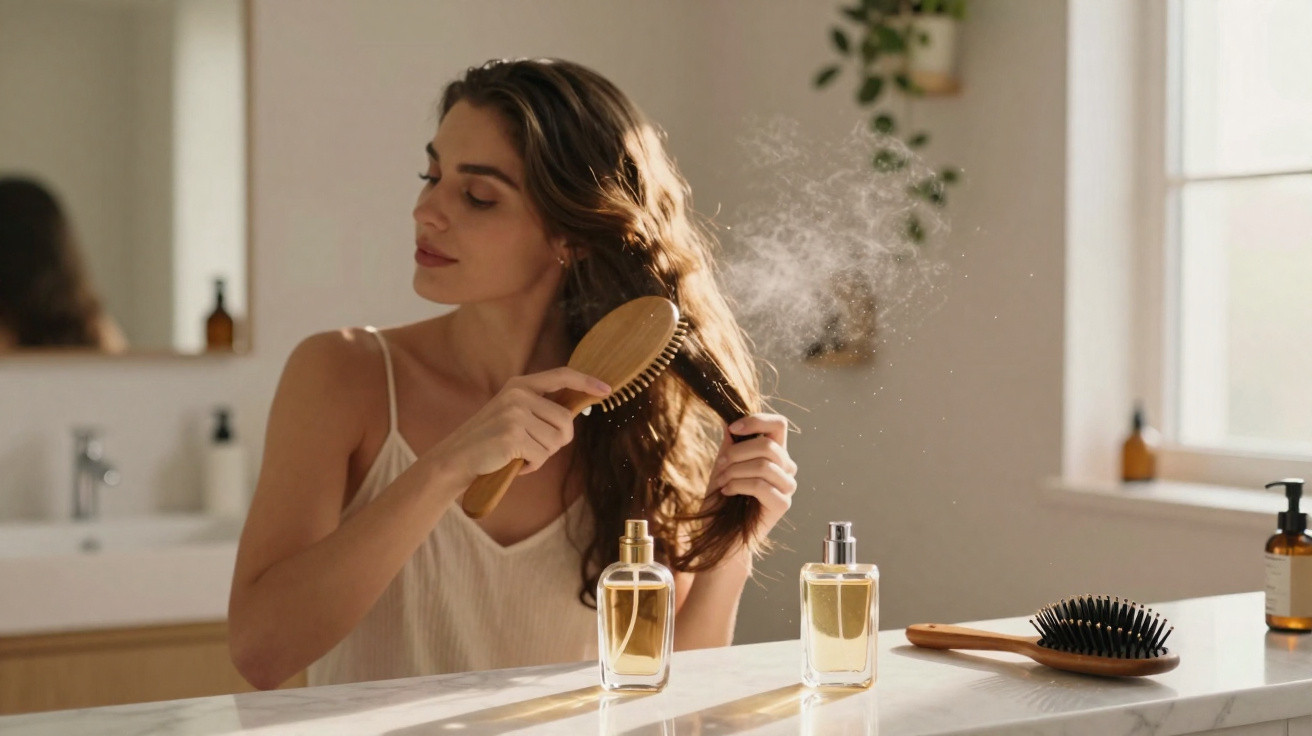
The technique is almost laughably straightforward. Instead of soaking your wrists, spray your perfume onto your hairbrush from about 15–20 centimetres away. One or two sprays is plenty. Give it a couple of seconds so the sharpest alcohol blast can lift off the bristles, then brush through dry hair from mid-lengths to ends. You’re scenting the strands, not the scalp.
What you get is a soft, halo-like fragrance that moves with you - without announcing itself to the room before you enter.
Understated, but unmistakably there.
Many people stumble on this by chance. A stylist mists fragrance backstage, it settles on brushes, and models step out smelling expensive without knowing the reason. Or you hug a friend on a windy day and she smells incredible, and she shrugs: “Oh, I just sprayed my brush.” That’s the whole secret - no complicated layering, no hidden salon potion. The fragrance grips the hair cuticle, especially when hair is a little dry or textured, and every turn of your head reactivates it.
We all know that moment: a stranger walks past, their scent lingers, and you wonder what they’re doing differently.
There’s another advantage your skin will appreciate. Most perfumes - even the posh ones - rely on a lot of alcohol to project and dry down quickly. On sensitive or already dehydrated skin, it can feel like hosting a party your epidermis never agreed to. Over time, redness, tightness, or those barely visible dry patches can show up. When you move a big chunk of your perfume routine to your brush, you cut down direct alcohol contact while keeping the full sensory effect. Your hair can handle the brief encounter, and the fragrance molecules settle into the fibres like they’ve signed a long lease.
Less irritation, more presence.
How to perfume your hairbrush without ruining your hair
Begin with a brush that’s clean and completely dry. Plastic or wood is fine - what matters is that the bristles aren’t already coated in styling products. Hold your bottle about a forearm’s length away and spritz once across the bristles, like you’re lightly misting a plant. Pause for two or three seconds. That small wait helps the harsh alcohol hit evaporate, leaving more of the fragrant oil behind. Then brush gently, keeping your focus on the lengths and ends rather than the roots.
Treat it as “brushing in” a veil of scent, instead of blasting your scalp straight from the bottle.
One caution: extra sprays don’t automatically translate to more elegance. If you drench the brush, you can dampen the hair and leave it a bit tacky - especially with intense perfumes. Start with one spray, then tweak next time depending on how strong the fragrance is. Bright citrus or airy florals might justify a second mist. Dark orientals or heavy gourmands almost never need it. And let’s be honest: hardly anyone does this every single day. Some mornings you’ll grab the bottle and spray your neck on autopilot - fair enough. The hairbrush trick shines on the days you want your scent to last into the evening without punishing your skin.
Gentle, not obsessive.
“When clients ask how to smell ‘expensive’ without suffocating a room, I always tell them: perfume the hair, not the neckline,” confides a Paris-based hairstylist who works with actors and news anchors.
- Spray the brush, not the roots: Keep to mid-lengths and ends so you don’t irritate the scalp or dry it out with alcohol.
- Pick lighter formulas for everyday wear: Hair tends to suit soft mists, colognes, and floral or musky fragrances more than ultra-heavy oud bombs.
- Alternate with hair-friendly scents: When your hair feels delicate, use dedicated hair perfumes or dilute classic perfume with a little water in a mini spray.
- Don’t combine five scents at once: Stay within one perfume family so your shampoo, conditioner, and fragrance don’t compete.
- Refresh in the evening, not every hour: A quick brush-through with a lightly scented tool looks more polished than repeatedly spraying your wrists.
Let your scent live where you actually move
Perfume performs differently depending on placement. On fabric, it can cling strongly yet feel flat. On sweaty skin, it can twist into something you didn’t intend - then disappear. In hair, it follows your gestures: turning your head, flicking your ponytail, sliding a strand behind your ear. That’s why people catch a hint of you when you’re not talking - when you walk past, bend to pick up your bag, or lean in briefly. Your presence carries further than words.
You stop chasing longevity and start working with it.
| Key point | Detail | Value for the reader |
|---|---|---|
| Hair holds scent longer | Perfume molecules cling to hair fibres and release with movement | Longer-lasting fragrance without constant reapplication |
| Less alcohol on skin | Spraying the brush reduces direct contact with drying alcohol | Kinder to sensitive or dry skin while keeping your signature scent |
| Controlled intensity | A light mist on the brush creates a subtle, even halo of scent | Smell present and sophisticated, not overpowering or “cloudy” |
FAQ:
- Question 1: Can spraying perfume onto my hairbrush harm my hair?
- Question 2: How frequently can I use this approach without going overboard?
- Question 3: Is a dedicated “hair perfume” better than ordinary perfume?
- Question 4: If I scent my hair, will my pillow or clothes end up smelling too strong?
- Question 5: Which type of brush is best for this trick?


Comments
No comments yet. Be the first to comment!
Leave a Comment