

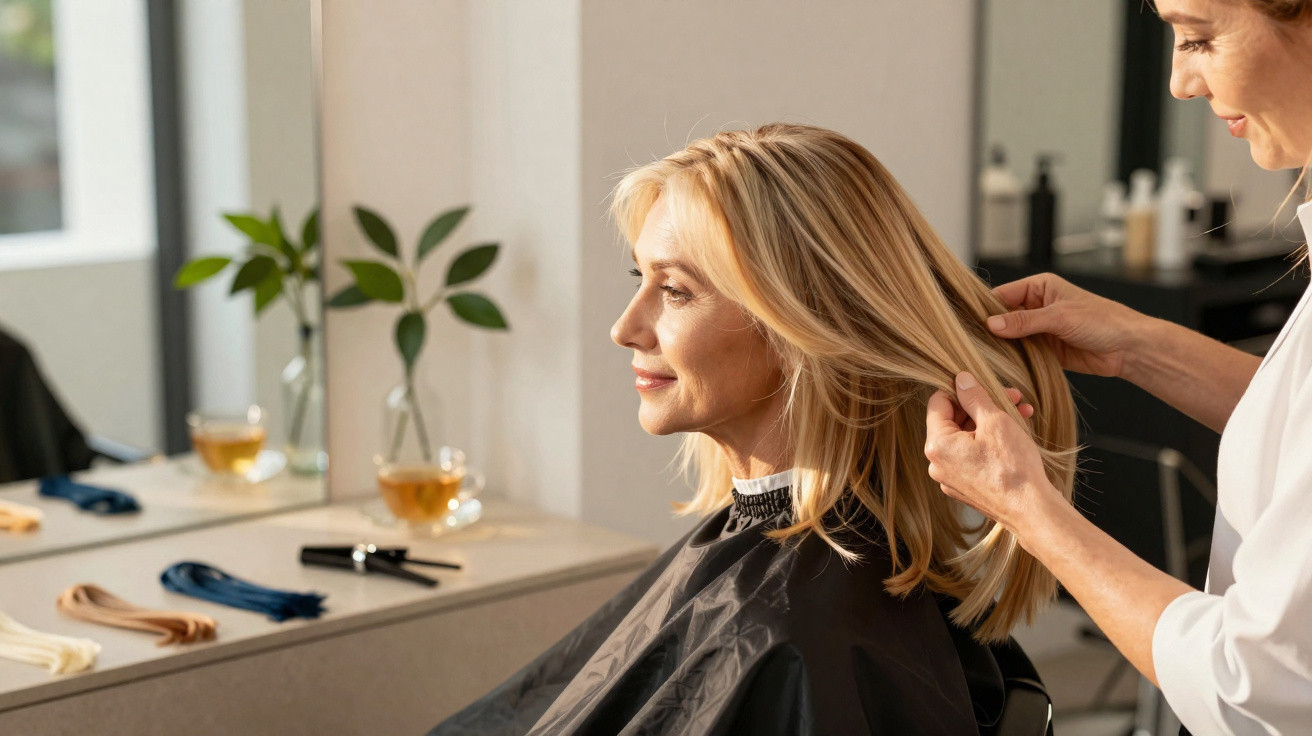
Her stylist had just spent a solid twenty minutes on the full routine: blow-dry, curls, root lift - the lot. The last curl fell into place. Her hair looked shiny… and instantly slumped.
She pressed two fingers into her roots, as if she could coax them up through sheer determination.
“I don’t understand,” she said. “I use all the ‘nourishing’ products everyone recommends. My hair should look healthy. Why does it drop before I’ve even left the house?”
The stylist’s eyes flicked to the fancy conditioner sitting on the counter, and one eyebrow rose. She barely needed to say a word. The culprit was right there - starting at the scalp.
And it begins well before you reach for the hairdryer.
The silent volume killer hiding in your shower
Because fine hair looks delicate, most people treat it like silk. They reach for weighty masks, rich creams, and “deep repair” formulas - again and again. It comes from a good instinct: if your hair feels like there isn’t much of it, you want to protect it by layering on care.
But then you step out of the shower and your roots already feel slippery. Not moisturised. Not springy. Just slick. A styling brush glides through without any grip. Your hair can’t hold lift because conditioner has coated each strand in a soft, invisible layer.
By the time it’s dry, volume has already lost - before styling has even started.
A London stylist once told me that on hectic Saturdays she can nearly call it in advance: she knows who’s put a heavy conditioner through their roots. They arrive with glossy, flattened hair that splits into limp sections rather than lifting as one. At the crown, it looks as though the hair is trying to cling to the scalp instead of rising away from it.
On a recent shoot, a model with naturally fine hair turned up convinced her hair was “prepped”. She’d smoothed a thick, creamy conditioner from scalp to ends “for extra smoothness”. In her bathroom mirror it looked sleek, but under studio lighting her roots lay like damp ribbons. The stylist ended up washing her hair again at the sink before doing anything else - just to remove the weight.
We spend plenty of time talking about heat damage and using the wrong brush. What hardly anyone points out is how many great hair days quietly end in the shower, smothered by products that are too rich and applied too close to the scalp.
Fine hair strands are physically smaller. With less internal structure, they become overloaded with far less product. Heavy conditioners are made to fill gaps, coat the cuticle, and add slip. On thick or coarse hair, that’s a gift. On fine hair at the roots, it turns into a literal anchor.
Once the base of the hair is coated with heavy emollients and silicones, the strands slide together instead of creating the friction that helps them lift. The root area - the place volume is born - gets pressed down. You can mist on all the volumising spray you like afterwards; if the foundation is slick, everything you pile on top is fighting a losing battle.
So when someone with fine hair says, “Nothing works on me,” it isn’t always about technique. Often it’s about what happened at the very start: how the hair was conditioned and prepared, right at the roots.
How to condition fine hair without killing the lift
Treat conditioner like butter on toast. You don’t start by buttering the crust. With fine hair, your “crust” is the root area. Begin at mid-lengths and move down towards the ends - where hair is older and genuinely benefits from extra nourishment.
Use a small amount, then distribute it with your fingers or a wide-tooth comb, but stop two or three finger-widths away from the scalp. That space matters - it’s your “volume zone”. Rinse for longer than you think you need to, especially around the crown and nape. A faint film left at the roots is often the quiet reason your hair goes flat by lunchtime.
If you want softness nearer the top, pick a lightweight, volumising conditioner - or use a spray conditioner and mist it only through the lengths.
One Monday morning, in a cramped Paris bathroom, a 29-year-old graphic designer called Léa tried this change for the first time. She’d always dragged a rich conditioner from roots to ends, copying her mum’s routine for thick Mediterranean hair. That day, she stopped around her cheekbones and worked only on the lower half.
She rinsed longer than usual, wrapped her hair in an old cotton T-shirt, and put the kettle on. Twenty minutes later, when she unwrapped it, she noticed something small but unfamiliar: the hair at her scalp wasn’t stuck down. It sat a little higher - even before blow-drying. The usual “helmet” effect had eased.
After drying with her head tipped forward, she sent a quick voice note to a friend: “I swear my hair has more air in it. I didn’t change anything else. Just where I put the conditioner.” That’s the thing with fine hair: tiny shifts in where you place product can look enormous in the mirror.
People with fine hair often assume they need “extra care” everywhere because their hair tangles, breaks, or looks frizzy. The reflex is to overdo it: a thick mask every wash, leave-in cream near the top, oil on the ends and… a touch at the roots “for shine”. Then they’re baffled when their hair looks as though it’s been gently pressed to their head.
Once you understand what’s happening, the logic flips. You don’t need more product; you need smarter product. Lightweight formulas, used only where they’re useful, leave space for air and movement. Heavy treatments work best as an occasional reset, not a daily habit. Let’s be honest: almost nobody truly does that every day, even if the bottle claims it’s a “daily treatment”.
Over-conditioning the roots brings another unwelcome side effect: it can make hair look dirty faster. An oily scalp plus slick product plus city pollution can create a film. Your hair appears greasy sooner, so you wash more often, and the cycle carries on. Breaking it usually starts by changing what you do in the two-centimetre zone closest to the scalp.
“For fine hair, volume is created in the first two centimetres from the scalp,” explains a London trichologist I spoke to. “If that zone is coated with heavy ingredients, you’re asking gravity to win. Condition the ends like silk, but treat the roots like feathers.”
To make it practical, here’s a simple routine adjustment many hair professionals quietly use for fine-haired clients:
- Use a light, volumising shampoo focused on the scalp area.
- Apply conditioner only from mid-lengths to ends, never directly on the scalp.
- Rinse an extra 30–60 seconds around the crown and hairline.
- Blot, don’t rub, with a towel or T-shirt to avoid flattening the roots.
- Apply volumising spray or mousse strictly at the roots on damp hair before drying.
Living with fine hair without fighting it
There’s a particular kind of relief in stopping the attempt to make fine hair behave like thick hair. The aim changes. You’re no longer chasing huge, immovable volume; you’re looking for lightness, air, and movement that lasts beyond your front door.
That begins with accepting that roots need less, not more: less product, less weight, less constant “repair”. Fine hair often looks best with a touch of texture at the base - that small bit of grip you get from clean, well-rinsed roots and conditioner used only on the lengths.
You can still enjoy rich masks and buttery creams. Just keep them away from the scalp, or save them for the occasional indulgent evening when you’re not bothered about lift.
In a crowded Tube carriage or a packed lift, you can often spot the people who’ve cracked this balance. Their hair isn’t enormous. It looks alive. The roots aren’t glued down, and the ends don’t look parched either. They’ve learnt a simple truth: volume is less about what you add, and more about what you stop doing at the roots.
Everyone knows that moment at about 3 p.m. when you catch your reflection and your hair has deflated into a soft, lifeless curtain. The sting is real. It isn’t vanity - it’s the feeling that you’re not quite showing up the way you meant to that day.
So perhaps the first step isn’t buying another styling product or hunting down the latest “root lifter” serum online. Perhaps it starts under hot water, with your hands hovering a little higher than usual when you reach for conditioner. A few centimetres of restraint in the shower can translate into hours of extra lift later.
You may find that once your roots get a break, everything else gets lighter too: fewer products, less time battling your hair, and more mornings where what you style at 8 a.m. still looks good at 6 p.m. That small, daily win feels far better than living in a constant argument with your mirror.
| Key point | Detail | Why it matters to you |
|---|---|---|
| Avoid conditioner at the roots | Don’t apply conditioner within 2–3 cm of the scalp | Protects the volume zone and reduces the “stuck down” effect |
| Choose lightweight formulas | Opt for “volumising” or more fluid conditioners for fine hair | Adds softness without weighing down roots or killing movement |
| Rinse for longer | Pay extra attention at the crown and nape | Cuts residue that drags roots down and dulls your styling results |
FAQs
- Should I completely skip conditioner if I have very fine hair? Not necessarily. Use a small amount on mid-lengths and ends only, and go for a lightweight formula so you keep softness without sacrificing root lift.
- Can a heavy conditioner on the roots cause hair loss? It doesn’t directly make hair fall out, but build-up and scalp congestion can make hair look flatter and thinner, which often feels like hair loss.
- How often can I use a deep mask on fine hair? Usually once a week - or even every fortnight - is plenty. Apply it from the ears down and keep the roots free of product.
- What’s the best way to dry fine hair for more volume? Dry with your head tipped forward or by lifting sections at the roots, and avoid pushing the brush or dryer flat against the scalp.
- How long before I see a difference if I stop conditioning my roots? Most people notice it from the very first wash: more lift at the crown and styles that hold better throughout the day.



Comments
No comments yet. Be the first to comment!
Leave a Comment