
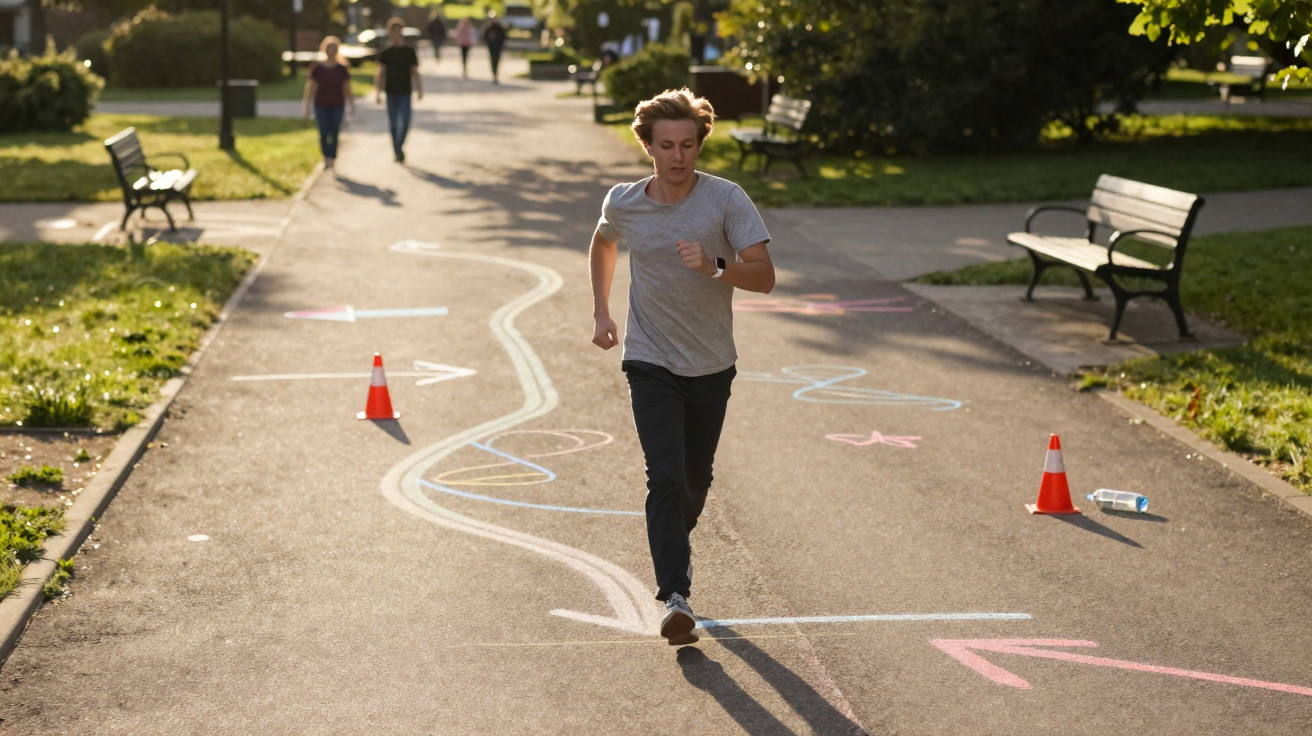
He pivots about 90 degrees, cuts straight across the square, turns back, and then-out of nowhere-threads his way through the pedestrian area in a set of zigzags. A few people glance over, confused; others grin; an older woman gives a small, disapproving shake of the head. I stop, curious, tracking his odd route-until I notice the running kit, the smart watch on his wrist, the headphones in his ears. This isn’t someone wandering aimlessly; it looks much more like a deliberate trial.
Later I find out: more and more movement specialists are recommending exactly these sorts of changes of direction in everyday life. Not just for athletes, but for ordinary people like you and me. Sounds a bit strange? Maybe. Yet it’s more than a passing fitness fad-much more.
Why walking in only one direction under-challenges the body
If you live in a big city, you’ll know the scene: endless streams of people moving in straight lines, one foot after the other, optimised to get from A to B as efficiently as possible. Your eye gets used to it quickly, and before long that linear way of moving feels completely normal.
But that “normal” is precisely the issue. We weren’t designed to spend hours walking as if we’re on rails. Our bodies thrive on unpredictability-ever since the days when we navigated roots and stones and pushed through long grass. Long, straight stretches can leave the deep stabilising muscles almost dozing, while joints tick along on autopilot. Comfortable, yes. Over time, often costly.
A sports scientist once told me about a study involving office workers who walked the same routes day after day: home, train, office, supermarket, home again. After a few months, many of them showed strikingly similar patterns-tight hips, stiff ankles, knees taking uneven loads. The problem wasn’t a lack of movement as such; plenty of them still hit 8,000 steps a day. The real snag was the sameness. Hardly any changes of direction, almost no lateral impulses, and nothing unexpected for the nervous system.
One participant summed up their walking perfectly: “Like a straight line in my head.” And there’s data behind the wider trend: in urban settings, knee problems among the under-40s have been rising for years-even as they track more “steps” than any generation before them.
Biomechanics researchers put it bluntly: if we always walk the same way, we only tap into part of our muscles’ movement potential. Quadriceps, calves, glutes-they do their work, of course. But the lateral stabilisers-the smaller helpers around the hips and ankles-remain chronically under-used. Over time that can create imbalances, meaning strength and stability no longer match up.
At the same time, the brain has little to do, because the movements are predictable and automated. Routines can feel safe-but the trade-off is often a body that works, yet isn’t really switched on.
How to build changes of direction into walking without feeling self-conscious
The reassuring part: you don’t need to weave through packed high streets like you’re running a slalom. Even modest, intentional direction changes can “wake up” your system.
One simple approach is to break your route into segments. Walk the first 200 metres as you normally would. Over the next 100 metres, add two or three deliberate direction changes-angle slightly across the pavement, take a short curve around a bench, cross the square diagonally instead of marching along the edge. Then go back to 200 metres of ordinary walking. That creates a small, repeatable rhythm: it doesn’t disrupt your day, but it does give your body fresh input.
For many people, the first hurdle is mental: “Everyone will stare if I start walking oddly.” Fair enough. We all know that gym moment when you try something new and suddenly feel as though you’re under a spotlight. Let’s be honest-nobody does this every day without occasionally rolling their eyes internally.
A practical trick is to begin somewhere you don’t care: in a park, on an empty car park, or on the short walk to the wheelie bin. At first, give yourself permission to overdo it slightly just to learn the sensation of side-steps, a few backwards steps, or a tight turn. Over time, you’ll make it subtler-but you’ll also become far more coordinated.
A physiotherapist from Berlin put it to me in plain terms:
“Anyone who never changes direction trains their system to be single-track-and then wonders later why the body complains at the slightest deviation.”
If you want to translate that into daily habits, small prompts and simple structures can help. For example:
- At the next traffic-light wait: take two steps sideways, then carry on straight-an invisible micro-workout.
- In the park: don’t always take the “proper” path; choose curves and diagonals on purpose, as long as you’re not getting in anyone’s way.
- At home: on the walk from sofa to kitchen, add a tight turn around the coffee table.
- At lunchtime: five minutes of a “play-walk”-slow down, switch direction, try a few backwards and sideways sections.
- Once a day: tweak a familiar route slightly-other side of the street, a different shortcut, a different bend.
What changes of direction do to your mind-and your everyday life
When specialists talk about switching direction, they rarely mean muscles and joints alone. Many also describe a shift in the head. If you stop walking stubbornly straight ahead all the time, you’re less likely to behave internally like you’re on a motorway with no exits.
Choosing to change direction creates a brief moment of attention-almost like rebooting. Suddenly you’re back in touch with your body: Where am I placing my foot? What does my knee feel like? Where am I in space right now? This more alert style of walking can feel like a quiet refusal of the constant “go, go, go” of everyday life.
What’s especially interesting is how quickly this experiment can spill over into other areas. Someone who starts taking a different way home may soon try a new café, sit somewhere else on the train, or approach a conversation differently. It sounds minor, but it follows a pattern: external changes of direction remind us we’re not bolted to an invisible track.
After a few weeks, many people report that they feel more mobile-not just physically. Less stuck in routines, a touch braver with small choices. It isn’t magic; it’s more like a quiet practice in loosening rigid grooves.
In the end, this is about a question far bigger than the angle of your foot on the pavement: how much room do we allow ourselves on an ordinary Tuesday? Do we move from appointment to appointment as if through a tunnel, or do we make space for tiny detours-for two unexpected steps to the side?
Changing direction while you walk is almost a small metaphor worth sitting with. If you notice that a gentle swerve on the pavement eases your hips, you might also sense that a gentle swerve in a life plan is sometimes exactly what the soul needs. No drama, no radical reset. Just a different angle. A different view. And suddenly the same route doesn’t feel quite so tight.
| Key point | Detail | Benefit for the reader |
|---|---|---|
| Changes of direction activate neglected muscles | Sideways and diagonal steps wake up stabilising muscles in the hips, knees and ankles | Reduces one-sided strain and can help prevent typical desk-job issues |
| Small everyday tweaks are enough | Zigzags in the park, curves instead of straight lines, a different route to the supermarket | Health benefits without extra workouts or expensive kit |
| Walking becomes a mental reset | Deliberate direction changes pull you out of autopilot and strengthen body awareness | More clarity, less tunnel vision, fresh perspective in day-to-day life |
FAQ:
Question 1
Do changes of direction while walking really help if I barely do any sport otherwise?
Yes-especially then. Just a few targeted direction changes per day give your body stimuli that are completely missing from a mostly seated routine, and they’re a gentle way into moving more.Question 2
Could sideways steps or zigzag walking cause injury?
If you start slowly, wear stable footwear, and don’t have acute joint problems, the risk is low. If you’re unsure, a quick check-in with a physiotherapist or your GP is worthwhile.Question 3
How often should I change direction while walking for it to make a difference?
A simple, practical target is: on any longer walk (from about 5 minutes), include two or three deliberate direction changes-sideways, diagonal, or a tight curve.Question 4
Is this suitable for older people or people who are overweight?
Yes, as long as the steps stay small, controlled and pain-free. For these groups in particular, gentle, varied walking can be a joint-friendly form of training.Question 5
Does this way of walking help with stress?
Many people find it does: because attention shifts onto movement, mental noise drops, rumination loops ease, and you feel more grounded.






Comments
No comments yet. Be the first to comment!
Leave a Comment