
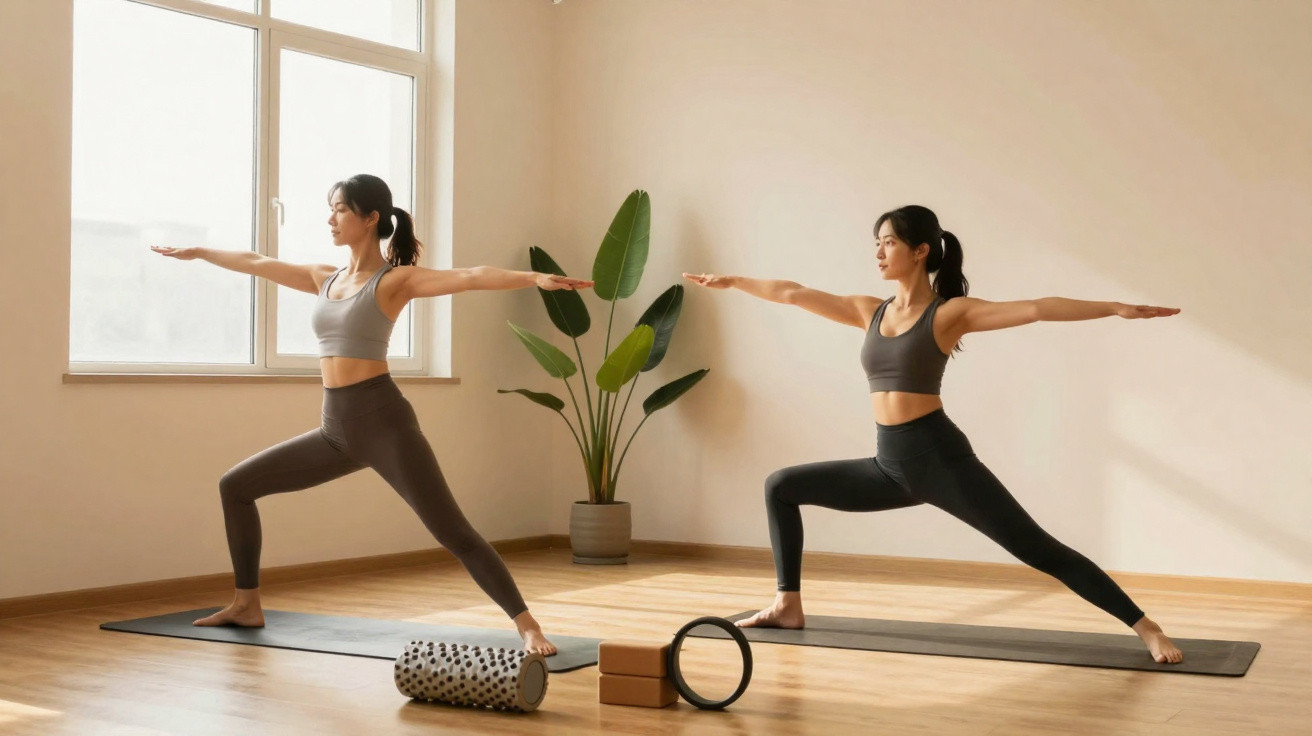
On the left, two friends unroll their yoga mats: barefoot, in colourful leggings, quietly giggling. To the right, someone adjusts a Pilates Reformer with focused attention; straps are being set and a faint metallic hum fills the air. One half of the room is breathing slowly and deeply, while the other counts repetitions with intense concentration. Two worlds sharing one space. Somewhere between them, you are sitting and wondering: which one actually suits my body – and my life?
Pilates vs. Yoga: two methods, one shared aim
Spend any length of time watching a studio and it soon becomes clear that yoga and Pilates often appeal to the same people. They are people who recognise that desk work, stress and constantly looking at a phone eventually take their toll. Both approaches promise greater body awareness, strength and a calmer mind. Yet their atmosphere could hardly feel more different. In yoga, a candle may flicker while someone breathes with their eyes closed; the Pilates instructor, meanwhile, counts crisply: “Three more. Two more. Hold. Breathe.” Different languages, but the same desire: to reclaim your own body.
Picture Berlin-Mitte on an autumn Tuesday evening. The after-work yoga class is fully booked: 26 people packed closely together for Vinyasa Flow. The teacher guides them through sun salutations; foreheads are sweaty, and some wobble from downward dog into an unsteady plank. Next door, there are just eight people doing mat Pilates, with every movement precisely instructed. While one person next door tries not to topple in Warrior II, the Pilates coach quietly adjusts the pelvis of the participant in position three. By the end, everyone leaves the studio red-cheeked. The yogis look slightly blissed-out, whereas the Pilates group appears alert and taller, as though an internal cord has been pulled taut.
The distinction starts at the roots. Yoga comes from an Indian tradition thousands of years old: a complete system of physical postures, breathwork, meditation and, at times, philosophy. Pilates, by contrast, is a relatively recent 20th-century creation by Joseph Pilates, originally designed as rehabilitation training for injured dancers. Yoga relies heavily on stretching, balance and a deliberate slowing down from everyday life. Pilates centres on the powerhouse – the deep abdominal and core muscles – and control in every single movement. Either can support the back, lower stress and improve sleep. The real question is whether you would rather tune inwards or “rewire” your body like an intelligent, sensitive system.
Who should choose which – and when Pilates or yoga works best
If you have back problems, spend much of the day seated or want to feel like yourself again after pregnancy, Pilates is often the more straightforward choice. Its exercises are designed to activate the deeper muscles around the spine and pelvic floor. The well-known Pilates breath, or ribcage breathing, helps with this: breathe into the sides of the ribcage as you inhale, then engage the abdomen as you exhale. Movements are small, controlled and almost microscopic. This can be especially reassuring for people who feel lost in a conventional gym: you receive clear cues, manageable sequences and quickly noticeable results, particularly in the lower back and posture.
Yoga is especially well suited to anyone who feels constantly “wired”. Its combination of stretches, held poses and intentional breathing can act as a mental reset. After a few weeks, many people find that they react more calmly, sleep better and no longer explode over every small thing. Let’s be honest: nobody willingly sits in Chair Pose for 60 seconds or holds a long plank simply to “grow spiritually”. People keep going because those minutes leave the body feeling different afterwards. For those prone to overthinking, inner restlessness or in need of a ritual, a regular yoga practice can become a steady anchor.
“Pilates builds you from the inside out. Yoga brings you back from the outside in.”
This line comes back to me repeatedly when I ask people about their experiences. It becomes particularly interesting when the benefits are considered in concrete terms:
- Pilates chiefly strengthens the core, pelvic floor and deep musculature – making it ideal for back pain, postural issues and recovery after injuries.
- Yoga improves mobility, balance and the nervous system – useful for stress, tension and sleep difficulties.
- Both methods can help manage weight, although not through burning calories; rather, through improved body awareness and less stress-related hunger.
- People who are very stiff often feel safer starting with Pilates before moving into yoga with greater ease.
- Anyone carrying a lot emotionally may find more respite in gentle yoga classes than in a structured Pilates countdown.
How to make your choice – and why combining them is often smartest
Here is a highly practical approach: take four weeks to test them deliberately – two weeks of Pilates and two weeks of yoga, with one or two sessions each week. Afterwards, write down a clear-headed assessment: how does my back feel in the morning? What about my neck by the evening? How quickly can I switch off mentally again? This mini self-study may sound demanding and perhaps take eight hours in total. But its impact can be far greater than any generic piece of online advice. The body rarely lies: if you walk taller after a Pilates session or sleep more deeply after yoga, that is a clear vote.
Many people make the mistake of letting Instagram images guide them: hyper-flexible yogis in the splits and Pilates bodies with ultra-defined abs. Looking at it from the outside can be paralysing. What truly matters is what your body can do NOW – and what you can maintain regularly. If the thought of “Om” already makes you switch off internally, creating a yoga studio routine will be difficult. If the sound of a Reformer stresses you, you are unlikely to attend consistently. Give yourself permission to be honest: what appeals to you more instinctively, and where do you feel less resistance? Your nervous system remembers every experience – and helps decide whether you stick with it.
“The best method is the one you still go to on a bad day.”
For many people, an intelligent combination is ideal:
- One Pilates session each week for posture, back health and core stability.
- One quieter yoga session, such as Yin or Hatha, for the nervous system, sleep and joints.
- Highly active people can use Pilates as “secret training” to prevent injuries.
- Those doing a lot of mental work can treat yoga as a weekly reset button.
- And: attend a workshop once a year – it deepens technique and prevents poor habits from creeping in.
This creates not a rigid plan, but a living system that adapts to your life – rather than the other way round.
What remains when the hype has passed?
Eventually, the day will come when “Pilates vs. Yoga” is no longer a trending subject. Studios will close, new methods will emerge, and TikTok will have long since announced the next wave of body hacks. What will remain? Probably not so much the label attached to the method, but the ritual of genuinely caring for your body once or twice a week. The quiet moment when, for the first time that day, you notice your feet standing on the floor. The instant when you achieve a movement that seemed impossible three weeks earlier.
Many of the people I have followed for features do not ultimately settle into either camp. They say things such as: “I go to Pilates on Mondays for my back and yoga on Thursdays for my head.” At that point, the argument about which is “better” suddenly seems remarkably theoretical. What is real is the body after a long office day, the mind after a week of deadlines, and the neck after too much phone use. Equally real is the small pleasure of realising: I can actively do something instead of simply complaining. Perhaps that is the quiet core of yoga and Pilates: the experience that change does not come from grand resolutions, but from those 50 minutes when you arrive at the studio on time and lie down on your mat.
| Key point | Detail | Benefit for the reader |
|---|---|---|
| Similarities between Pilates and yoga | Both improve body awareness, posture and can reduce stress. | Understands why the two can often feel similar and takes the pressure out of choosing. |
| Differences in focus and origins | Pilates: centred on the core and stability, a modern method. Yoga: an ancient practice involving stretching, breathing and sometimes philosophy. | Identifies which method is better suited to back health, mobility or mental strain. |
| Individual strategies | A short four-week trial, honest self-observation and the option of combining both. | Receives a practical everyday route to finding a personal routine without dogma. |
FAQ:
- Is Pilates better for the back than yoga? Pilates targets core stability and deep musculature more directly, which can quickly help many people with back pain. Gentle yoga can also relieve tension, but works less technically on the deep muscles.
- Can I lose weight with yoga or Pilates? Both burn calories, but neither is a classic “fat-burning” workout. Many people still lose weight because stress falls, cravings lessen and they become more active overall.
- What is better for complete beginners? It depends on your personality: people who like structure often feel more comfortable with Pilates, while those seeking calm and stretching may prefer yoga. A trial class in both usually makes everything clear.
- How often should I do Pilates or yoga each week? Two sessions per week produce noticeable effects. One session is better than none, while three are ideal if your routine allows it and you do not feel drained afterwards.
- Can I practise both at the same time? Yes, many people benefit from exactly that: Pilates for strength and stability, yoga for mobility and the nervous system. One or two sessions of each method suit most people well.



Comments
No comments yet. Be the first to comment!
Leave a Comment