
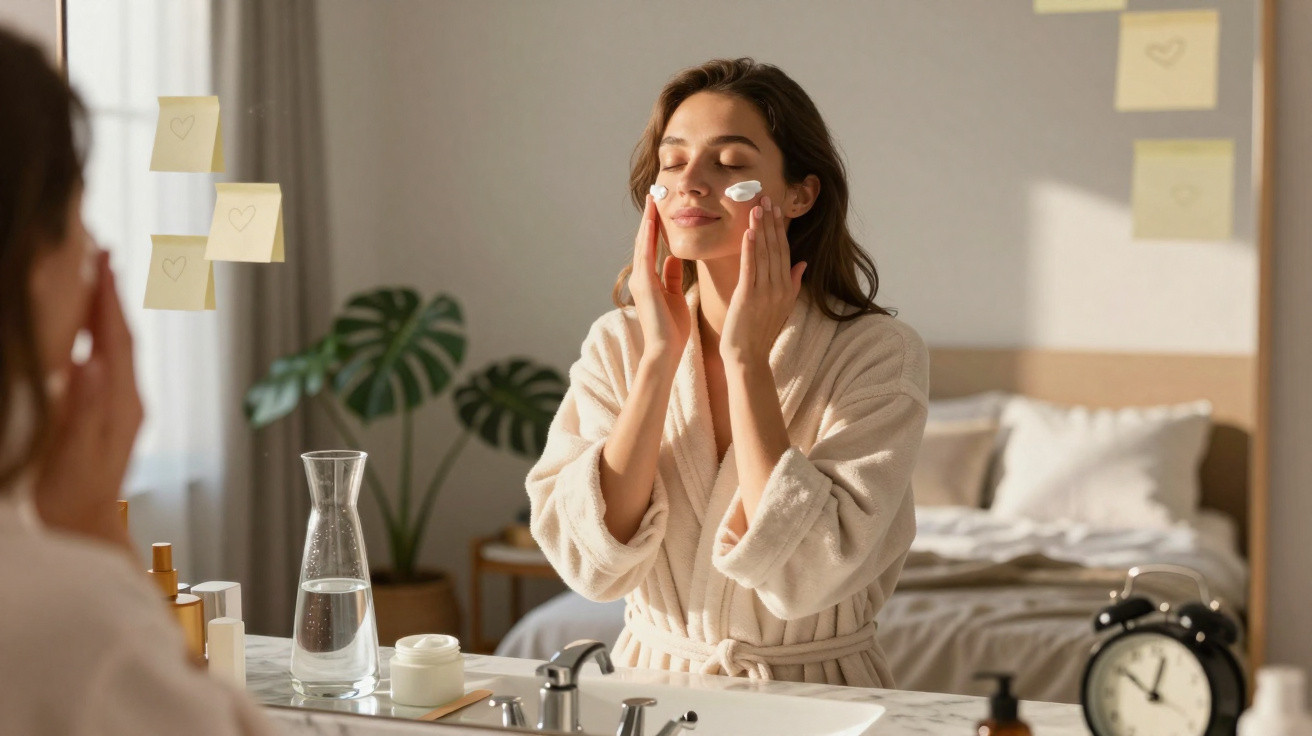
The first time it really hit me was looking around a train carriage: hands glued to phones, faces washed in blue screen-light - and, in between, tight, thirsty skin, cracked knuckles, tiny flakes at the neck. No one seems to notice; everyone keeps scrolling. The air conditioning blows, the heating’s on, wind outside, neon light inside. And our skin? It just goes along with it. Quietly. Without complaint. Until, one day, it does speak up - through itching, redness, and fine lines that show up earlier than we’d like.
So we buy pricey serums, flashy masks, specialist products for every pore. Yet the simplest thing slips in everyday life: moisturising regularly. It’s almost ridiculous. And it still happens all the time.
Why we keep “forgetting” to moisturise
In the bathroom there’s a half-used bottle of body lotion; next to it, a face cream that’s meant to be applied “morning and evening”. On the shelf there’s hand cream. Somewhere in a bag, a travel-sized tube. The products exist - what’s missing is the routine.
Plenty of people say they “don’t have time”, even though they’ll still spend 20 minutes tapping through Instagram at night. We all know that moment: you’re already in bed and you think, “Oh right - moisturiser… tomorrow.” Tomorrow rarely arrives. Daily life swallows small care rituals before they ever become habits. And the skin pays for it - quietly, over the long term.
Anna, 34, works in an office and commutes by train every day. She has atopic eczema, and her skin reacts strongly to dry, heated indoor air. Her dermatologist advised her to moisturise her whole body at least once a day - and twice a day in winter if possible. She nodded at the clinic, even bought a large bottle of medical lotion. Two weeks later, it was still almost untouched in the bathroom, the pump dispenser gathering a fine layer of dust. On stressful days she just about manages to remove her make-up. Body lotion? “I just don’t have the headspace for that,” she says. Surveys suggest that more than a third of people in Germany only moisturise their body occasionally, and many do it only in summer. In winter, our skin is essentially running in low-power mode.
Part of the problem is rooted in how we perceive skincare: it’s invisible, slow, and not especially dramatic. If you take a tablet for a headache, you usually feel relief within an hour. Moisturising rarely delivers that kind of instant “wow” moment. There’s no fireworks display, no overnight transformation. The benefits build gradually - and because nothing “big” happens, it drops down the priority list.
On top of that sits an old pattern: many of us learned that care is something “luxurious”, not a basic need. If you moisturise, you’re doing “wellness”; if you don’t, you’re simply being practical. The fact that skin is our largest organ and our shield against the outside world remains a piece of theory - not something we feel, day to day.
How to turn moisturising into a genuine everyday ritual
The real trick isn’t adding more products - it’s removing decisions. If you have to decide from scratch every time whether you’ll moisturise, tiredness and convenience will win. What works far better is a fixed anchor in your day.
For instance: moisturise immediately after showering, while you’re still wrapped in a towel, before you even pick up your phone. Or: apply hand cream every time after brushing your teeth at night. That way, skincare is linked to a habit that already exists. Keep it to one product, placed where you can’t miss it, ideally with a pump dispenser. No rummaging in drawers. No ten different tubes that are all “kind of good”. A simple, clear ritual beats a complicated bathroom shelf every time.
A lot of people fall at the hurdle of unrealistic standards. They plan to moisturise their entire body every day - complete with a massage, scented candles, and a self-care playlist. Lovely in theory; it lasts exactly three days. Let’s be honest: hardly anyone truly does that daily. But if you say, “Right, I’m starting with my shins and hands,” you’ve already made progress. Dry patches calm down, and the good feeling follows naturally.
Another common misstep is choosing a cream that’s too rich - it shines, it feels sticky, and then getting dressed becomes annoying. Jeans catch on your thighs, and suddenly the motivation is gone again. A better choice is a texture that sinks in quickly, even if it isn’t “Instagram-pretty”.
I hear one sentence all the time: “My skin is just like this - it’s dry.” As if it were a personality trait, not a changeable condition.
“Most people underestimate how much consistent moisturising can soothe their skin barrier. It’s not the most expensive cream that makes the difference, but the one you genuinely use every day,” says a dermatologist who has supported patients with chronically dry skin for years.
The plain truth: our skin isn’t asking for perfection - it’s asking for consistency.
- Start small: 2 minutes every day beats 20 minutes once a month
- Choose a neutral, low-fragrance cream you like and tolerate well
- Put the cream where you’ll see it: by your toothbrush, by the bed, or directly in the shower
- Pair moisturising with something pleasant: music, a podcast, a short breathing exercise
- Treat dry patches not as a “flaw”, but as a signal from your body
What our skin is really trying to tell us
If we look properly, our skin tells a detailed story about our lives. The cracked hands of a care worker who has to disinfect constantly. The scaly forearms of people spending all day in air-conditioned offices. Lips that split the moment the central-heating season begins. These are all signs that the natural protective layer is under strain.
In that context, moisturising isn’t merely cosmetic - it’s small-scale repair work, a little bit each day. No big drama; more like washing up or brushing your teeth: unglamorous, but decisive over time.
We live in an era where people talk endlessly about “self-care” - breaks, retreats, detoxes. Yet many forget the simplest form of daily, physical contact with themselves. One conscious minute spent moisturising can be more grounding than the eighth mindfulness post on social media.
It’s the moment you notice: “There’s a dry patch on my elbow - it feels rough.” That’s closeness to yourself, not just a beauty habit. And perhaps that’s exactly why so many people put moisturising off: contact with your own body can feel unfamiliar - almost intimate.
If that idea touches something as you read, you’re not alone. Many people feel a quiet shame about dry skin: they hide their hands, wear long sleeves, avoid looking at their legs. But this isn’t about imperfections - it’s about signals.
The interesting question is this: what would happen if we all took those small signals more seriously, before dryness becomes cracks, cracks become inflammation, and discomfort becomes a constant theme? Perhaps it really does start with tomorrow morning - when the body lotion isn’t just sitting on the shelf, but actually gets used.
| Key point | Detail | Benefit for the reader |
|---|---|---|
| Moisturising is often underestimated | Skincare works slowly and without spectacle, so it slips down the daily to-do list | Better understanding of why routines don’t stick - and less guilt |
| Rituals instead of resolutions | Link moisturising to existing habits, e.g. after showering or brushing your teeth | A practical strategy to keep care consistent |
| Small steps, big impact | Start with just a few areas, choose the right texture, take the pressure off | An everyday-friendly way in that supports the skin barrier over time |
FAQ:
- How often should you actually moisturise? For most people, once a day after showering is enough. If your skin is very dry or sensitive, a second round in the evening can be helpful.
- Is it enough to moisturise only your face? Your face benefits, but the rest of the body ages and dries out too - especially shins, hands, and elbows need care.
- Does moisturising often make skin “lazy”? No. A healthy skin barrier needs support, particularly with dry central-heating air, frequent washing, and friction from clothing.
- Which cream is most practical for everyday use? A light, low-fragrance lotion that absorbs quickly and doesn’t leave residue on clothes is most likely to be used consistently.
- What if you simply keep forgetting to moisturise? Put the cream in plain sight, attach it to an existing routine, and begin with just one area until it feels more automatic.



Comments
No comments yet. Be the first to comment!
Leave a Comment