
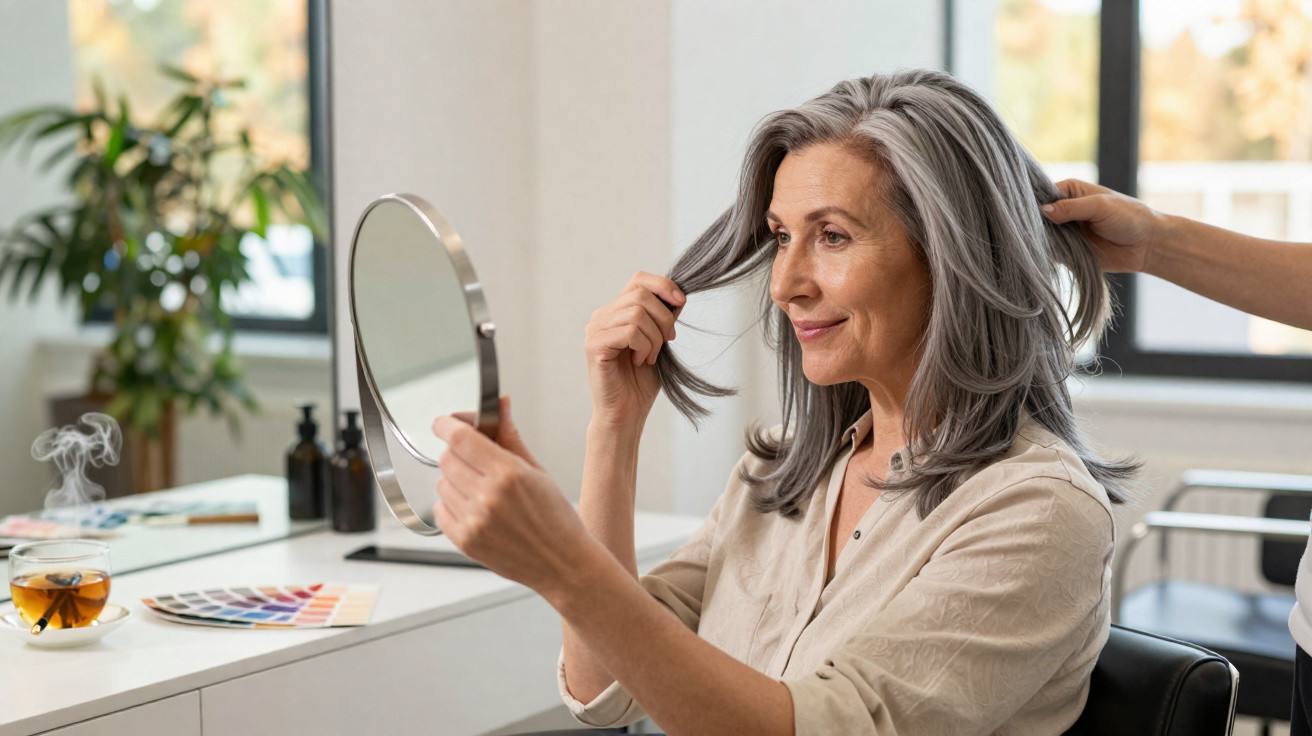
Grey hair no longer pushes so many people into a closed-box dye appointment every month. In salons, the conversation has shifted, and gray blending has become more common because it creates a soft transition between the roots, lengths, highlights and reflections. The finish avoids that flat, uniform block of colour and tends to look better as the hair grows.
Why is gray blending showing up so often in salons?
Gray blending is a colouring technique that combines cool-toned shades, very fine highlights and strategic depth to weave grey strands into the rest of the hair. Rather than masking everything with an opaque layer, the colourist builds contrast, nuance and placement so the regrowth line is less obvious.
In day-to-day terms, that changes the upkeep. Because the gap between natural growth and coloured lengths isn’t as stark, top-ups are usually needed less often. For people whose grey is concentrated at the hairline or crown, this kind of placement often looks lighter and more in tune with the hair’s texture.
What changes compared with traditional dye?
Permanent dye is designed for full coverage, laying down pigment evenly. Gray blending, by contrast, allows tonal variation and treats grey strands as part of the look. That affects not only how it looks, but also how you schedule appointments, because the roots don’t “give away” the last visit as quickly.
Before deciding, it’s worth comparing the two approaches in clear terms:
- with full coverage, regrowth tends to create a more visible line
- with gray blending, highlights break up the divide between grey and the base colour
- a solid, all-over dye generally requires more frequent reapplication
- the blended effect often suits layered cuts and movement better
Can people with lots of grey hair go for this natural effect?
Yes - but the technical plan matters. When the percentage of grey is already high, the professional looks at the natural base, strand thickness, porosity and how the greys are distributed to choose between highlights, lowlights, toning or a gloss. The aim isn’t to hide everything; it’s to create a colour map that keeps the transition looking polished.
Curly, wavy and straight hair reflect light in different ways. With natural bend or curl, the blend often reads even more believable because the shine shifts with volume. On very dark bases, it may be necessary to soften contrast gradually to avoid creating noticeable bands around the face.
Which aftercare helps the result stay looking better for longer?
After colouring, maintenance isn’t only about returning to the salon. A natural-looking finish relies on shine, a smoother cuticle and keeping yellow tones under control - especially when grey strands sit more exposed between highlighted pieces. Very stripping products or harsh washing can dull the nuance and leave the surface feeling rough.
A few habits can help extend the finish without adding much effort:
- use a gentler shampoo and a mask that replenishes lipids
- protect hair from heat from a hairdryer, straighteners and hot tools
- use a purple/toning product only when there is genuine yellowing
- refresh shine with a soft toner, instead of recolouring everything
How should you talk to your colourist to avoid regret?
Bringing visual references is useful, but the consultation needs to go beyond a photo. Share how long you’ve been colouring your hair, where the grey shows up first, how often you can realistically return to the salon, and how much contrast you’re comfortable seeing in the mirror. Those details guide the technique, the level of tone, the maintenance interval and the amount of highlighting.
When the plan respects your natural base, hair density and care routine, it tends to look better between appointments. That’s why gray blending is gaining ground: it approaches colour, roots, shine and texture as one package, without forcing the whole head of hair to stay tied to a rigid monthly coverage schedule.




Comments
No comments yet. Be the first to comment!
Leave a Comment