
The woman ahead of me in the pharmacy stared at a box of hair dye as if it had personally offended her. Loyalty card clenched in one hand, phone in the other, she grumbled, “Twenty euros… again?” A second later, another viral clip flashed up: someone insisting her natural hair colour had “come back” without dyes, without salons-just a bargain conditioner hack. No harsh chemicals. No appointments. Just a bottle cheaper than a coffee and croissant.
All around us, the aisles of permanent colour, root cover sprays and toners suddenly felt… dated. The unspoken thought hung there: what if going grey isn’t a permanent surrender, just a stage? What if the solution isn’t in a colour kit, but in your shower routine?
The stranger slid the dye back onto the shelf.
I watched-and I got why this so-called “miracle” is making people a bit obsessed.
Millions are ditching dye: the grey hair rebellion nobody saw coming
Open TikTok or Instagram for long enough and you’ll find them: slick makeover reels where wiry greys appear darker, softer, almost as though the old shade is slowly returning. The name most often used is the “conditioner reversal”-a budget routine that supposedly encourages pigment to come back into the hair. No ammonia, no developer, no box dye. Just a supermarket conditioner and a lot of patience.
Underneath the trend is simple exhaustion. People who have coloured their hair faithfully for 10, 15, 20 years are now doing the maths: the expense, the hours lost, the irritated scalp, the scorched chemical smell that seems to linger in the bathroom for days. Against that backdrop, the idea that conditioner could undo the whole cycle feels part fairy tale, part quiet revolt.
Consider Louise, 49, from Manchester. Her before-and-after video has sailed past two million views. In the first clip, her regrowth is silvery and peppered, a stark border between “old” and “young”. Six months on, her hair looks more supple, a touch deeper at the temples, less like a solid sheet of grey and more like a salt-and-cinnamon mix. She insists she used no dye at all-only a cheap chemist conditioner with plant oils and caffeine.
The comments section quickly turns into a tug-of-war: some beg her to “drop the brand name”, while others shout “filters” and “lighting tricks”. Dermatologists step in carefully, pointing out that pigment-producing cells don’t simply reboot because a product has gone viral. The whole thread reads like a courtroom, with every hair strand treated as evidence.
So what is actually going on? Grey hair appears as melanocytes-the cells that supply pigment to each hair-slow down or stop. Genetics, age, stress and inflammation can all contribute. When a follicle has fully stopped making melanin, no conditioner can flip it back on like a switch. That’s the less glamorous reality.
Still, hair is brilliant at creating optical tricks. When fibres are well hydrated and smoothed down, they reflect light in a different way. On top of that, yellowish build-up from pollution, hard water, or remnants of old colour can make grey look dull, flat and nearly white. Remove that film, coat the cuticle with softening ingredients, and perhaps add a faint surface tint from botanical extracts, and the grey can look deeper and richer-closer to the shade you remember. Often, that’s the quieter truth behind the “miracle”.
The cheap conditioner trick everyone is arguing about
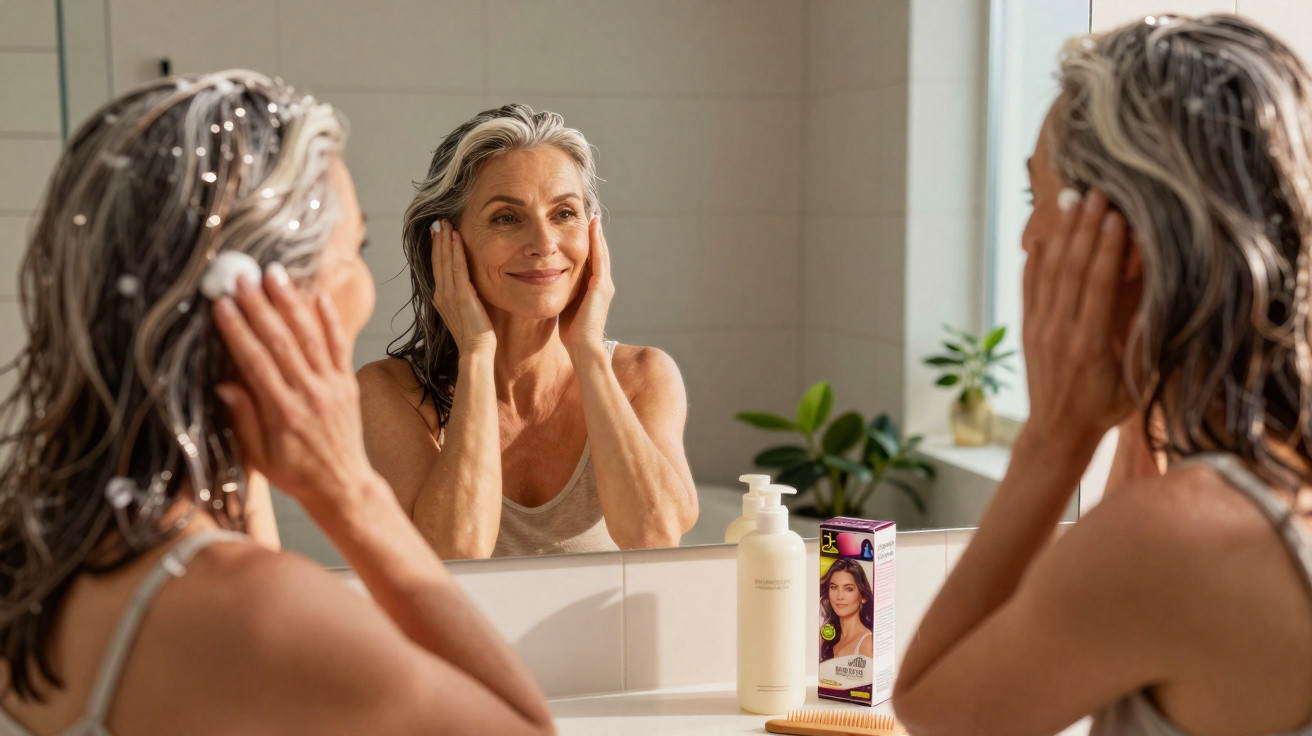
This is the routine people swear by-usually shared in comment threads or chaotic bathroom selfies. Rather than a rushed 30-second rinse-out, they treat conditioner like a mask. A thick, low-cost conditioner-often one featuring ingredients such as amla, rosemary, caffeine or henna derivatives-is worked through slightly damp hair from roots to ends.
Then it’s left to sit: 10 minutes, 20 minutes, and for some people up to an hour once or twice a week. Hair is wrapped in a towel or a plastic cap so steam from the shower or body heat helps the product settle into the cuticle. Rinsing is done gently-sometimes with cooler water-to lock in shine. The claim isn’t instant transformation, but a gradual toning-down of harsh grey over a few weeks.
Those who rate the method talk as much about feel as they do about colour. Grey hair can be rough, dry and determinedly frizzy. With time, these longer conditioning sessions can leave strands smoother, weightier and easier to manage. When hair sits flatter and reflects more light, the divide between “grey” and “natural brown” or “dark blonde” looks less abrupt.
Many people also steer clear of stripping shampoos and sulphates, which can lift the cuticle and remove natural oils-making greys stand out more. Others massage the scalp with the same conditioner, betting that improved circulation might support whatever pigment activity remains. Realistically, few keep it up every single day. As a weekly ritual, though, it feels doable-and oddly soothing.
Online, the debate has split into two loud camps: one convinced their original colour is returning, the other certain it’s all placebo, angles, lighting and filters. Between them sit the quieter voices trying to pin down what’s genuinely happening.
“I don’t think my grey literally disappeared,” says Carla, 56, who started the trick after chemo left her hair fragile and pale. “But my hair doesn’t scream ‘grey’ anymore. It looks like me again. If that’s nonsense, I’ll happily keep my nonsense.”
- Pick function over promises
Go for an inexpensive conditioner with nourishing oils, without overpowering fragrance and without strongly drying alcohols. - Be consistent, not obsessive
Using it once or twice a week as a mask is more effective than a frantic month of daily testing. - Watch for tone changes
Some botanical formulas can nudge grey warmer or cooler; try a small section first. - Listen to your scalp
If you notice itching, burning or increased shedding, stop and swap to a different product. - Pair it with lifestyle tweaks
Sleep, stress and diet can affect how quickly new greys appear, even if they don’t “reverse” existing ones.
Miracle or myth? What this trend really reveals about us
When you strip away the clickbait, this isn’t really a story about melanin-it’s a story about agency. Most people recognise the moment: you catch a new cluster of greys in the bathroom mirror and it feels like a small betrayal. The notion that a €3 conditioner could undo that betrayal is both absurd and completely human.
Yes, plenty of “back to natural colour” photos come down to better light, healthier hair, and more flattering angles. Yes, some products quietly include semi-permanent tint that clings to grey the way tea stains a mug. But beneath the hype is something softer: a growing acceptance that people can experiment with ageing instead of disguising it at all costs. Some will keep colouring. Some will embrace full silver. Others will stay in the messy middle-armed with a conditioner mask and a hopeful streak. Maybe the real miracle isn’t a shade shift, but having permission to choose.
| Key point | Detail | Value for the reader |
|---|---|---|
| Conditioner “miracle” is mostly optical | Hydration, smoothing and mild plant pigments can make grey appear darker and richer without genuinely restoring melanin | Helps set realistic expectations and prevents disappointment or expensive product-chasing |
| Cheap, consistent care beats harsh dye cycles | Weekly conditioner masks, gentle shampoos and scalp massage improve texture and shine | Offers a low-cost routine that’s sustainable over the long term |
| Emotional comfort matters as much as science | Feeling more “like yourself” can come from small rituals, not only dramatic colour changes | Encourages readers to choose what feels right rather than following viral claims |
FAQ:
- Question 1 Can a conditioner really bring my natural hair colour back after it’s gone grey?
- Answer 1 No. If a follicle has completely stopped producing melanin, an ordinary conditioner cannot restart it. What it can do is moisturise, smooth and lightly tint the surface so greys look softer and less noticeable.
- Question 2 Why do some people online show dramatic “before and after” photos?
- Answer 2 Many transformations combine improved lighting, filters, a fresh cut and consistent care over time. Some products also include plant-based staining agents or very mild dyes that shift tone subtly without being marketed as traditional hair colour.
- Question 3 Is there a specific ingredient I should look for in a cheap conditioner?
- Answer 3 Prioritise nourishing oils (argan, coconut, olive), humectants such as glycerin, and soothing ingredients like aloe or panthenol. If you’re comfortable with slight tone changes, gentle botanical extracts such as amla or henna derivatives can add warmth-particularly on lighter hair.
- Question 4 Can this trick prevent new grey hairs from appearing?
- Answer 4 No product can override ageing or genetics. Good scalp habits, lower stress, adequate sleep and solid nutrition may influence how quickly greys become obvious, but they will not stop them entirely.
- Question 5 Is it safer to try this conditioner routine than to keep using chemical dyes?
- Answer 5 For most people, a straightforward conditioner mask is kinder to the hair and scalp than frequent chemical colouring. Even so, patch-test new products and, if you have allergies or ongoing scalp problems, speak to a dermatologist or trichologist before changing your routine.


Comments
No comments yet. Be the first to comment!
Leave a Comment