
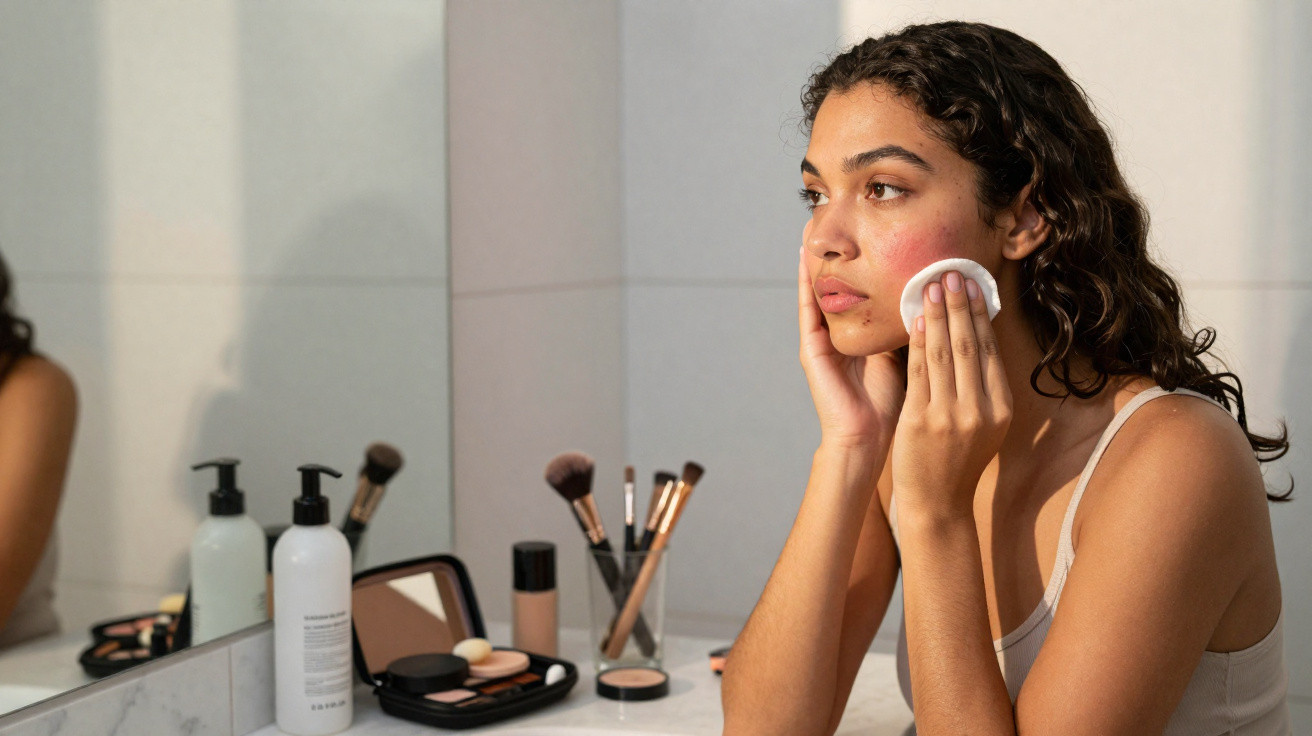
Hardly anyone realises it, but a daily make-up routine can take a real toll on your skin over the long term.
Foundation, concealer, powder - for many people they are as much part of the morning as coffee or brushing your teeth. Underneath it all, your skin is still trying to do its own job: protect you, renew itself and stay balanced. Putting make-up on every day interferes with that process - and the downsides often only become obvious once the issues have already appeared.
Why wearing make-up every day can knock your skin out of balance
Your skin isn’t a silent backdrop for cosmetics; it’s a living organ. It produces sebum, sheds old cells and continuously maintains a protective barrier. When it’s covered daily with several layers of make-up, that system can be thrown off.
"Many make-up products act like a film on the skin - leftover sebum and bacteria get trapped underneath and can multiply undisturbed."
Particularly problematic are:
- high-coverage foundations that promise “Full Coverage”
- long-wear formulas such as “24h” make-up
- mattifying products that heavily block sebum
They sit over the pores like a coating. Sebum can’t drain as easily, so it backs up - an ideal breeding ground for blemishes. If you’re already prone to acne or blackheads, you’ll often notice this effect even more.
Spots, redness, stressed skin: common day-to-day effects
A lot of people wonder why their skin becomes more “temperamental” over time, even though their skincare routine keeps getting more elaborate. Daily make-up use can contribute to a whole mix of problems developing.
Blocked pores and inflamed spots
When sebum is trapped under a make-up film, bacteria can build up in it. Pores become inflamed, leading to red, sore spots or deep, under-the-skin bumps. Areas that tend to be most affected are the ones where a lot of product is applied:
- cheeks and jawline
- forehead and sides of the nose
- around the mouth
Many people then reach for even heavier coverage to hide the new blemishes - which only tightens the screw on the problem.
Slow-building irritation from ingredients
A second driver is ingredients that irritate the skin without causing an immediate, obvious reaction. Common culprits are found in:
- fragrance, which can make skin more reactive
- preservatives, which can irritate at higher concentrations
- certain colour pigments, which can stress sensitive skin
Skin may feel tight, flush more easily, itch or sting - sometimes subtly, sometimes clearly. Over time this can turn into a persistently stressed state. The natural barrier becomes weaker, and the skin reacts more quickly to temperature changes, wind or friction.
Taking make-up off: the underestimated risk factor
The biggest mistake often doesn’t happen in the morning at the mirror, but at night when tiredness wins. If make-up isn’t removed properly, you take away the skin’s most important recovery window.
"If make-up stays on the skin overnight, it can’t properly renew itself during its regeneration phase - the effects range from spots to premature fine lines."
Over the course of the day, the skin accumulates:
- make-up residue
- sweat and sebum
- fine dust and airborne grime
- bacteria from hands, phones and brushes
If that isn’t removed carefully, the surface becomes clogged and stuck together. The complexion can look dull, grey and uneven. Over the long term, collagen production may slow down, and the skin can look tired and older sooner than it needs to.
What a sensible make-up removal routine looks like
If you wear make-up daily, evening cleansing needs to be more than a cotton pad with a bit of micellar water. Dermatologists usually recommend a two-step cleanse:
- oil or balm cleanser to dissolve make-up and sunscreen
- gentle gel or foam cleanser to wash away sweat, sebum and remaining residue
Important: use water that isn’t too hot, avoid harsh rubbing, and don’t use a strong exfoliant every night. Otherwise, the cleansing ends up doing more damage than the make-up itself.
How to wear make-up without ruining your skin
No one has to give up make-up completely. What matters is how you use it - that’s what determines how well your skin copes over time.
Choose lighter products
If you wear make-up every day, it’s worth choosing formulas that don’t further clog pores. Labels such as “non-comedogenic” can be a helpful hint, even though the term isn’t legally protected. Useful options include, for example:
- light tinted moisturisers instead of heavy, high-coverage foundation
- liquid textures with less of a silicone film
- BB or CC creams with skincare benefits and lighter coverage
Fewer layers mean lower risk: if you’re already using a well-formulated day moisturiser with sun protection, you don’t necessarily need a serum underneath, three boosters and then a heavy foundation on top.
Plan make-up-free days
Skin benefits hugely when it regularly gets to “breathe” - in other words, days when nothing sits on top of it. These breaks help the barrier recover and allow sebum to flow normally again.
"Even one or two make-up-free days a week can be enough for skin to look calmer, clearer and less patchy."
If going out completely bare-faced feels uncomfortable, start small: just mascara, just a tinted moisturiser, no heavy full-face make-up for the office - save it for occasions instead.
Hygiene: brushes and sponges as a breeding ground for bacteria
One detail many people underestimate: make-up can be top quality, but if the tools are dirty, a whole mix of germs ends up on your face.
| Tool | Recommended cleaning |
|---|---|
| Foundation brush | at least 1× per week, thoroughly with a mild shampoo |
| Beauty sponges | wash 2–3× per week, replace regularly |
| Eyeshadow brush | clean every 1–2 weeks |
When product residue remains in brushes, it mixes with sebum and dead skin flakes, and bacteria multiply quickly. Each new application presses that mixture into pores - a direct route to inflamed areas, especially along the jaw and on the cheeks.
The psychological pressure: not “presentable” without make-up?
Many people say they feel “naked” without make-up or worry they won’t be taken seriously, particularly at work. The mirror shows blemishes, redness, dark circles - all completely normal, yet often treated as flaws.
"Make-up can be empowering when it remains a choice - it becomes a problem when it feels like an obligation."
When you give your skin a bit more space, an unexpected shift often follows: over time, the skin tends to look more stable, the complexion more even, and the urge to cover everything can fade. That supposedly “perfect” foundation matters less because the skin itself looks calmer.
What terms like “occlusive” and “non-comedogenic” really mean
Two technical terms come up again and again in this context:
- occlusive: products with a strongly occlusive effect create an almost airtight film on the skin. They can lock in moisture, but they can also trap sebum. In skincare this can sometimes be useful (for example, with very dry skin), but with daily, heavy foundation it’s more of a concern.
- non-comedogenic: this label is meant to indicate that a product shouldn’t clog pores. Because the term isn’t strictly regulated, it’s worth paying attention to your own skin’s response: if blackheads and spots increase with a product, it simply doesn’t suit you - regardless of what the packaging claims.
Understanding these terms makes it easier to make smarter buying choices and tailor your routine more precisely to what your skin actually needs.
In the end, a lot of it comes down to one straightforward idea: make-up can be fun, highlight your features and soften insecurities. But your skin will thank you if it isn’t under multiple layers every single day, if it’s cleansed properly, and if it gets the occasional break with nothing on it at all. That’s when you see how much “glow” doesn’t come from a pot, but from skin that’s allowed to get on with its work.

Comments
No comments yet. Be the first to comment!
Leave a Comment