
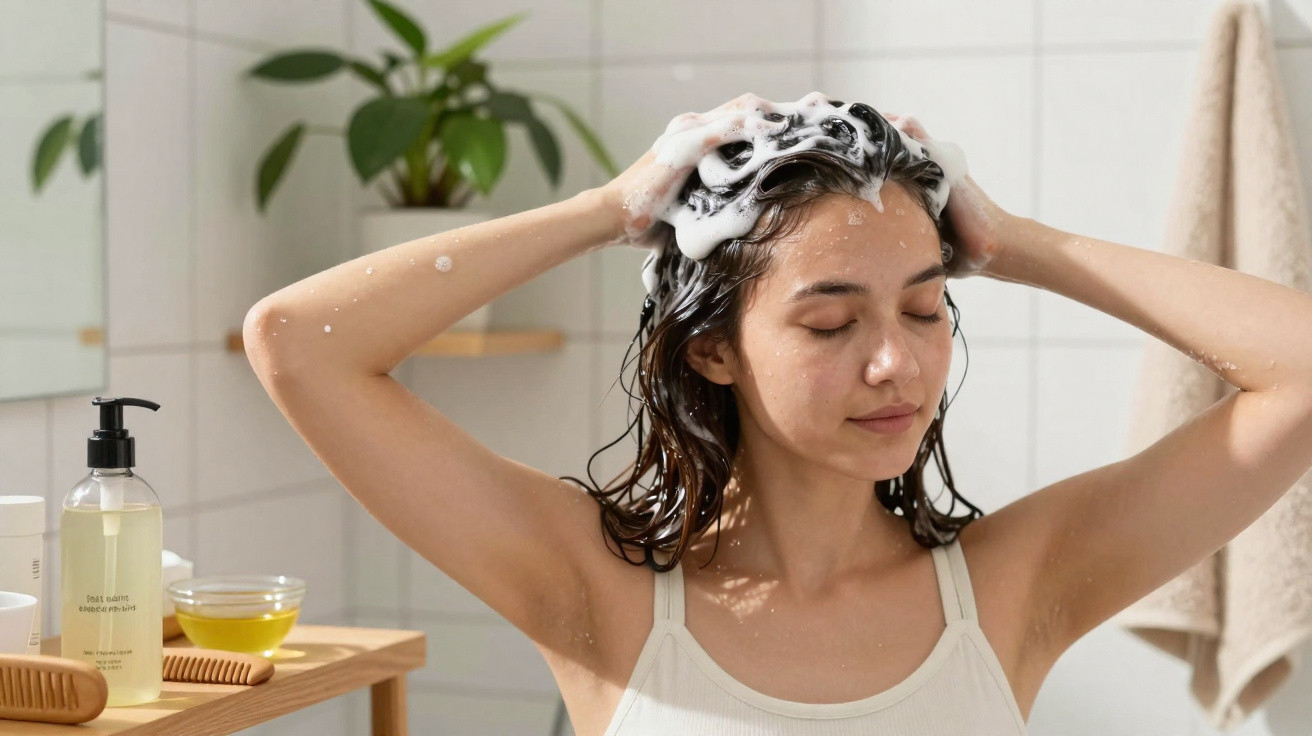
It is early morning, the bathroom is still half-dark, and you are standing in front of the mirror. One hand holds the shampoo bottle while the other is already in your wet hair. The sequence is so familiar that you no longer think about it: pour it on, scrub hard, rinse quickly. Just as you did yesterday. And the day before. For years. Yet your hair looks dull, the ends are fraying and your roots become greasy in record time. Something does not add up. We wash our hair as automatically as we brush our teeth, but hardly anyone has ever properly learned how to do it. There is no course, no guide, just imitation. That is where the misunderstanding begins. Many of the ingrained movements do more harm than good. The real surprise lies beneath the foam.
Why your “perfectly normal” hair wash does more damage than cleaning
Watch people wash their hair and you will nearly always see the same routine: a generous amount of shampoo in the palm, vigorous rubbing, scratching the scalp with fingernails and a rushed rinse. It looks thorough, feels clean and initially leaves hair feeling light. Even so, many people complain about split ends, greasy roots and an itchy scalp. It is a contradiction that is easily overlooked in everyday life. We wash as though we need to work decades of road grime out of a carpet, when it is merely one day’s worth of life on the skin. Our idea of “clean” is often far harsher than hair and scalp can tolerate.
Take Anna, 32, who works in an office and has long, straight hair. She showers every morning, and a walnut-sized amount of shampoo is never enough for her: she uses at least two generous portions. She scrubs as if she were removing a stain from a white T-shirt, working foam all the way through the lengths and into the ends. By evening, her hair feels airy, but after two days the roots appear flat and the ends feel straw-like. So she washes it again. It is a classic cycle. In surveys, many people say that they wash their hair “almost every day”. Let us be honest: nobody does this every day in a way that would genuinely benefit their scalp. Some overdo it, while others cut corners in the wrong place.
The heart of the issue is often a misunderstanding of shampoo. Shampoo is primarily a scalp cleanser, not laundry detergent for every individual hair fibre. In most cases, the foam that runs down the lengths is entirely sufficient to clean them. Massaging shampoo directly into every section puts strain on delicate lengths, particularly if the hair is already damaged. Water that is too hot creates another problem: it removes natural oils faster than the scalp can replace them. The skin then goes into a state of alarm, increasing sebum production so the roots become greasy sooner. Ironically, trying to get “properly clean” can create precisely the opposite result.
Gentle hair washing: how a wash can feel like a mini treatment
Perhaps the most important bathroom change starts with something very ordinary: water. Keep it lukewarm rather than scalding hot. First, thoroughly wet the scalp and roots for at least half a minute. Next, rub a small amount of shampoo - often a hazelnut-sized portion is enough - between your hands until it begins to foam, then apply it only to the scalp. Use your fingertips, never your nails. Make slow, circular movements, as though you were massaging a mildly tense forehead. The lengths should only receive foam as it flows over them during rinsing. Do not rub the ends separately.
Many common mistakes are hidden in details we never question. For instance, squeezing the shampoo bottle directly onto wet hair because it seems “quicker”, or kneading the hair into a tangled bundle to “reach everywhere”. Often, this comes from unconscious stress: too little time in the morning or tiredness in the evening. Once you recognise that, you can reorganise the process. Start with the scalp, then do a second gentle wash if styling residue is involved. Only detangle the lengths once conditioner is in the hair, rather than beforehand. And never scratch with your nails, however relieving it may briefly feel. Tiny scalp injuries can later show up as redness, flakes and itching.
“The best hair wash is the one after which you barely notice your scalp – yet your hair falls as if you had given it a break.”
- Use lukewarm water only, so natural oils are not stripped away completely.
- Foam the shampoo in your hands, then distribute it solely over the scalp.
- Use your fingertips and a gentle massage instead of aggressive scrubbing.
- Do not lather the lengths separately; foam from the roots is sufficient.
- Finish with a brief cooler rinse to encourage shine and softness.
What changes when you genuinely let go of your hair-washing routine
People who change the way they wash their hair rarely notice a difference on the first day. At first, it can even feel unfamiliar: less foam, less friction and more patience. After a week, the scalp tends to feel calmer, the itching eases and hair no longer sits as flat on the second day. Over several weeks, sebum production settles into a new rhythm, allowing many people to extend the time between washes by a day. A rigid ritual becomes a carefully attuned moment with your own body. Suddenly, the thing that was meant to happen “quickly” each morning becomes a quiet routine that works with you rather than against you.
| Key point | Detail | Benefit for the reader |
|---|---|---|
| Less is more with shampoo | Apply shampoo only to the scalp, use a small amount and foam it well | Gentler cleansing, fewer dry lengths and longer-lasting freshness |
| Gentle technique rather than scrubbing | Fingertips, circular movements and no forming a “hair bundle” | Less breakage, a calmer scalp and less irritation from flakes |
| Water temperature and rhythm | Lukewarm water, cooler at the end, gradually extend the intervals between washes | More stable sebum production, greater shine and healthier-looking hair overall |
FAQ:
Question 1 How often should you really wash your hair?
Most scalp types cope well with two to three washes a week; greasy roots may need washing a little more often, while dry hair may need it less often. What matters is whether your scalp feels comfortable, not simply how the roots look.Question 2 Does washing every day automatically damage hair?
Daily washing can work if the technique, product and water temperature are gentle. However, vigorous scrubbing, strongly degreasing shampoos and very hot water can quickly make daily washing a problem.Question 3 How much shampoo is actually necessary?
For medium-length hair, a hazelnut-sized amount is usually sufficient. For very long or heavily styled hair, you may need twice that amount over two washes. If hardly any foam forms, the hair is often very oily - in that case, do a brief first wash and repeat it.Question 4 Should you apply conditioner to the scalp?
In most cases, no. Conditioner belongs on the lengths and ends, roughly from ear level downwards. On the scalp, it can weigh hair down and clog pores, leading to greasy roots and sometimes irritation.Question 5 Does cold water at the end really help?
A cool final rinse can help the hair cuticle lie flatter, creating more shine. It is not a miracle cure, but it is a small and often noticeable effect - especially for dull, stressed hair.





Comments
No comments yet. Be the first to comment!
Leave a Comment