
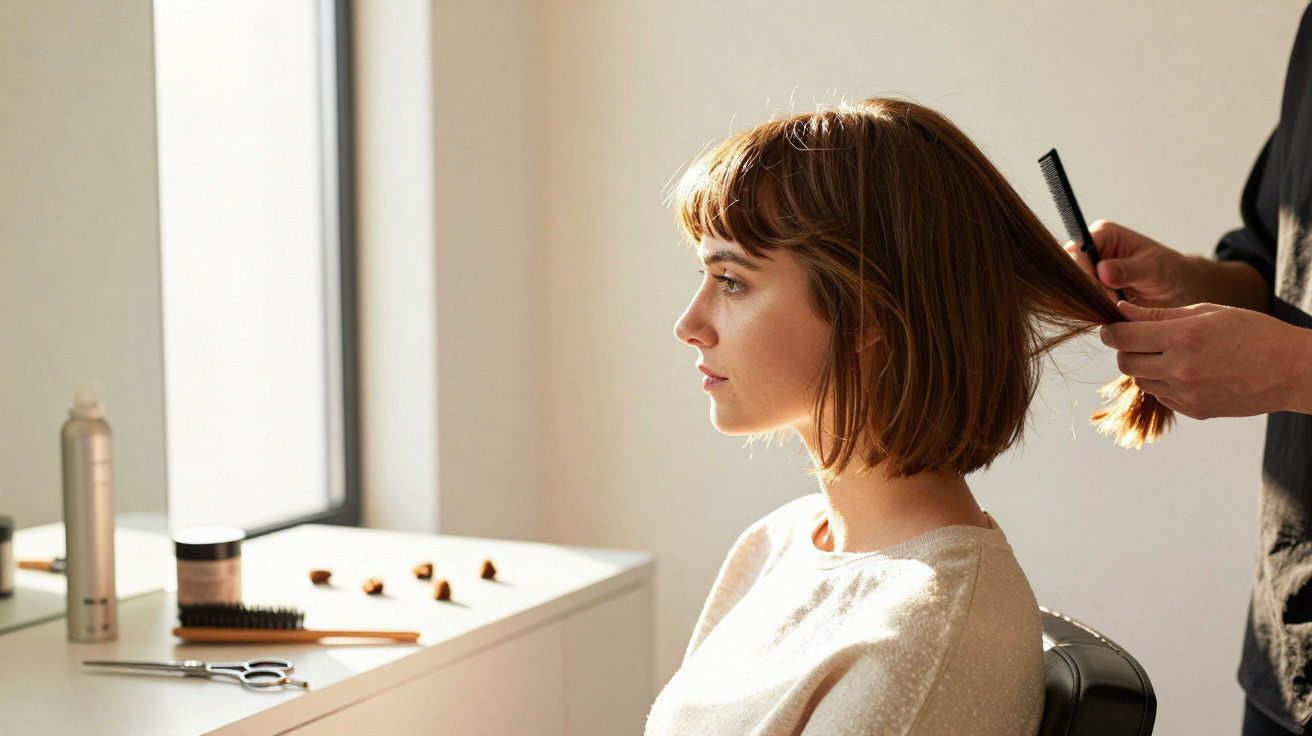
The woman in the salon chair wore an expression you may recognise: optimistic but slightly panicked, flicking through Pinterest images with unsteady hands.
Her hair was extremely fine and rain-flattened, and she kept enlarging photos of immaculate cropped styles that promised “instant volume” and “no styling needed”. With scissors poised, the stylist agreed while her friend recorded the transformation from the sofa for Instagram.
Forty minutes on, her expression was entirely different. Although the haircut itself was technically well executed, the crown had fallen flat, the nape was clinging to her neck, and each change of light in the mirror made her hair seem sparser. Notifications were already appearing on her phone: “Wow, bold”, “Looks… different”. She never said she wished she had not done it, but her posture said enough.
What she had not been told was this: certain short cuts for fine hair create drama on the first day… then silently wreck your look by the next morning.
The 4 “volume” cuts that quickly work against you
Any seasoned stylist will point to four familiar culprits: the extremely stacked bob, ultra-choppy pixie, rounded “helmet” bob and very short shag. On TikTok, they appear almost miraculous, turning limp hair into a crisp, sculptural cloud of volume.
The problem is that fine hair behaves more like silk than wool. It slides, droops and cannot maintain that structure for very long. Consequently, cuts sold as delivering “bold volume” may become flattened silhouettes, odd empty sections and a face that looks permanently worn out by the third day.
During a packed Saturday at a London salon, I saw three women with fine hair arrive carrying screenshots of the same viral “French bob”. It had a fringe brushing the eyelashes, a heavily stacked back and blunt ends. In the influencer’s diffused lighting, it looked gorgeous. Two weeks later, one of those women returned wearing a cap - her weighty fringe had separated into wispy strands, the stacked back was jutting out in clumps, and her neck looked shorter rather than longer. Each morning, she had spent twenty minutes with a round brush. Even so, the volume had disappeared before lunchtime. Quietly, she said: “I feel like my hair is wearing me.”
A survey by a major UK salon chain found that women with fine hair regret dramatic short cuts almost twice as often as those with thicker strands. The promise of “more hair” appeals to them, but the reality is a style requiring constant styling effort they simply do not have time for. One stylist told me that 6 out of 10 corrective cuts in her chair begin with: “I wanted volume, but…”
Fine hair has three main enemies: gravity, oil and weighty edges. Each of these four dramatic styles plays into all three. An extremely stacked bob concentrates layers at the back; as it grows, that weight drags the top down and leaves a ledge at the nape. The ultra-choppy pixie relies on severe thinning shears, potentially making already-fine hair appear translucent under strong lighting. A rounded “helmet” bob creates an even curve around the jaw, but once the blow-dry has dropped, the line turns inward and makes the face appear narrower.
A very short shag may seem light and airy on the first day, yet its brief, uneven crown layers grow in every direction, leaving hair fluffy rather than full. Fine hair does not tolerate excessive layering. After too much density has been cut away, no product in the world can restore what the scissors removed. That is when the “instant volume” fantasy becomes a lengthy, awkward grow-out you never intended to have.
How to request short hair without sacrificing volume
If you have fine hair but still want a short cut, absolute clarity during the consultation is essential. Take pictures not only of styles you love, but also of cuts you dread: ones that are overly round, too piecey or too shaved. Say clearly: “My hair is fine and drops flat quickly. I want softness, not a science project.” That single sentence can alter the stylist’s entire plan.
Ask the stylist to preserve “internal bulk” and not use aggressive thinning on the ends. For many women with fine hair, a blunt bob at collarbone or jaw length, with barely visible light layers around the face, is far more effective than a stacked bob. The lift should come from restrained graduation at the back rather than a pronounced shelf. A gently undercut nape may make the hair above appear fuller, if it is created softly rather than as though it were a buzz cut.
That same Saturday, I watched another fine-haired client leave the salon happily - and she was still happy when I looked at her Instagram weeks afterwards. She had wanted a choppy pixie but feared ending up looking like a plucked chicken. Instead, her stylist proposed a “soft pixie-bob”: a little more length around the ears, a side-swept fringe and just a touch of crown texture.
She achieved the movement she wanted, while the outer line remained substantial enough to look like “hair” rather than fluff. At 7 pm, 10 hours after her blow-dry, she shared a selfie from her work lift and the silhouette was still intact. It was not unchanged or salon-perfect, but it had life. Her caption read: “I can actually style this in five minutes. That’s a first.” This is when short cuts for fine hair are at their best: when the cut carries most of the load, rather than your right arm and a round brush.
In theory, the routine for fine, short hair sounds easy: a lightweight volumising shampoo, some root spray, a rapid rough-dry with your head upside down, then a brush only around the front. Let’s be honest: nobody really does that every day. Real life is being half-dressed, with your phone buzzing, while attempting not to burn your ear with the hairdryer. This is precisely why the cut’s construction matters more than any tutorial.
A well-designed short cut for fine hair includes “lazy volume” - a shape that settles properly even on an ordinary day. In practice, that means top layers slightly longer than those seen on Instagram, so they have enough weight not to fly about. It means rejecting heavy, blunt fringes that split apart, in favour of softer side-swept pieces that can grow out without becoming tragic. It also requires accepting that some viral hairstyles are performance art for cameras, rather than looks designed for the 8 am commuter train.
“Fine hair needs respect, not punishment,” says London stylist Sarah M. “Every time you over-layer or over-thin, you’re stealing from the illusion of thickness. Short hair can be beautiful on fine strands, but the scissors have to be kind.”
A few straightforward safeguards can prevent the most serious regrets:
- Treat any style that is substantially shorter at the back than the front with caution if your hair is very fine.
- Steer clear of dense, thick fringes cut straight across the forehead.
- Decline “piecey texture everywhere” when your ends already look see-through.
- Ask what the haircut will look like after four weeks, rather than only judging it in today’s salon mirror.
- Opt for cuts you can occasionally leave unstylised without disliking your reflection.
Short, fine hair that genuinely fits your life
Everyone knows the experience of noticing their reflection in a shop window and suddenly feeling ten years older than they felt in their mind. The wrong short cut on fine hair can provoke that feeling every morning. Yet the right style can achieve the reverse: brighten your features, lengthen the appearance of your neck and give your eyes an unexpected definition, much like good eyeliner.
Stylists who frequently work with fine hair often refer to “future-proof” cuts. These are shapes that remain flattering not merely on day one, but on day twenty too, when the fringe has become a little too long and you have not used volumising mousse for a week. Usually, that involves softer transitions, delicate graduation and a defined strategy for growing the cut out. Consider French-inspired bobs that brush the jaw in a light, broken line - rather than perfectly rounded, solid helmets that flatten the cheekbones.
Some readers send direct messages to say they still want the drama of a stacked bob or a micro pixie, even after having a bad experience before. The truthful response is that you can certainly choose a bold, short style with fine hair, but not in exactly the same way as somebody with a thick, coarse mane. For you, volume is about air, light and movement rather than pure density. It exists in the gap between hair and scalp, in a modest lift at the crown, and in ends that do not sit in one straight, mournful line along the jaw.
Perhaps, then, the real question is not “Which cut gives me instant volume?” but “Which cut lets me feel like myself - on Monday morning, after the gym, under harsh office lights?” That is the haircut that will not spoil your look overnight. It is the one that will quietly see you through days when you have only three minutes for your hair but still want to recognise yourself in the lift mirror.
| Key point | Detail | Benefit for the reader |
|---|---|---|
| Avoid the 4 “trap” cuts | Extremely stacked bob, ultra-choppy pixie, rounded “helmet” bob, very short shag | Reduces the chance of regret and an awkward, lengthy grow-out |
| Favour softer shapes | More blunt bobs, gentle graduation, soft side fringes | Creates lasting volume without weighing hair down or making it look sparse |
| Think about real life, not Instagram | Cuts that settle with minimal styling and hold their shape over the weeks | Saves time every day and improves confidence in the mirror |
FAQ:
- Which short haircut is safest for very fine hair? A slightly blunt bob around the jaw or collarbone, with minimal, invisible layers and a soft side part, is usually the most forgiving and volumising.
- Are pixie cuts bad for fine hair? Not always, but ultra-choppy pixies with lots of thinning can make fine hair look sparse; a soft pixie-bob with longer top layers tends to work better.
- How often should I trim a short cut on fine hair? Every 5–7 weeks keeps the shape and volume; beyond that, layers can collapse and the cut may start to look flat or uneven.
- Can products replace a good cut for volume? Products can boost lift temporarily, but if the cut removes too much bulk or is overly stacked, no mousse or spray will fully fix the shape.
- What should I tell my stylist to avoid “helmet hair”? Say you want soft graduation instead of a perfect round shape, no thick blunt fringe, and a cut that still looks natural when air-dried.




Comments
No comments yet. Be the first to comment!
Leave a Comment