
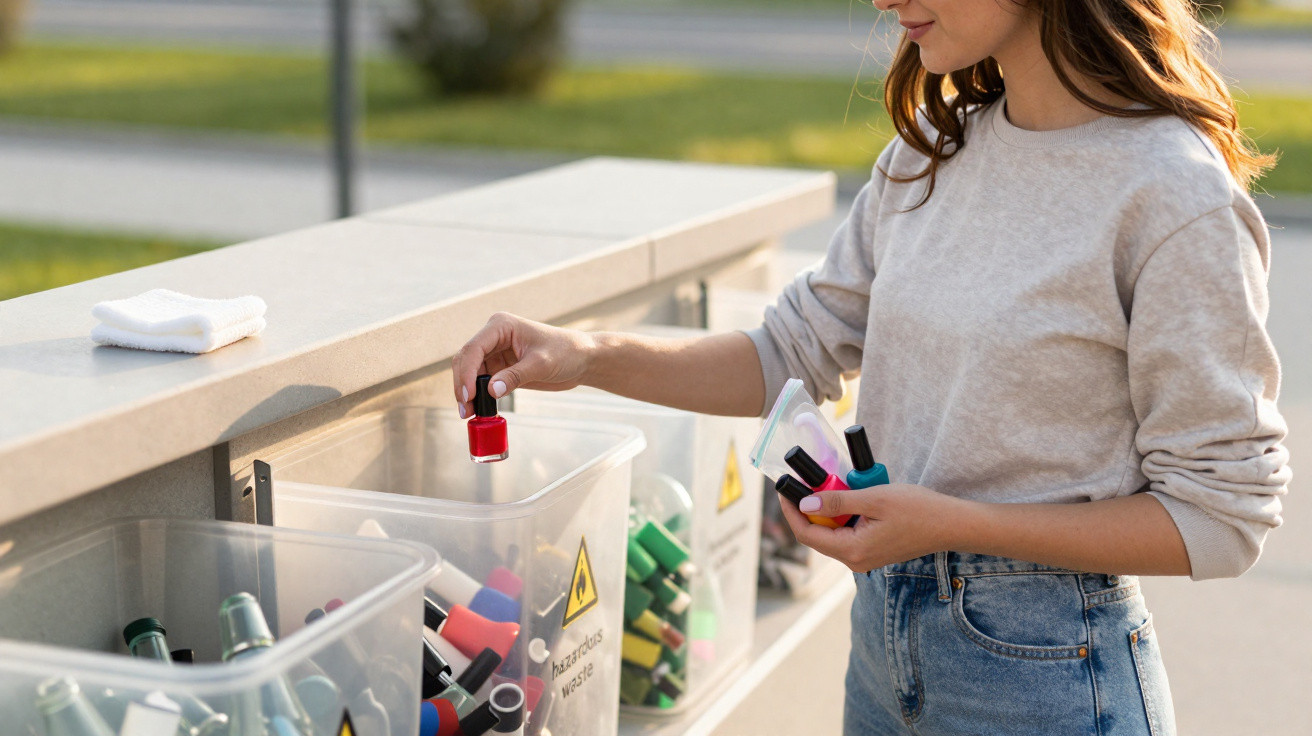
Clearing out the bathroom cupboard often ends the same way: the dried-up red nail polish goes straight into the nearest bin. We tend to think about making space, not about chemicals, fire risk and waste regulations. That is exactly where the issue starts, because in legal terms nail polish is not treated like ordinary cosmetic leftovers, but as problematic waste that comes with specific rules.
Why nail polish does not belong in the regular bin
At first glance the little bottle seems harmless: a bit of glass, a brush, and a trace of colour. For refuse collectors and waste processors, though, that combination is a real headache - whether it ends up in the bathroom bin, the yellow bin, or the glass bank.
The mistaken assumption about the glass bank
A lot of people drop empty or nearly empty nail polish bottles into the glass bank because the container is made of glass. It sounds sensible, but it does not fit how recycling facilities actually work.
"Nail polish bottles do not belong with standard packaging glass and disrupt the entire recycling chain."
There are several reasons for this:
- Glass used for cosmetic packaging often has a different composition from drinks bottles and jam jars.
- The bottles are very small, so they can slip through conveyor systems or pass sensors without being picked up correctly.
- The plastic brush, metal parts in the cap, and chemical residues inside contaminate the recycled glass.
In the worst case, one tiny nail polish bottle can make whole batches of collected glass unusable for further processing.
Why the yellow bin and residual waste are also tricky
Putting nail polish in the yellow bin or the standard residual waste is not a good workaround either. What is left in the bottle is not just “a bit of colour” - it is a mix of substances that needs careful treatment during disposal.
If polish goes into an incinerator along with normal household waste, it alters the flue gases and the remaining residues. Facilities can technically handle this, but only by using more energy and greater filtration capacity. That pushes up costs and increases the environmental burden.
What is in nail polish - and why it is so risky
A mini-sized chemical cocktail
Behind attractive shade names you will usually find blends of solvents, plasticisers and resins. Many traditional formulas contain or contained substances such as toluene, formaldehyde or certain phthalates. Even with newer products marketed with “free” claims, problematic ingredients can still be part of the picture.
"One bottle may seem harmless - millions of them every year create a постоян additional load on waste systems and the environment."
When this mixture is burned, gases are produced that can only be captured with complex filter technology. If nail polish ends up uncontrolled on landfill sites or in the natural environment, components can pollute soil and groundwater over the long term.
Fire risk in refuse lorries
Nail polish and the matching remover are highly flammable. At home we know not to paint our nails near an open flame - but once it is in the bin, that danger is often forgotten.
Inside refuse lorries, waste is compacted with considerable force. If a bottle breaks, the contents can mix with other chemicals or combustible materials. Sparks, heat or friction can then be enough, in some situations, to start a fire.
These smouldering fires are not only unpleasant; they put waste workers directly at risk. Every bottle disposed of incorrectly raises that risk a little.
Does the fill level matter?
The theoretical exception: a completely empty, clean bottle
Only in one very rare scenario is a bottle considered unproblematic: when it is genuinely completely empty, clean, and free of any product residue. In practice, that is hardly ever the case. The neck is narrow, and nail polish is sticky and stubborn once it starts to set. Anyone trying to remove every last trace typically needs a lot of remover - which simply creates additional hazardous waste elsewhere.
In real life, there is almost always some residue. And it is that small remainder that determines the disposal category.
The normal case: dried remnants in the bottle
Most people get rid of nail polish because it has thickened, because they no longer like the colour, or because only a small puddle is left at the bottom. As soon as there is any material left in the bottle - liquid, stringy or dried out - it is classified as hazardous waste.
"As soon as there is still polish in the bottle, it no longer counts as simple packaging, but as chemical waste."
That places nail polish in the same category as, for example, leftover paint, varnish, solvent or certain cleaning products.
What penalties can apply for disposing of it incorrectly?
Fines can apply even for incorrect sorting
Many cities and districts are tightening checks on household waste. One reason is the growing workload caused by incorrect sorting. If residual waste bins repeatedly contain noticeable amounts of problematic substances, it can become expensive.
When inspectors identify containers with chemicals, solvents or comparable substances in normal household rubbish, fines may be issued. Amounts of around 35 euros for incorrect separation are not unusual - for something you had mentally written off long ago.
When it becomes genuinely costly
If the fine is not paid on time, or if illegal dumping is involved as well, the totals can rise quickly. Depending on the area, 75 euros and substantially more is possible - particularly if paint- or polish-containing waste ends up in nature or on public land.
Anyone who simply leaves old polish “somewhere” risks sums that would easily pay for several professional manicures. A bit of convenience can turn a purely cosmetic issue into a very real financial one.
The only correct place for old nail polish
What “hazardous waste” actually means
Old varnishes, paints, certain adhesives or plant protection products are treated as waste that requires special handling. They should be dealt with by specialist operators, who incinerate them at high temperatures using dedicated technology. The aim is to release as few pollutants into the environment as possible.
This system is financed in part through manufacturer levies. So when you buy nail polish, you indirectly contribute to its safe disposal later - provided the bottle ends up in the right place.
Where you should actually take your bottles
The cleanest option is to use your nearest recycling centre or civic amenity site. Almost every local authority provides a dedicated area for chemical products. You will typically find secured cupboards or locked containers there, often with trained staff on hand.
Many towns also run mobile collection points, for example with collection vehicles at weekly markets or central locations. These allow residents to hand in leftover varnish, solvents and similar products conveniently.
- Look up the address of your local collection point on your council or community website
- Take old polishes, removers and similar products together in one bag
- Ask on site where solvent-based cosmetics should be placed
Taking bottles there reduces the burden on waste workers, air and water - and helps you avoid the hassle of fines.
How to use nail polish for longer and reduce waste
Rescue thickened polish instead of throwing it away
Before a bottle finally goes into the hazardous-waste box, you can often get more use out of it. Special nail polish thinners can make thick products fluid again. Standard remover is not suitable for this: it breaks down the formulation and can make the polish unstable.
"A few drops of a suitable thinner and a little patience can give a favourite shade months of extra life."
One key point: roll the bottle between your hands rather than shaking it hard. This distributes the thinner evenly without creating air bubbles, which can later leave streaks and blisters on the nail.
When you no longer like the colour
Some shades simply stop suiting you, go out of fashion, or remind you of a bad purchase. If the polish is still in good condition, it does not have to go in the bin:
- Pass it on to friends or family
- Offer it via local swap groups or neighbourhood communities
- Use it for creative projects, such as marking keys, decorating stones, or adding colour accents to tools
For crafts, nail polish can work much like enamel paint: it covers well, dries relatively quickly, and adheres to many surfaces.
Practical everyday tips for nail polish
If you think ahead when buying, you reduce the disposal problem later. Smaller bottles are more likely to be used up before the contents thicken. Neutral or classic colours are used more often than extreme shades, so they are less likely to be forgotten at the back of a cupboard.
It also helps to keep a dedicated place in the bathroom for “problem products”. That is where old polishes, remover, hairsprays, certain cleaners, or leftover hair dyes can go. Once the box is full, you take everything to the collection point in one trip. That means a single journey - and the barrier to disposing of things properly drops noticeably.
If you get into the habit of treating nail polish as a chemical product rather than a harmless accessory, better decisions follow automatically. In the end, the environment, the health of waste workers and your own wallet all benefit.




Comments
No comments yet. Be the first to comment!
Leave a Comment