
The answer is often not in the tube.
When your hands are dry and rough, it is easy to reach automatically for richer and richer hand creams. Yet the results are usually disappointing: before long, the skin feels tight again. That is exactly where a different approach begins - not by buying yet another product, but by reviewing what you do every day, from the tap to the towel.
The hidden vicious circle of hand creams
Most people follow a simple equation: dry skin = not enough care = more cream. It sounds reasonable, but it regularly ends in a vicious circle. Over time, tubes pile up in handbags, bathrooms and offices, while hands still feel coarse.
The problem is a common misconception. Skin is not an empty container that just needs “topping up”. It has its own protective layer: the hydrolipid film - a very thin blend of water and oils that acts like a natural coat.
"If you attack your skin every time you wash, no cream in the world can balance it out in the long term."
If daily cleansing repeatedly disrupts this barrier, even the richest products only offer short-lived relief. Skin can become accustomed to constant external replenishment, then reacts more quickly with a tight feeling and seems to become “dependent” on cream. Rather than endlessly repairing after the fact, it pays to look at the start of the chain: how are your hands washed, with what, and how are they dried?
The underestimated tap factor: temperature makes the difference
People often scrutinise the ingredients list on a hand cream, but almost nobody considers the water temperature they use when washing. And yet those few seconds at the sink shape the future of the skin barrier.
Very hot water may feel as though it cleans more thoroughly, but on skin it behaves like washing-up liquid on a greasy pan: it dissolves fats. Those fats are exactly what help hold the cells in the outermost layer of skin together.
"The ideal temperature for washing hands is lukewarm - around 30 to 35 °C."
Water above this range pulls lipids out of the stratum corneum, the skin’s natural outer layer. The result is predictable: moisture loss, roughness, tightness, and faster cracking. Cold water can be a little gentler on oils, but it emulsifies soap less effectively. You end up rubbing longer and harder, which mechanically stresses the skin.
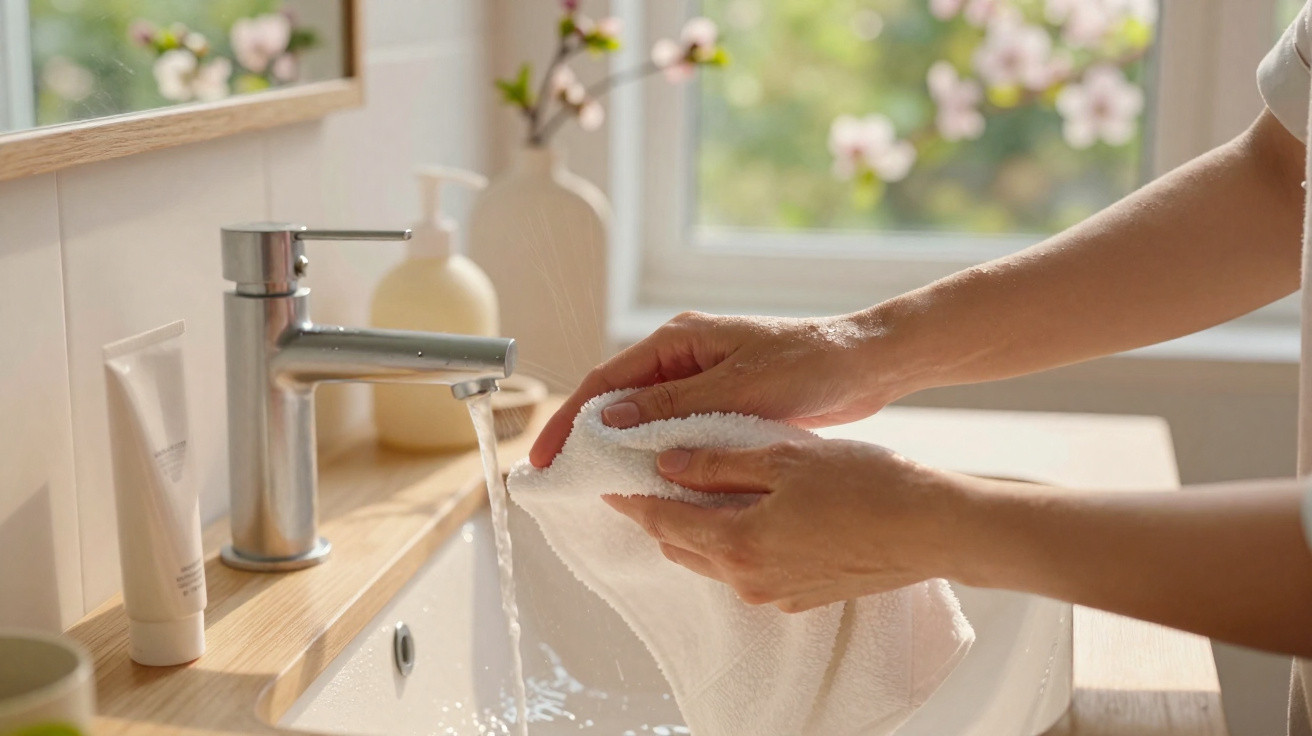
The simple but effective change is to set the mixer tap to comfortably lukewarm and stick with it. A small adjustment with a big impact on how your hands feel - especially if you wash them frequently during everyday life.
The right soap bar: choose superfatted, not stripped
Temperature matters, but the cleansing product matters just as much. Traditional hard soaps and strongly foaming wash gels often have an alkaline pH and robust surfactants. They clean effectively, but they also remove the protective sebum.
A widely recommended alternative is a so-called superfatted soap bar. These products include extra re-oiling ingredients such as oils or butters, which leave a fine protective film during washing.
- Gentler cleansing: less aggressive surfactants, pH closer to the skin
- Less moisture loss: studies show up to 50 % less drying compared with standard soaps
- Care while washing: oils such as almond, shea or glycerin remain as a thin layer on the skin
When shopping, it is worth checking the label. People who avoid harsh surfactants such as Sodium Lauryl Sulfate usually do better. A good soap bar leaves hands feeling soft and supple after rinsing - without that “squeaky-clean” sensation. That convincing squeak is a sign that oils have already been thoroughly removed.
The forgotten care step: drying your hands properly
When it comes to skin care, drying is rarely part of the conversation. Yet vigorous rubbing with a towel can damage the very skin that has just been softened by water and soap, and is therefore especially sensitive.
If you scrub your hands dry, you can create micro-injuries and dislodge protective flakes from the stratum corneum. That makes the surface more vulnerable to irritants and speeds up moisture loss.
"Gently pressing dry instead of rubbing protects the skin - especially with frequent washing."
An ideal routine looks like this:
- After washing, let your hands drip for a moment.
- Use a clean, soft towel.
- Press the skin dry with light pressure - do not wipe.
- Dry carefully between the fingers so no residual dampness remains.
Letting hands air-dry may feel convenient, but it pulls additional moisture from the surface: as water evaporates, it takes some of the skin’s own moisture with it. In spring in particular, when wind and fluctuating temperatures increase, this can intensify dryness.
Spring as a stress test for skin
Many people relax once winter is over and pay less attention to their hands. Yet spring brings fresh strains: cold mornings, mild afternoons, more time outdoors, gardening, cycling, and contact with soil and pollen.
These constant shifts repeatedly challenge the skin barrier. As the heating season ends, the outdoor “stress season” begins. Wind, UV radiation and dirt particles hit hands that may be left with only a thin residual barrier.
If you rely only on rich hand creams now, you are addressing symptoms rather than causes. A consistent routine change is noticeably more effective: lukewarm water, a superfatted cleansing bar, gentle drying - and only then carefully chosen care.
Minimalist care routine: one hand cream, one time
A hand-friendly washing routine does not mean giving up care products entirely. It simply changes the emphasis: away from constant top-ups throughout the day, towards a clear, targeted application.
One proven strategy is to use a single, well-formulated hand cream - ideally containing glycerin. This ingredient binds water in the upper layers of skin and, when the skin is intact, can provide lasting comfort.
"On healthy, not over-stressed skin, an evening application is often enough for the entire following day."
A minimal routine might look like this:
- During the day: wash hands with lukewarm water and a superfatted soap bar
- Every time: press dry gently, and do not forget between the fingers
- In the evening: apply a small amount of glycerin-containing cream before going to bed
When people follow these steps consistently for a few weeks, they often notice they reach for hand cream less often during the day. The skin seems more resilient, cracks less quickly, and needs less “emergency help” from a tube.
What terms like hydrolipid film and stratum corneum actually mean
“Hydrolipid film” sounds like lab language, but it is simply an everyday protective layer. Sweat provides the watery component, while the sebaceous glands contribute oils. Together, they form an ultra-thin coating that slows the evaporation of skin moisture and helps keep external substances out.
Directly underneath lies the stratum corneum. It resembles brickwork: corneocytes are the bricks, and fats are the mortar. If that mortar is repeatedly dissolved by hot water, harsh soap or heavy rubbing, the wall starts to crumble. Micro-cracks, redness and split knuckles are the visible outcome.
By changing your routine, you help this “wall” become stronger again in day-to-day life - not by adding more from the outside, but by causing less damage with each wash.
Practical everyday examples
In the office, a small change is often enough. Instead of attacking your hands with very hot water and strongly scented liquid soap during every quick toilet break, wash thoroughly with lukewarm water and a mild product. If possible, keep your own superfatted soap bar by the sink.
For DIY or gardening, extra protection is worthwhile: thin cotton gloves under work gloves, lukewarm water for cleaning afterwards, then a calm moment to dry properly and apply hand cream in the evening. Many people report they can then do without the usual “emergency tubes” in a jacket pocket.
The switch can also make a noticeable difference in families with children. When small hands need constant washing, hot water can irritate their already sensitive skin far more. Lukewarm water, mild cleansing bars and soft towels bring double relief - for children’s skin and for everyone who later needs to apply less cream.



Comments
No comments yet. Be the first to comment!
Leave a Comment