
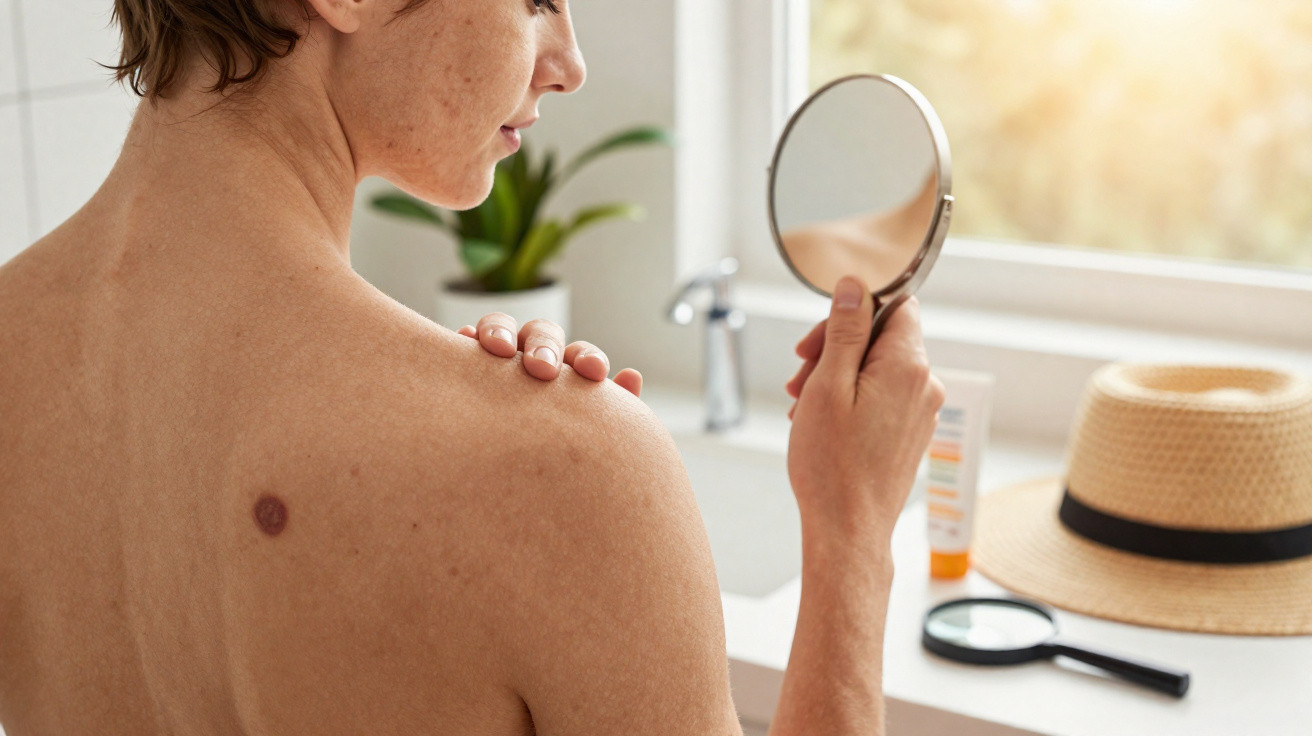
A new brown mark on your face can be confusing: is it a freckle or a sunspot? And if you’ve noticed a darker patch on your back that resembles a mole but sits flatter than the others, you might wonder whether it’s a mole or simply a dark freckle.
Below is a guide to distinguishing freckles, sunspots and moles - and knowing when a spot should be checked in case it’s skin cancer.
Freckles
Freckles (ephelides) are tiny, flat, pale-brown marks that commonly show up in people with fair skin, or red or light-coloured hair.
People with these features are more likely to carry the MC1R gene, which makes freckling more likely.
Freckles develop because of sun exposure, which is why they tend to stand out more in summer. When sunlight reaches the skin, specialised cells called melanocytes make melanin - the pigment responsible for skin colour.
In people who are prone to freckles, that melanin isn’t distributed evenly. Instead, it gathers in small clusters, creating the speckled appearance.
Freckles usually first appear in childhood and can become less noticeable as you get older, particularly if you spend less time in the sun. With age, the body produces less melanin, and existing pigment can also break down or spread out, which can leave freckles paler or fewer in number.
Daily sun protection can reduce the chance of new freckles forming, particularly on areas that catch the most light such as the face and arms. Sunscreen and protective clothing are both helpful.
Although freckles themselves are entirely benign, they can indicate a genetic tendency that is linked with a higher risk of skin cancer.
Sunspots
Sunspots are also known as age spots or actinic keratoses (they’re sometimes called liver spots, but they are not related to the liver). They are bigger than freckles - sometimes roughly the size of a small coin - and appear as flat brown patches.
They typically arise gradually after years of sun exposure, which drives higher melanin production. As a result, they are most often seen on areas that receive a lot of sun, including the face, hands, shoulders and arms.
Freckles may lighten when sun exposure decreases, but sunspots generally do not fade over time. If sun exposure continues, they can become darker.
Some people choose to treat sunspots for cosmetic reasons, using options such as laser treatment, a chemical peel, or a prescription topical cream.
Sunspots are not usually dangerous in themselves, but they are associated with an increased risk of other skin cancers developing in the same region.
They also need watching because some slow-growing melanomas can look like sunspots at first. If you notice a spot changing in size, shape or colour, see your doctor to exclude skin cancer.
Moles
Moles are typically darker skin growths that may be raised or flat, and they can appear anywhere on the body.
Some moles are present at birth, but many develop and change across childhood, adolescence and early adulthood. They can also grow during pregnancy as hormones shift. New moles may appear and existing moles may enlarge up to around the age of about 40.
Most adults have between ten and 40 moles. A high mole count means 50 or more moles, and a very high mole count is 100 or more.
Moles form when melanocytes multiply in clusters rather than spreading evenly through the skin.
Whether a mole sits above the skin or remains flat depends on the mole’s type, its depth and how long it has been there.
Raised moles, called compound naevi, contain both flat and raised parts and usually have pigment located deeper within the skin.
Dermal naevi are also raised, but are often skin-coloured or light brown.
The majority of moles are harmless. Some may have hair growing from them; some may fade away; and others may darken or otherwise change with age or with hormonal shifts.
That said, certain moles can progress to melanoma, a serious form of skin cancer.
When to see your doctor
Freckles and sunspots are harmless, but moles deserve closer attention - particularly if they alter in size, shape, colour or texture.
If you notice any of the warning signs below, arrange an appointment. Your doctor may use the ABCDE rule to assess whether a lesion could be skin cancer:
- asymmetry: one half does not match the other
- border: irregular shape, jagged outline, or poorly defined edges
- colour: different shades within the mole, or a sudden change in colour
- diameter: larger than 6 millimetres (about the size of a pencil eraser)
- evolving: any change in size, shape, colour, or sensation (such as itching or bleeding) lasting for more than a few weeks
Research shows that only 21.7% of people can correctly identify melanoma without help, which is why professional checks matter.
How to prevent skin damage
Because sun exposure influences freckles, sunspots and some types of moles, you can reduce skin damage by:
- staying out of the sun when ultraviolet rays are strongest
- using sunscreen with SPF 50 every day, even on cloudy days - put it on 20 minutes before going outside and reapply every two hours
- wearing protective clothing, including a wide-brimmed hat that shades your face, neck and ears, plus long-sleeved tops and trousers to cover your arms and legs
Mike Climstein, Associate Professor, Faculty of Health, Southern Cross University; Jeremy Hudson, Adjunct Associate Professor, Faculty of Health, Southern Cross University; Michael Stapelberg, Adjunct Associate Professor, Faculty of Health, Southern Cross University; and Nedeljka Rosic, Senior Lecturer, Human Sciences, Southern Cross University
This article is republished from The Conversation under a Creative Commons licence. Read the original article.




Comments
No comments yet. Be the first to comment!
Leave a Comment