
Dealing with head lice - and the children they take hold of - is among the most testing jobs a parent or carer can be faced with.
And it is becoming more difficult. Many of the chemical treatments people have relied on for years no longer work as effectively, which means lice are increasingly tough to kill.
It is still possible to clear lice from your children’s hair - but you will probably need time, patience and persistence.
Remind me, what are head lice? And nits?
Head lice are minute, six-legged insects that live only in the hair on a human head - most often among primary school-aged children.
Humans have lived alongside head lice for millions of years as we evolved.
They thrive in hair, but several times a day (up to half a dozen) they travel down to the scalp to feed on blood.
Their claws are well suited to gripping and moving along hair shafts. However, away from hair they do not cope well - they are awkward, poorly coordinated and die quickly.
The word ‘nits’ refers to head lice eggs. They are frequently the earliest clue that lice are present. As a single louse can lay more than 100 eggs over its roughly month-long life, nits can build up quickly.
Can they spread diseases?
No. Head lice are unpleasant and their bites can trigger skin reactions, but Australian health authorities do not regard them as a health risk. There is no evidence that head lice transmit pathogens that cause disease.
In practice, the social stigma attached to head lice can be worse than any direct health impact for children who have them.
Why do my children always pick up lice?
From nursery or child care through to primary school, most children are likely to experience head lice at least once. One Australian study reported that infestation levels in Australian classrooms ranged from none to 72 per cent of children.
Girls are more likely to carry head lice than boys. With longer hair, it is simpler for lice to transfer across.
Head lice cannot jump or fly; they spread through direct head-to-head contact.
Lice arrive home because children spend time close together - hugging, playing, or clustering around books or screens. Any contact where heads touch can allow an infestation to pass from one child to another.
Rules vary a little by state, but in New South Wales and Queensland, children do not need to stay off school because of head lice.
How can I keep my home free of head lice?
A spotless home will not stop head lice. They are not bothered by how clean your sheets and towels are, or by how often you vacuum carpets and rugs.
Sharing pillows may carry some risk of transfer, but even that risk is small.
When you find lice in a child’s hair, there is no need to change bedding for that child or anyone else in the family. Evidence-based guidance from NSW Health states that "bed linen, hats, clothing and furniture do not harbour or transmit lice or nits and that there is no benefit in washing them as a treatment option".
I've used nit solution. Why isn't it working?
Pharmacies stock many different head-lice treatments. In Australia, the Therapeutic Goods Administration evaluates these products to make sure they are safe and effective.
The difficulty is that most options are insecticides: they can kill lice on contact, but they may not destroy the eggs.
On top of that, if you do not finish a course exactly as the label directs, some lice can survive.
There are also signs that head lice are increasingly resistant to the chemicals used against them, making infestations harder to clear.
So how can you get rid of them?
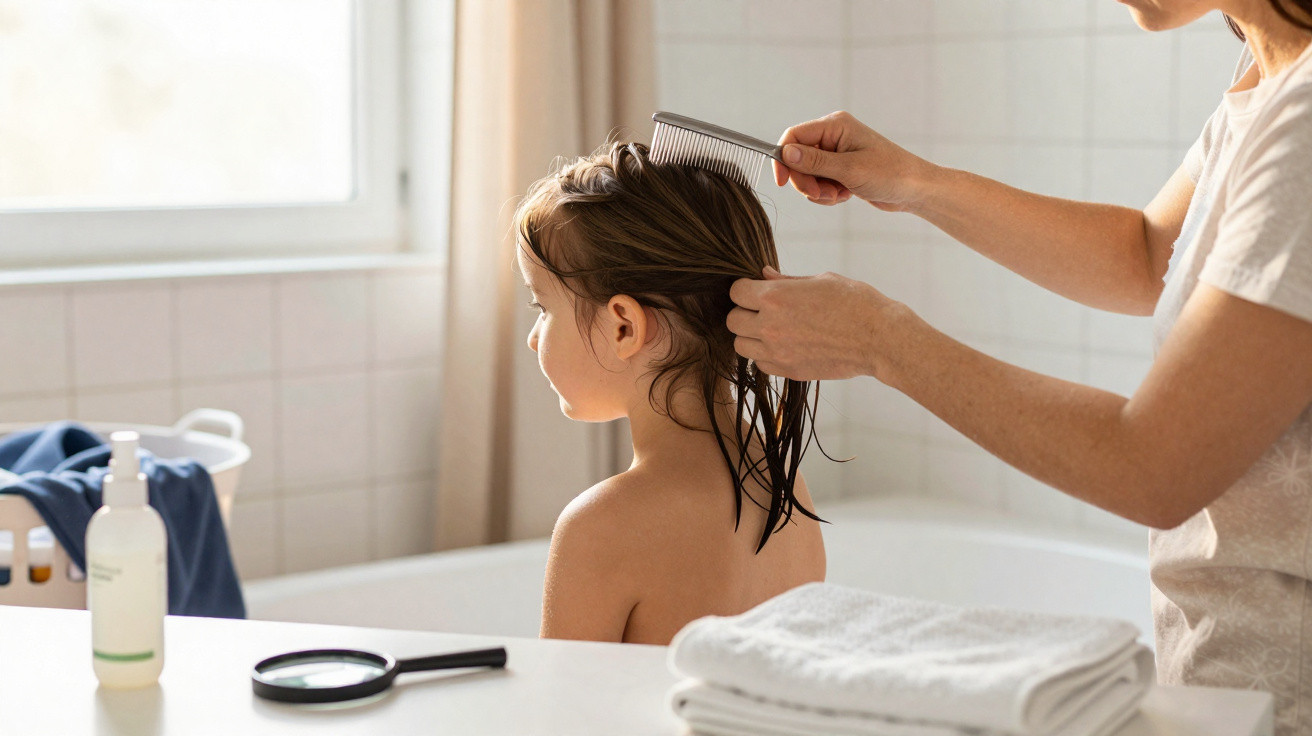
Do not expect a magic fix. Australian health authorities commonly recommend the ‘conditioner and comb’ (or ‘wet comb’) approach, which removes lice physically rather than relying on chemical treatments.
There are three key steps:
- Immobilise the lice by working hair conditioner through the child’s damp hair, then leaving it in place for around 20 minutes.
- Comb methodically with a fine-toothed “lice comb”. Wipe conditioner and lice onto paper towels or tissues. You will only collect adult lice at this stage - but do not worry, the eggs will be dealt with later.
- Do the process twice, roughly a week apart, to disrupt the head lice life cycle.
Repeating after about a week gives any remaining eggs time to hatch. It may sound counter-intuitive, but once they hatch the young lice are easier to remove than the eggs. The key is to comb them out before they mature, lay new eggs and the infestation carries on.
Although children are far more likely to have head lice, anyone in the household can still end up hosting a louse or two. It is not always necessary to treat everyone, but “grown ups” should be on the lookout for lice as well.
Cameron Webb, Clinical Associate Professor and Principal Hospital Scientist, University of Sydney
This article is republished from The Conversation under a Creative Commons licence. Read the original article.




Comments
No comments yet. Be the first to comment!
Leave a Comment