
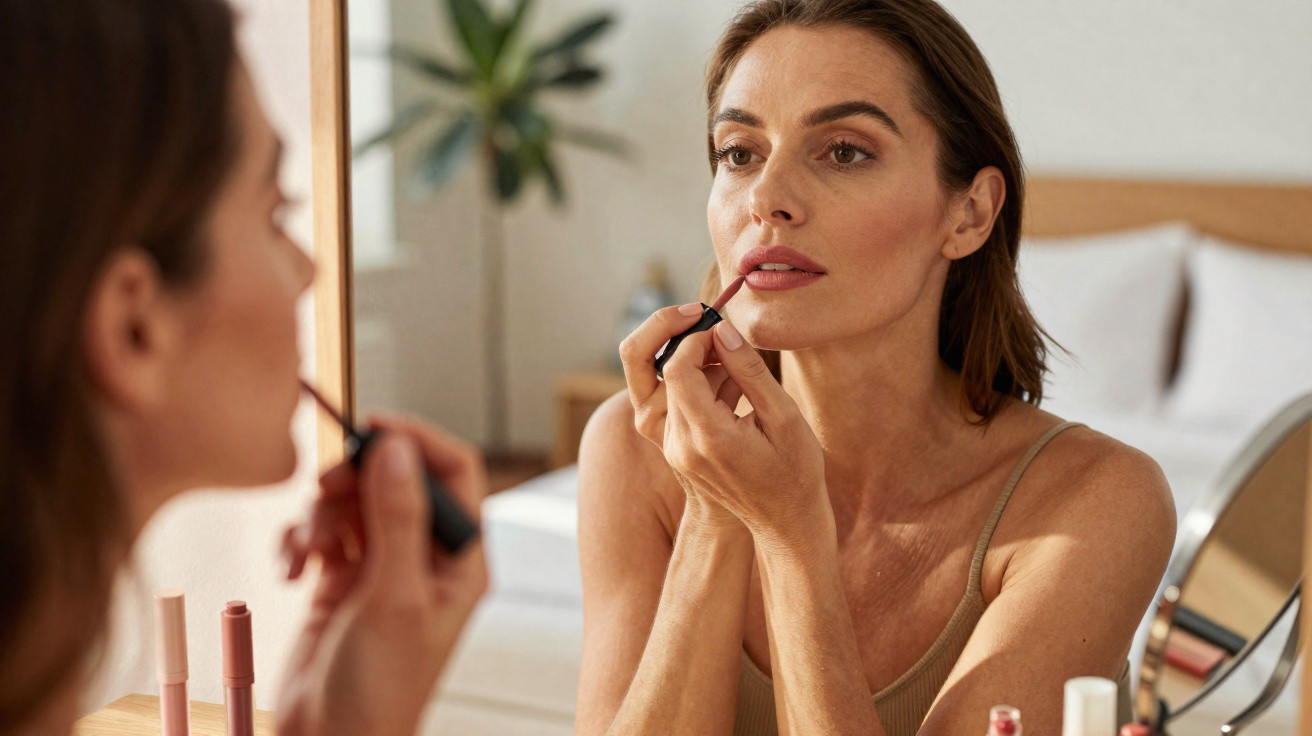
Lip liner has carved out a place in beauty routines as a practical tool for outlining, defining and helping lipstick stay put. Among people aged 40 and over, it is often used to bring back a clearer lip shape, soften visible signs of ageing and improve facial proportions, creating a more polished finish without requiring major changes to everyday make-up.
What are the main benefits of lip liner?
One of the most frequently mentioned advantages is how it can restore the lip outline. Over time, the natural border can look less sharp and fine lines may appear around the mouth, making it easier for lipstick to feather and slip.
Lip liner reinforces that boundary, acting like a “frame” that recalls the original shape and allows small symmetry tweaks. It can also subtly shorten the distance between the nose and the mouth and help disguise the vertical “barcode” lines, bringing a more balanced look to the face.
How do you use lip liner for a natural-looking result?
Some people avoid lip liner because they worry it will look too harsh. In practice, a natural finish comes down to choosing the right shade and texture, plus applying it in a softer way-ideally using a colour close to your natural lip tone or matched to your lipstick.
A few simple habits can keep the result understated and long-lasting day to day, particularly for anyone who wants practicality without losing that well-finished look:
- Choose the right shade: tones that mirror the natural pigment of the lips work with many lipsticks.
- Use gentle strokes: draw short, connected strokes rather than one heavy continuous line.
- Soften the edge: blend the outline with a brush or your fingertip to avoid an overly rigid border.
- Lightly fill in: adding a little pencil through the centre of the lips can improve wear time and even out colour.
How does lip liner help after the age of 40?
From the age of 40 onwards, lip liner becomes a strategic step for offsetting the natural loss of volume and definition. It helps “rebuild” edges that have become less distinct, enhancing the lips’ original shape without changing it completely.
At this stage, creamier textures often feel more comfortable on drier lips, while long-wear formulas tend to cope better with heat, humidity and richer, more emollient lipsticks. Techniques such as the “smoky lip” effect-applying pencil around the edges and gently pulling it inward-create a soft gradient that is widely used for professional and social looks.
What should you consider when choosing the best lip liner?
When picking a lip liner, it is worth paying attention to texture, finish and comfort-especially if your lips easily feel tight or dry. Many brands sell liners designed to pair with their lipsticks, making everyday colour matching simpler.
In general, creamy formulas are easier to blend, while drier ones usually last longer and hold back liquid or very creamy lipsticks more effectively. The format also affects how you use it: retractable pencils avoid the need for a sharpener, whereas traditional wooden pencils can be sharpened to a finer point for precise outlining. By choosing rosy nudes, light browns or shades close to your lipstick, lip liner stops being reserved for more elaborate looks and becomes part of simpler routines, adding definition and helping prevent smudging across different age groups.


Comments
No comments yet. Be the first to comment!
Leave a Comment