

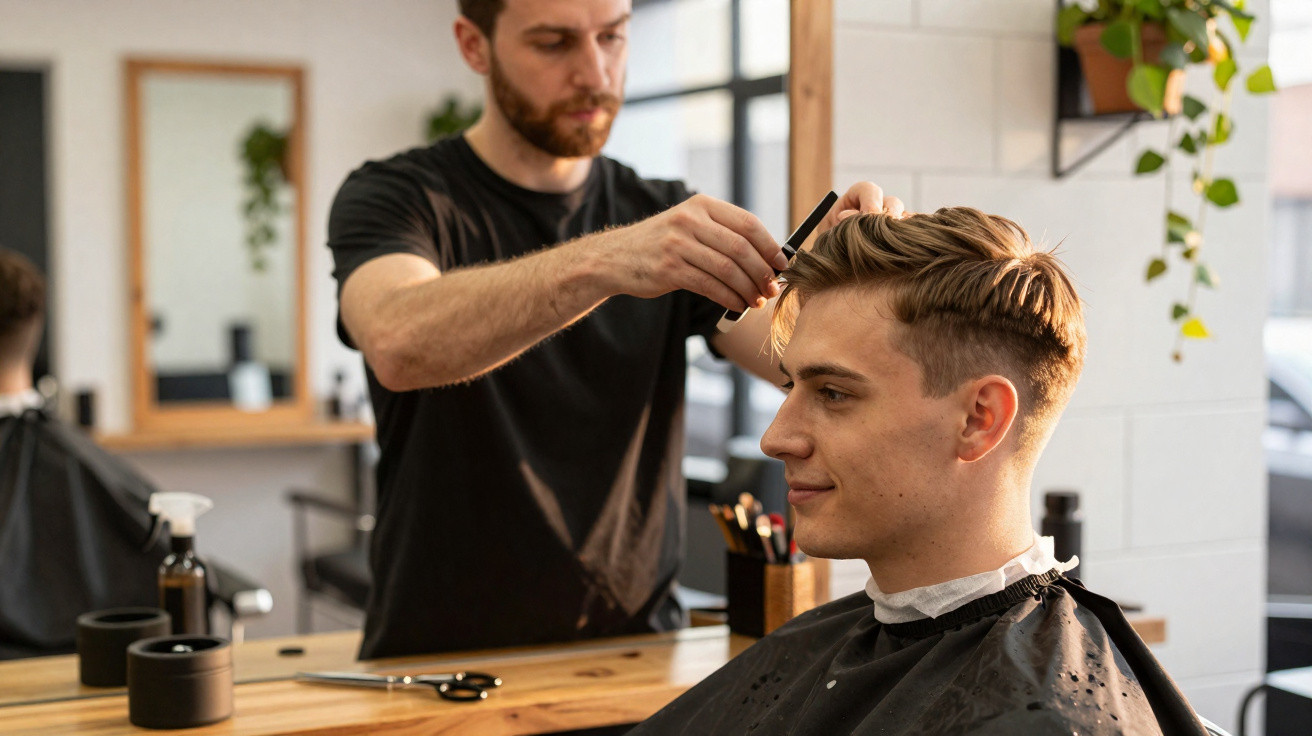
In a small London salon with a faint mix of hairspray and coffee in the air, a woman in her late fifties studies her own face in the mirror.
Her hands clamp around her phone, showing a screenshot from Instagram: a “flattering pixie for mature women”. Behind her, the hairdresser pauses with his scissors mid-air. He doesn’t start cutting. “Why do you want to cut it all off?” he asks, and the words land with more bite than the blades. She gives a quick laugh-part awkward, part guarded. “Well… I’m over 50. Isn’t this what I’m supposed to do?”
The stylist eases the comb down, meets her eyes through the reflection, and slowly shakes his head. His response won’t be what she’s braced for-and it has nothing to do with wrinkles or hair thinning.
Why one hairdresser tells women over 50 to pause before going short
The hairdresser is Liam. He’s been working with hair for almost twenty years, and these days he finds himself repeating one particular sentence at least twice a week: “Short hair isn’t a rule. It’s a story you’ve been sold.”
In Liam’s view, the cut itself-bob, pixie, anything in between-isn’t the real point. What matters is the unspoken pressure sitting underneath the request. The message that after a certain birthday you should “play small” with your hair: be less noticeable, take up less space, and blend quietly into the background.
That, he says, is why so many women over 50 arrive asking for a dramatic chop. Not because they’re excited by it-because they’ve made peace with what they think is expected.
He recalls a Tuesday afternoon when a client named Marie came in with a slight flush to her cheeks and hair reaching halfway down her back. She was 62 and hadn’t done more than the occasional trim for years. “Right,” she said as she sat down, “I’m going short. My daughter says long hair is for young girls.”
Liam didn’t reach for the scissors. Instead, he started with questions. When did she last recognise herself? When was the last time she looked in the mirror and genuinely liked what she saw? Marie fell silent for a moment. “Honestly? About ten years ago. Around this length,” she replied, gesturing roughly to her shoulders, “but I didn’t feel old then.”
They did cut her hair-just not into the choppy, anonymous crop she’d arrived requesting. She walked out with a soft, shoulder-length shape that framed her jaw and made her silver streaks look intentional and striking. As she combed her fingers through it, she murmured, almost startled: “I look like me again.”
To Liam, the rush towards short hair after 50-plus is rarely just a style choice. It’s a script. Many women have absorbed the idea that long hair is youthful, romantic, maybe even a touch frivolous-while short hair is “sensible”, neat, and suitably age-appropriate. So when the first deeper lines show up, or the first grandchild arrives, the cut can become an odd sort of rite of passage.
From his side of the chair, he notices something else too: women arriving already apologising. Apologising for greys they “haven’t had time to cover”. Apologising for length that’s “ridiculous at my age”. Apologising for wanting movement, a fringe, or layers-anything beyond the safe, practical crop. The issue isn’t short hair. It’s how often the choice is made to satisfy other people, rather than to match what the woman herself wants to see in the mirror.
How to decide if short hair is really for you (and not for everyone else)
When a woman over 50 asks Liam for a short cut now, he follows a low-key routine.
He begins with one question: “If nobody commented on your hair, what length would you secretly choose?” He pays more attention to where their eyes go than to what they say. Quite often, their gaze drops towards the collarbone rather than up towards the ears.
Then he uses a simple test that tends to reveal more than a conversation does. He gathers the hair into a low ponytail and slowly slides his hand up the back of the neck. “Tell me when this feels like too much hair gone.” Many clients stop him sooner than they imagined they would. The dream pixie turns into a softly layered bob. It shifts the decision away from abstract age rules and towards what it actually feels like on your head.
After that, he asks about day-to-day life. Is it the gym every day, or mainly desk and coffee? Do they enjoy a blow-drier, or are they firmly towel-and-go? “Short hair that needs twenty minutes of styling every morning isn’t low maintenance,” he laughs. “It’s a job you might resent.”
Plenty of women hope that a shorter cut after 50 will fix everything in one go: thinning, flatness, that creeping feeling of being overlooked. Sometimes it can-an intentional crop can lift the face, add spring, and spotlight cheekbones. But shorter doesn’t automatically mean fuller. Very close cuts can make sparse areas more obvious, whereas a softly layered mid-length can add movement and disguise breakage more effectively.
He thinks of a client, Sandra, who spent nearly a year wishing she hadn’t gone so drastic. She asked for “the classic mature pixie” because her friends had all done it. Her hair was fine but thick, with a natural wave. Once it was cut short, the wave sprang up in unpredictable ways, creating cowlicks she’d never had to deal with before. Mornings became a battle with products, and she found herself missing the quick ponytail she used to complain about.
Liam’s logic is straightforward: don’t pick a haircut simply because you’ve reached a certain age. Choose it because it suits the way you live. Because it frames your eyes so you pause a second longer at the mirror. Because it reflects the woman you are now, not the number on the last birthday cake. Age can be one factor-just not the deciding one.
What stylists wish women over 50 knew before drastic cuts
There’s also a practical angle. Before going much shorter, Liam often recommends a “test drive”. Rather than jumping straight from mid-back length to a pixie, he’ll usually bring it to just below the shoulders first, then perhaps move towards a textured lob (long bob) a couple of months later.
Doing it in stages means clients can live with each length. They can see what it does on third-day hair. They can check how it sits with their favourite earrings, their glasses, and different necklines. And it gives the emotional side time to catch up, too. Hair carries memory; a gradual change respects that instead of slicing it off in one dramatic, sometimes unsettling moment.
He will often adjust colour subtly at the same time: softening harsh lines, lifting dull tones, or embracing natural grey if that’s what the client wants. The goal isn’t to look younger at any cost. It’s to look awake.
The biggest misstep Liam sees isn’t “going short”. It’s choosing something generic. Bringing in a photo of someone half your age-with a different hair type and face shape-and saying, “Just do this.” Or, just as commonly, accepting the default “mum cut” because you don’t want to be seen as demanding.
He stays kind, but he doesn’t dodge the truth. If the requested cut will fight your natural texture every day, he’ll tell you. Short hair isn’t automatically easy. Fine hair can collapse without the right structure. Curly hair often needs a shape that works with shrinkage rather than against it. And if you carry stress high in your shoulders, an exposed neck may not feel comfortable all year round.
Then there’s the emotional comedown that rarely gets mentioned: that moment later at home, under bathroom lighting that’s far less forgiving than the salon’s, when the new reflection catches you off guard and you think, Who is that? On a tired Tuesday, learning to style a completely new outline can feel like learning your face again. Let’s be honest: hardly anyone manages that perfectly every single day.
“I don’t care if you’re 25 or 75,” Liam says. “My only rule is this: don’t cut your hair because you think you’re no longer allowed to enjoy it. Cut it because you’re curious. Because you want to feel something new, not less.”
He wishes more women would walk in asking “What could my hair do now?” rather than “What am I still allowed to wear at my age?” That tiny change in wording can open up far more options: soft shags, sculpted curls, long silver layers that catch the light like silk.
To make the choice feel manageable, he suggests a few checkpoints:
- What length makes you feel most like yourself?
- How much time do you genuinely want to spend styling?
- Which features do you love and want to bring forward?
- What does your hair do naturally on a lazy day?
- Are you cutting from joy… or from fear of judgement?
A new way to think about hair, age and visibility
Once you spot the pattern, it’s difficult to miss it again. The friend who apologised for her “witch hair” at 55 before booking a drastic crop she didn’t truly want. The colleague who called her long curls “a bit ridiculous at my age” while absent-mindedly twirling them around her finger, clearly attached to them.
There’s a quiet kind of rebellion in asking a different question: what if the rule is wrong? What if long, loose, wild, silver, curly, structured-or anything in between-still belongs to you at 50, 60, 70 and beyond? What if the question isn’t “Should I go short now?” but “What kind of presence do I want when I walk into a room?” Hair is part of that presence. Not the whole story, but not nothing either.
In practical terms, resisting the automatic short cut can save money, time, and a lot of mirror-based regret. Emotionally, it pushes back on the idea that ageing means shrinking-shrinking ambition, style, voice, and even hair. You don’t owe anyone a tidy silhouette. You owe yourself a reflection that doesn’t make you exhale in defeat.
Some women will still go for the close crop and adore it. They’ll feel lighter, quicker, almost streamlined. Others will keep the long hair they were told to abandon, or fall for a swishy mid-length that skims the collarbone. That’s the quieter revolution happening in the salon chair.
| Key point | Detail | Why it matters to the reader |
|---|---|---|
| Question the “short hair after 50” dogma | Going shorter is often driven by social pressure, not a genuine personal wish. | Gives you permission to challenge age-based expectations. |
| Test in stages before a big change | Move gradually through different lengths and shapes. | Lowers the chance of regret and allows time to adjust. |
| Match the cut to real life | Consider styling time, texture, and the features you want to highlight. | Makes it more likely you’ll enjoy your hair day to day. |
FAQ:
- Should women over 50 stop wearing long hair? No. Long hair can look powerful, soft, or sophisticated at any age-provided the cut and texture suit your lifestyle and features.
- Does short hair always make you look younger? Sometimes it adds definition in a flattering way; other times it can make features look harder. The result usually depends more on shape, movement, and colour than on length alone.
- How do I know if a pixie cut will suit me? Try pinning your hair up to mimic the length, check your profile, and have an honest conversation with a stylist about your hair type and your usual styling habits.
- Is grey hair harder to wear long after 50? Not necessarily. Grey can look beautiful at longer lengths if it’s well cut and cared for, using the right products to reduce dullness and prevent yellowing.
- What should I tell my hairdresser if I’m unsure about going short? Say so plainly: you’re interested but nervous. Ask for a transitional cut and a plan across several appointments, rather than one irreversible chop.




Comments
No comments yet. Be the first to comment!
Leave a Comment