
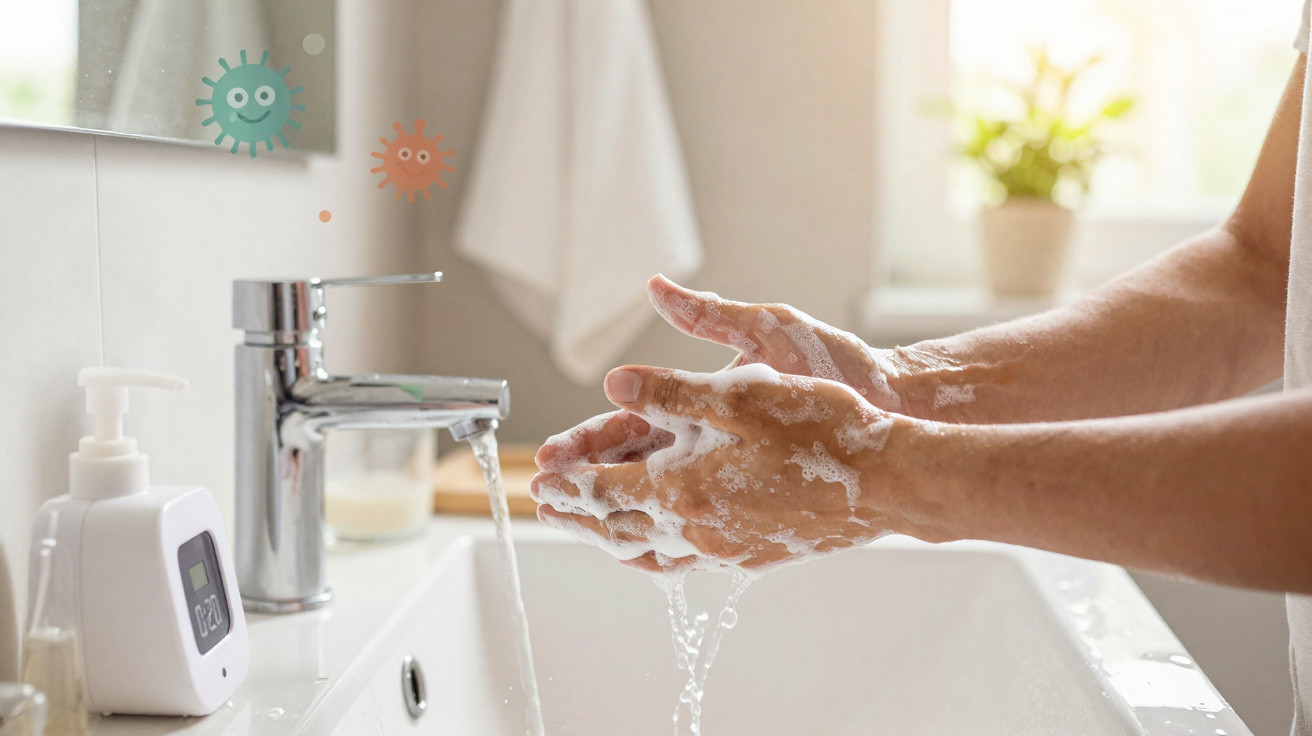
That tiny, clunky pause happens in nearly every public loo in Britain.
You walk up to the basin, nudge the tap on with your elbow (because you’re being “hygienic”), run your hands under the water, maybe squeeze out a blob of soap if you’re in a conscientious mood, rub for a moment, rinse, shake and leave. The last twenty people did much the same. Everyone heads out thinking: sorted - hands clean, conscience clear.
Only they probably aren’t clean. Not in the way you assume. Most of us have built a habit that prioritises speed over results. We spend five seconds and call it done because there’s a queue, we’re running late, or we simply can’t be bothered. The irritating twist is that the gap between a “quick rinse” and genuinely reducing the germ load on your skin is comically small. It’s roughly 20 seconds. And what you do inside those 20 seconds is where things get awkwardly revealing.
The Lie We Tell Ourselves at the Sink
In your head, there’s an ideal version of you: eats sensibly, gets eight hours, and always washes hands properly. Then there’s the real you at a motorway services toilet, doing a three-second rinse and labelling it hygiene. If we’re honest, nobody nails this perfectly every day, every time.
Part of the problem is that nothing happens immediately, so we convince ourselves nothing happened at all. You don’t feel a germ entering your body. You don’t hear bacteria cheering when you skip the soap. You dry your hands on your jeans, pick up your phone and carry on. That silent space between what you do and what it leads to is exactly where misplaced confidence thrives.
There’s also a peculiarly British politeness around shared sinks. You glance sideways, clock how long the person next to you is taking, and instinctively avoid looking like you’re showing them up. Nobody wants to be the odd one still scrubbing while someone else’s hand dryer has already finished. So our standards get set by awkwardness and routine, not by science.
Why “A Quick Rinse” Barely Touches the Germ Problem
Here’s the mildly grim reality: your hands do a lot of work. Every door handle, card reader, lift button, phone screen and train handrail you’ve touched has left something behind - bacteria, viruses, dead skin, traces of other people’s day. Much of it is harmless, but not all of it is. And it doesn’t disappear because you waved your fingers under lukewarm water for five seconds.
Water alone is a surprisingly poor cleaner. It shifts a little surface dirt, yes, but the stubborn stuff hangs on to oils and sits in tiny creases. That’s what soap is for. Soap molecules act like double agents: one end binds to oil and grime; the other end bonds with water. Given enough rubbing time, they surround the muck and germs, lift them from your skin and allow running water to carry everything away.
Cut it short and the soap never gets to finish the job. It’s like paying for a full wash cycle and cancelling it right after the pre-rinse. Infection control research keeps landing on the same conclusion: washing for about 5 to 10 seconds barely makes a dent. Washing with soap for around 20 seconds can remove up to 99.9% of the nasties on your hands. That “point nine nine” looks like boring label filler, but it’s why fewer children get ill in winter, fewer stomach bugs rip through offices, and fewer vulnerable people end up in hospital.
The Uncomfortable Bit: You’re Probably Missing the Worst Spots
Ask people whether they wash their hands properly and most will say yes without a second thought. But if you observe casually - not in a creepy way, just in passing - you’ll see the same routine repeat. Palms together, a quick rub, fingers pressed, rinse. It resembles handwashing, but it misses the places where germs actually linger.
Think about how your hands work all day. You pinch, tap, scroll and twist. That means fingertips, thumbs and the backs of your hands do most of the contacting, not just your palms. Yet when we wash, we focus on the easiest flat areas and hope the rest takes care of itself. It doesn’t. Germs favour warm, slightly tacky folds of skin: the base of your thumbs, the ridges around your nails, and the gaps between fingers where water won’t reach unless you force it to.
The “Hurry Up” Wash vs The Real Thing
Everyone’s had that moment in a café toilet when you realise someone’s waiting outside. You feel observed before the door even opens. So you do the quickest socially acceptable version of clean and leave. That’s the “hurry up” wash: a fast splash, a half-hearted rub, maybe a token swirl of soap.
The real version - the 20-second wash that actually shifts germs - looks almost theatrical next to that. There’s rubbing, twisting, interlacing fingers, working the thumbs. It can feel over the top, even faintly ridiculous, because you can’t see the germs leaving. Under a microscope, though, the difference is stark. It’s the space between “probably fine” and “safely clean”.
The 20-Second Method That Actually Works
Let’s remove the faff. No lab coat, no lecture - just a routine your brain can manage even when you’re tired and fed up. The key is 20 seconds of active scrubbing with soap. Not 20 seconds standing near a sink: 20 seconds of friction. That’s what dislodges germs so they can’t cling on.
A Simple, Human-Sized Routine
This is roughly what those 20 seconds should include:
Start by wetting your hands thoroughly. Then use enough soap to build a proper lather - not just a miserable smear. Rub palms together for a few seconds until it’s slippery and foamy, not merely damp.
Then interlace your fingers and scrub back and forth so the lather gets into the valleys between each finger. After that, push the backs of your fingers into the opposite palm and rub - the awkward move you’ve likely seen on hospital posters but never bothered to copy. Next, clasp one thumb in the other hand and twist as if you’re gently wringing it out, then switch.
Finally, do your fingertips: press them into the opposite palm and scrub in small circles, like you’re trying to shift ink. Nails are tiny shelves for dirt, so give them a beat. Add a quick rub of the wrists too - germs don’t stop politely at the base of your hand. Rinse under clean, running water and let the soap take everything down the drain. That’s what a real 20 seconds looks like, and it’s the difference between “feels clean” and “actually clean”.
“20 Seconds” Doesn’t Have to Feel Like an Eternity
Standing at a sink counting “one Mississippi, two Mississippi” makes you feel like you’re in detention, not just getting on with your day. Nobody wants that. So people cut corners - not because they’re reckless, but because it feels slow and tedious. The trick is to attach the timing to something that doesn’t feel clinical or forced.
Plenty of parents teach kids to hum “Happy Birthday” twice. It works, but as a grown adult singing to yourself in a crowded office loo, that’s social suicide. You don’t need a nursery rhyme. You only need a rough sense of how long 20 seconds is: a chorus you can’t stop hearing, reading the soap label once, or simply catching your reflection, taking one calm breath, then getting it done.
A small mindset shift helps too: instead of treating those 20 seconds as wasted time, use them as a micro-pause. A moment when nobody can email you, ping you or demand anything. Just warm water, soap and a brief blank space in your day. It sounds a bit daft, but as soon as it becomes a tiny ritual rather than a chore, you’re far more likely to do it.
The Hidden Chain: From Your Hands to Everyone You Love
Here’s the blunt truth: your hands don’t only affect you. They affect every person you touch, every surface you share, every sandwich you make. One lazy wash after using the loo can turn into your child’s stomach bug, your partner’s week off work, your gran’s chest infection. Suddenly that “can’t be bothered” moment looks different.
Germs travel through quiet, normal behaviour. You scratch your nose, tap your phone, pick up a biscuit, touch the kettle, pass it on. The trail is invisible, but it’s real. Think of that colleague who coughs all winter, sniffs, touches everything, and then everyone else mysteriously goes down ill in slow motion. Some of that spreads through the air, but plenty of it is shared surfaces - shared hands - shared shortcuts.
That 20-second wash is you snapping the chain. You’re stopping a whole pile of “might-have-happened” infections before they begin. You won’t get applause. No one will thank you. But your family, your colleagues, and the stranger beside you on the train all benefit quietly, without ever knowing why.
Truth Moment: No One Nails This Every Time
This is what hygiene campaigns rarely say out loud: you won’t perform the full, perfect 20-second routine every single time you touch a tap. Sometimes you’ll be sprinting for a train. Sometimes the soap dispenser will be empty. Sometimes you’ll just forget. Beating yourself up won’t help.
What matters is your average, not perfection. If you shift from “quick splash most days” to “proper 20-second wash most of the time”, the difference is massive. Fewer lingering colds. Fewer “dodgy tummy” days. Fewer children stretched out on the sofa, grey-faced, watching cartoons while clutching a bowl.
You don’t need to become a germ-obsessed robot; you just need to stop kidding yourself that what you’re already doing is enough. That’s the uncomfortable part. For years we’ve told ourselves a five-second rinse counts as hygiene. It doesn’t. But rewriting that story doesn’t require a personality transplant - just a bit of honesty and 20 quiet seconds.
From Awkward Habit to Quiet Superpower
There’s something oddly satisfying in realising a tiny, boring action can have an outsized effect. You’re not going to fix the NHS. You can’t wave away every virus in circulation. But you can stand at a sink, feel warm water on your skin, build a proper lather, and know you’re disarming 99.9% of the germs that hitched a ride.
Next time you’re at a public sink and that old reflex kicks in - the quick rinse, the “no one’s watching, I’ll be fine” shrug - pause for half a second. Picture every lift button, every shared keyboard, every fine mist of sneeze-spray from the day sitting on your hands. Then give yourself those 20 seconds. Not to be perfect - just to be responsible.
That’s all the 20-second method is: a small act of care, repeated quietly, again and again, when no one is clapping and no one is looking. A dull habit that protects the people you love far more than it will ever protect your image. And once you understand what your handwashing really is, it’s hard to go back to the three-second lie.

Comments
No comments yet. Be the first to comment!
Leave a Comment