
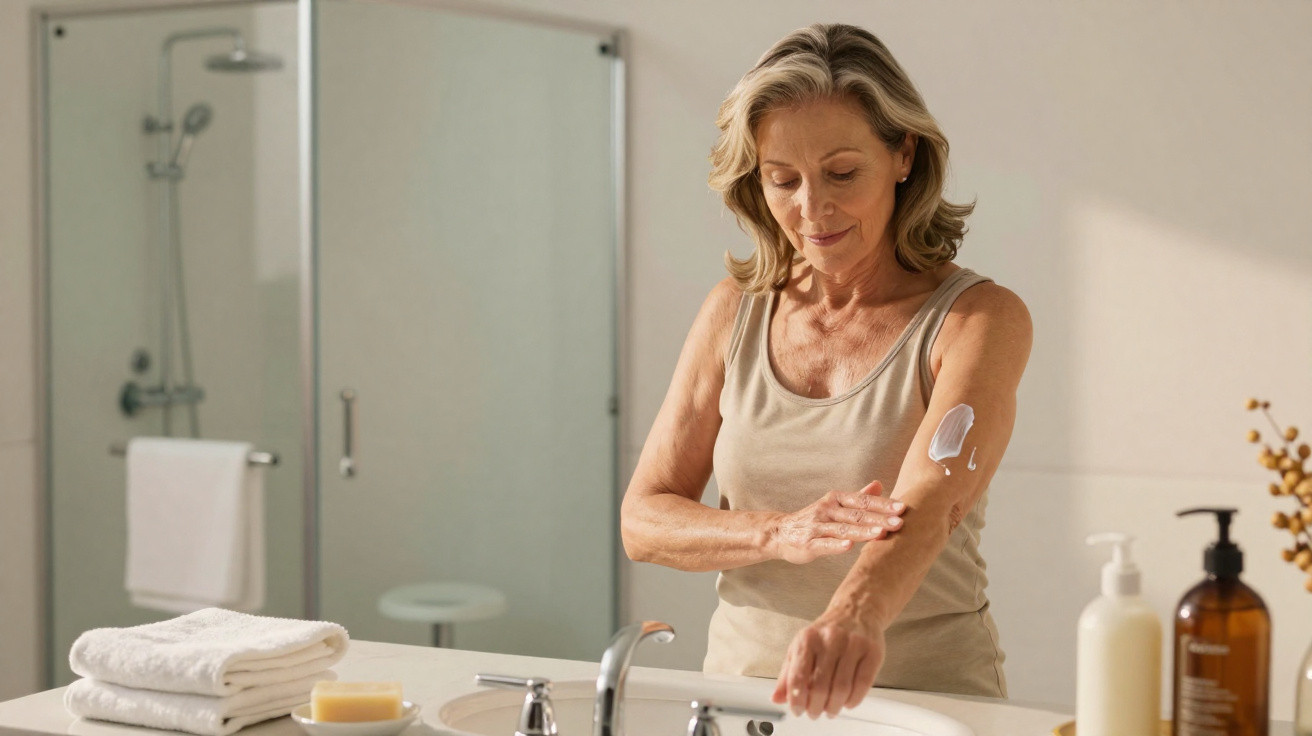
A woman in her late sixties stands at the bathroom mirror, dabbing a clean circle with the corner of a towel, studying her own face. Her smartwatch buzzes against the sink: steps, heart rate, sleep score. Everything measured, optimised, plotted. Yet the question she can’t shake this morning is far more basic: at her age, does it really make sense to shower every single day?
After a hot shower her knees feel a touch stiffer. The skin along her shins seems itchier than it used to. At her last appointment, her dermatologist muttered something about “microbiome” and “gentle washing”. She has spent decades absorbing the idea that cleanliness equals discipline, equals respectability. Now, that certainty is wobbling.
She turns on the tap and then pauses. The water streams out-hot, inviting. Her hand lingers above it, as if she’s deciding something weightier than “shower or skip”.
How many showers a week does healthy aging really need?
How often should you actually shower after 50?
Somewhere around midlife, the daily shower stops feeling like a default and starts feeling like a choice you have to justify. Skin can feel more delicate. Hair often changes in texture. What used to feel invigorating at 30 can leave you parched and tight at 65. You stand with the water running, wondering whether the routine you’ve always followed is quietly working against you.
Dermatologists are becoming more straightforward on this point: for older adults, more washing isn’t automatically healthier. Many well older people over 50 are fine showering about two to four times a week rather than every day. The “right” frequency varies with how much you sweat, how active you are, what medicines you take, and the climate you live in. That’s the part that catches many people off guard. Being clean doesn’t require being constantly scrubbed.
So instead of repeatedly asking, “Did I shower today?”, the more useful question becomes: “What do my skin and body need this week?”
One American survey found that roughly two-thirds of adults said they shower daily. Among those over 60, the figure falls markedly. That shift isn’t just about motivation; it’s often the body insisting on a rethink. New red patches appear. Arms become flaky. Heels crack and sting the moment hot water touches them.
Talk to a group of active grandparents after a yoga session or a long walk and the stories tend to rhyme. “I shower after swimming, and that’s about it.” “I just wash my armpits and feet on non-shower days.” “I used to feel guilty if I skipped a day. Now my skin just feels better.” These are not people who have stopped caring-they’re people who have adjusted.
Healthy aging doesn’t mean abandoning hygiene; it means recognising that a 20-year-old’s habits applied to a 70-year-old’s body can come with downsides. Daily, full-body hot showers combined with strong soaps can strip natural oils at a time when ageing skin is already producing less. Then you find yourself trying to compensate with creams and balms, while the underlying cause is still waiting for you in the shower.
Biologically, skin shifts as the decades pass. Sebum production decreases, the protective barrier weakens, and the helpful bacteria that live on the skin become easier to disturb. Frequent hot showers can throw that balance off. That’s when dryness and itching become more common, and tiny fissures can appear-raising the risk of infection.
In practical terms, aiming for balance is usually wiser than aiming for maximum frequency. If you’re mostly sedentary, live somewhere temperate, and aren’t sweating heavily every day, two or three showers a week is often sufficient. In between, a quick wash of the key areas keeps you socially comfortable and perfectly healthy. If you’re very active, three to four showers a week tends to be the sweet spot.
The hardest part can be letting go of the old script. Many of us grew up with the belief that a “proper adult” showers daily, without exception. Dropping that rule can feel almost rebellious-even when your skin is clearly pleading for it.
The smart shower routine for healthy aging
A straightforward approach that many geriatric specialists recommend is to separate your week into “full shower days” and “spot-clean days”. On full shower days, you wash all over, but you do it gently: lukewarm water, a mild cleanser for the armpits, groin, feet, and any areas that are visibly dirty. Unless they truly need it, you avoid aggressive scrubbing on arms and legs.
On spot-clean days, you skip the shower entirely. Instead, you go to the sink with a soft flannel, warm water, and a small amount of gentle soap for the places most likely to smell or become irritated-usually the armpits, under the breasts, the groin, and the feet. It takes about five minutes. Put on clean underwear and you’re done. Skin protected, dignity intact, no exhausting grooming marathon.
Use that as a baseline, then flex it according to real life. A day of heavy summer gardening? Add a shower. Spent the day quietly reading indoors? You might not need one. One advantage of age is that you can design a routine around your actual days, not an advert slogan from the 1990s.
A common worry-especially for older generations-is: “If I shower less, I’ll smell.” Hygiene is loaded with emotion. It connects to how you were brought up, how classmates or colleagues judged you, and the remarks that never quite left you. But in practical terms, body odour comes mainly from bacteria in sweaty areas rather than from your forearms or calves. Clean those key zones consistently, change clothes, and you’re already doing what matters most.
Where many people overdo it is in chasing an “extra clean” feeling: very hot water, long showers, and multiple strongly fragranced products. Then winter arrives and they wonder why their skin stings when they step outside. This isn’t a personal failing-it’s simply habit colliding with physiology. Your body at 65 simply doesn’t want the same thing your body did at 25.
Let’s be honest: nobody truly does this perfectly every day. No one keeps up the idealised “perfect routine” beauty magazines promote, especially over years. You get worn out. You travel. You help the grandkids with homework late into the evening and drift off on the sofa. Skipping a daily shower doesn’t make you unhealthy; ignoring what your skin is clearly telling you might.
“For healthy older adults, the question isn’t ‘Am I showering enough?’ but ‘Is my routine working with my skin, or against it?’” says one London-based dermatologist who specialises in patients over 60. “Two to four showers a week, plus targeted washing on other days, is a very reasonable goal for most people.”
To keep things simple, here’s a quick checklist you can keep in mind:
- 2–4 full-body showers per week, adjusted for sweat and activity
- Short, lukewarm showers instead of long, hot ones
- Mild, fragrance-free cleanser on “high-odour” areas only
- Spot-clean at the sink on non-shower days
- Moisturise within 3 minutes of stepping out of the shower
Taken together, these small shifts can mean fewer itchy nights, fewer winter flare-ups, and a body that simply feels easier to live in. You don’t need perfection-you need a routine that suits the skin you have now.
Listening to your body, not just the rules
How many showers you “should” take is less of a fixed rule and more of an ongoing conversation with your body. Treat your skin like a record of what’s working. Do your shins look pale and flaky a couple of hours after drying? That’s information. Are you waking at 3 a.m. scratching? More information. Do you feel noticeably better in weeks when you shower three times rather than six? That isn’t laziness-it’s feedback.
This isn’t discussed much, but showering can carry a lot of emotion, particularly as you get older. When joints ache, climbing in and out of the bath or shower can feel like an expedition. When your energy is low, even standing under water for ten minutes can feel like a task. At a human level, your hygiene routine should support health rather than drain your strength. In a good week, two considerate showers can feel better than seven rushed ones.
Next time you’re in front of the bathroom mirror, try not to begin with, “How many showers did I have this week?” Start with, “How does my skin feel today?” Perhaps you run a finger along your forearm and notice it feels comfortable rather than tight. Perhaps you look at your diary and see several long walks coming up, so you’ll likely shower a bit more. Or perhaps you’re caring for a partner and that quiet time in the bathroom is your only real pause in the day.
Healthy aging isn’t about following stricter rules than ever. It’s about noticing the small, quiet signals from your own body-and adjusting, even when it clashes with what you were taught in childhood.
| Key point | Detail | Why it matters for the reader |
|---|---|---|
| Ideal frequency | For many adults over 50, 2 to 4 showers per week are enough | Helps reduce dry skin while still feeling socially comfortable |
| Hybrid routine | Alternate “full shower days” with “spot-clean days” at the sink | Keeps sensitive areas clean without stripping the whole body |
| Quality over quantity | Short showers, warm (not hot) water, gentle cleanser, moisturise quickly | Protects the skin barrier and reduces itching and discomfort |
FAQ:
- How many showers per week are healthy after 60? For many healthy older adults, 2–4 showers per week work well, with quick washing of armpits, groin, and feet on other days. Your activity level and climate can nudge that number up or down.
- Is it unhygienic to skip a daily shower? Not if you keep key areas clean and change your clothes and underwear. Odour comes mainly from sweaty spots, not from your entire body. Hygiene is about targeted care, not constant scrubbing.
- Can showering too much damage aging skin? Yes. Frequent hot showers and strong soaps can strip natural oils, weaken the skin barrier, and trigger dryness, itchiness, or eczema flares, especially on already fragile mature skin.
- What’s the best shower routine for very dry, mature skin? Keep showers short and lukewarm, use a gentle, fragrance-free cleanser on limited areas, avoid harsh scrubbing, and apply a rich moisturiser within three minutes of towelling off.
- Should older adults shower more often if they exercise? If you sweat heavily with exercise, you might need an extra shower, especially in warm weather. You can also rinse and focus on sweaty zones rather than doing a full, long wash every single time.


Comments
No comments yet. Be the first to comment!
Leave a Comment