
A single, everyday ingredient from the kitchen can leave even professionals scratching their heads: how can such a cheap, unassuming liquid make hair feel smoother, look brighter and comb through more easily than many hyped-up salon products? That question sits at the heart of this first-hand account - and it also explains why this old grandmothers’ trick is suddenly having a comeback.
When the hairdresser assumed I’d had luxury treatment
Plenty of people know the routine: you settle at the backwash and almost brace yourself for the verdict on dry ends, brittle lengths and lacklustre strands. Months of central heating, scarves and hats take their toll. This time, though, it played out differently.
My hairdresser ran his hands through my hair, paused mid-motion and looked genuinely puzzled. The texture felt unusually sleek. The brush slipped through the lengths without snagging, and the surface looked almost polished. The shine was so strong it could have passed for a fresh in-salon gloss.
With that assumption, the professional asked which expensive brand I’d been using - some “high-end product” that would explain the finish.
"What looks like luxury care can, in reality, be a kitchen staple - used properly, the price hardly matters."
The punchline was simple: there was no specialist mask or new trend range behind it. The result came from stripping my routine right back to one very ordinary product - and deliberately skipping conventional conditioners.
Why traditional conditioners left my hair feeling tired
Before I changed anything, my routine looked completely standard: shampoo, a rich conditioner, a mask now and then, and sometimes a serum on the ends. In the short term, my hair felt soft. Over time, the pattern shifted: weighed-down lengths, a dulling film and barely any volume.
A big part of the issue sits in many high-street formulas. They often use silicones or other film-forming ingredients that wrap the hair in a thin, plastic-like coating. At first, the effect is convincing: the surface seems smoother and tangles are easier to manage.
But with every wash, more residue layers onto the fibre. Gradually, this turns into build-up - an invisible accumulation of product leftovers. Hair then absorbs moisture and nourishing ingredients less effectively, and it starts to feel sluggish and flat. If you respond by washing more often and adding yet more “care” on top, the cycle usually gets worse:
- Roots become greasy more quickly because you’re constantly trying to cleanse the coating away
- Lengths dry out further as the natural balance is disrupted
- Styling holds less well because the surface feels slightly sticky and coated
That spiral is exactly what pushed me to look for an alternative that would lift residue, make hair feel lighter - and still stay gentle.
The forgotten staple from Grandma’s kitchen
The surprising answer is in many cupboards: apple cider vinegar. It’s been a salad staple for decades, but in hair care it was sidelined for a long time - and it’s now quietly returning. Anyone who explores minimalist beauty will come across it sooner or later.
Apple cider vinegar is made from fermented apple juice. Fermentation produces organic acids, trace elements and minerals. What matters most here is the acetic acid content alongside its mildly acidic pH. Unlike many “deep-cleansing” shampoos, apple cider vinegar doesn’t feel like sandpaper on the scalp; it behaves more like a gentle descaler for hair and mineral deposits.
"Apple cider vinegar works like a natural reset button: it clears the weight from hair without stripping it."
If you choose an organic, naturally cloudy (unfiltered) product, you also get additional compounds from fermentation. These are often said to support the scalp’s microbiome and soothe irritation - a detail that can be particularly relevant for people with sensitive scalps.
What actually creates that extra shine
Tackling limescale from tap water
In many areas, tap water is hard, meaning it contains a lot of limescale. With each wash, tiny mineral particles can settle on the hair’s surface. Over time, this creates a dull veil - like a dusty film across the hair. Shampoo can remove dirt and oil, but it often struggles with mineral deposits.
The acidity in apple cider vinegar helps dissolve these limescale residues. Afterwards, hair doesn’t just feel lighter; it reflects light far more clearly. Shine doesn’t come from piling on a thick coating of product - it comes from having a clean, smooth surface.
Using pH to keep the cuticle lying flat
Healthy hair and a stable scalp sit in a slightly acidic range. Water - and many cleansing products - is closer to neutral or even slightly alkaline. That shift can lift the cuticle on the hair shaft. Hair then feels rougher, picks up grime more easily and tangles faster.
An acidic rinse with apple cider vinegar lowers the pH again. The cuticle can settle down more tightly, so the surface looks more sealed. Light reflects better, hair looks glossier, and combing becomes easier. It’s exactly this slip that hairdressers notice when they run their fingers through the lengths.
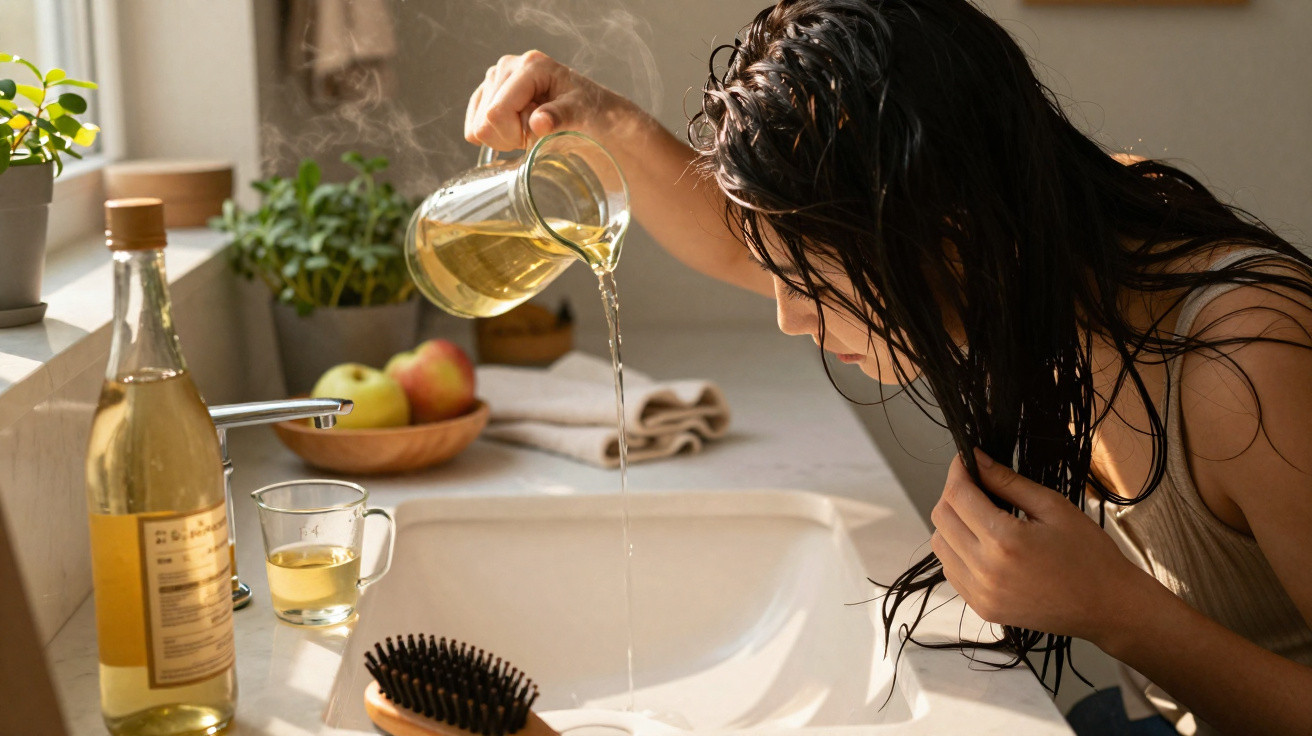
The easy “1-to-4” method at home
If you want to try apple cider vinegar, don’t use it straight from the bottle. In its concentrated form, the acidity may irritate the scalp and hair. A diluted rinse works better, used after shampoo.
A well-tested ratio is:
- 1 part apple cider vinegar (ideally organic and naturally cloudy)
- 4 parts cool water
How to apply it, step by step:
- Wash your hair as usual with shampoo, then rinse thoroughly.
- Slowly pour the prepared apple cider vinegar mix over your scalp and lengths.
- Massage in gently, focusing on areas that typically knot up.
- Leave it on for about two minutes so the acidity and minerals can do their job.
- Rinse out with clean water, preferably on the cooler side.
The cooler rinse boosts the effect: it acts like a small temperature shock that helps smooth the hair structure further. The typical vinegar scent disappears once the hair dries. If you want, you can mist a light, silicone-free spray onto the ends - but for many people the rinse alone is enough.
How often makes sense - and who it suits
For many, once a week is plenty. Oily roots, flaky scalp or itchiness often improve with slightly more frequent use, such as every four to five days. Very dry or heavily coloured hair can be more reactive: in that case, it’s sensible to test cautiously and, if needed, increase the water content in the mix.
Children’s hair usually copes well too, provided there’s no stinging and the dilution is right. If you’re prone to allergies or have broken skin on the scalp, start with a very low concentration first.
Noticeable benefits for your wallet and your bin
There’s also a practical side effect: once apple cider vinegar becomes part of your routine, you typically need far fewer standard conditioners and masks. Many people report cutting them out completely or only reaching for an extra product occasionally. That can noticeably reduce the number of plastic bottles used over a year.
At the same time, a litre of apple cider vinegar costs a fraction of what salon products or trend serums demand. Because you dilute it, it lasts a long time. The bathroom feels less cluttered, shelves look clearer, and attention shifts back to a few deliberate steps.
"Fewer bottles, fewer ingredients, more impact - apple cider vinegar fits perfectly with a minimalist care approach."
What to watch out for when using apple cider vinegar on hair
As straightforward as the trick sounds, a few points matter. Highly sensitive scalps or freshly coloured hair may react more strongly. Mild itching or a tight feeling suggests the mix is too strong or the rinse is being used too often. In that situation, adjust the dilution - for example, 1 part vinegar to 6–8 parts water.
Quality also plays a role: a cheap, heavily filtered vinegar in a large catering container won’t necessarily provide the same fermentation by-products as an unfiltered one. If you already like using apple cider vinegar in salads, it makes sense to choose a type that works equally well in the kitchen and the bathroom.
What this trick changes in the rest of your routine
The longer-term impact is where it gets interesting. When you regularly remove limescale and product residue, you often find that many other steps become unnecessary. Styling mousse can grip better because hair is no longer coated. Air-drying becomes easier because strands don’t catch on each other as much. Even heat styling tends to look more defined when the base is right.
At the same time, it can shift how you view new products. Instead of chasing every launch, many people start checking ingredients, film-formers and genuine benefits. Realising that a simple household staple can keep up with expensive care can make you more critical - and more confident - about how you look after your hair.




Comments
No comments yet. Be the first to comment!
Leave a Comment