
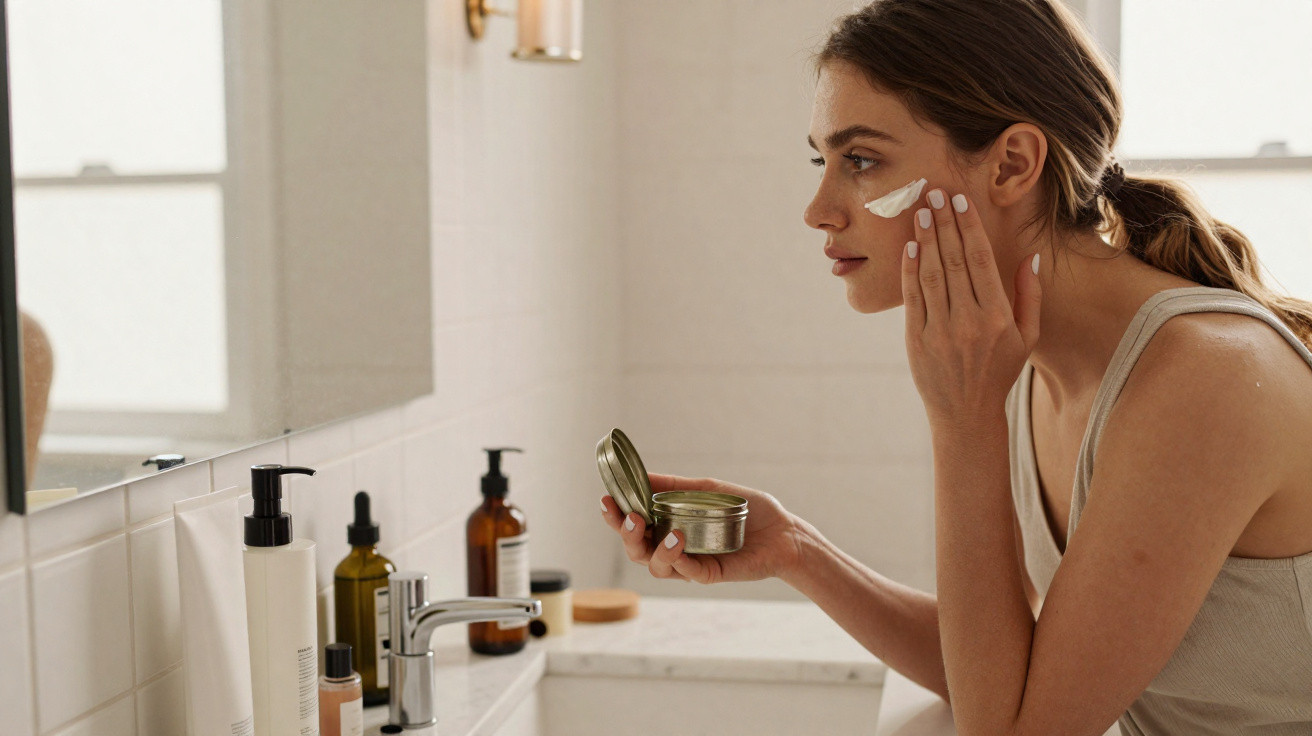
The jar was barely on your radar.
A squat white tub with a slightly yellowed label, wedged at the back of the bathroom cabinet beside out-of-date aspirin and a long-abandoned perfume. You unscrew the lid, partly curious and partly nostalgic - your grandmother’s moisturiser, the one she applied every night, without fail.
The smell arrives first: clean, powdery, faintly medicinal. You smooth a small dab onto the back of your hand, bracing for something thick and tacky. Instead, your skin absorbs it as if it has been waiting for that exact feel. An hour later your hand is still soft, and the £80 cream on your shelf suddenly looks like an overpriced ornament.
Some older products don’t age well. This one feels, almost irritatingly, brilliant.
It makes you wonder what else the beauty industry never bothered to mention.
Grandma’s cream quietly wins the skincare war
Dermatologists see the fallout every day: faces flushed raw by acids, eyes stinging from retinol, and rashes triggered by fragrances that “smell like a dream” but behave like a nightmare. Then a person arrives with calm, steady skin and says - almost sheepishly - “I just use that cheap cream my mum always used.” That’s the moment the dermatologist rolls closer.
More often than not, that “cheap cream” is a traditional occlusive moisturiser: Nivea Creme, Pond’s Cold Cream, Eucerin Original, classic petroleum jelly, straightforward glycerin lotions. These formulas lean on simple, heavy-duty moisturisation rather than a jumble of trend-led ingredients and glossy buzzwords. They are not glamorous. They are not “Instagrammable”. But they quietly do the work of supporting a compromised skin barrier while the rest of us chase serums with names that sound like chemistry exams.
A London dermatologist told me about a patient who had spent over £3,000 in a year on luxury skincare - glass bottles, frosted jars, influencer-approved kits shipped in from Korea and California. Her skin, though, was angry, tight, and constantly breaking out. The doctor pared her routine down to a basic cleanser and a classic chemist moisturiser, and within six weeks her skin had changed completely. No magic. No “secret ingredient”. Just barrier repair and consistent hydration.
Consumer surveys echo this. In blind tests, lots of people cannot consistently tell a premium cream from an affordable moisturiser. Yet the global premium skincare market continues to grow, driven by the belief that price equals performance - and dermatologists say that belief is exactly where we’re being played.
Here is the plain, unsexy reality: your skin doesn’t care about the logo on the jar. It reacts to ingredients, texture, and how regularly you apply them. Old-school blends loaded with petrolatum, glycerin, lanolin, and mineral oil excel at one job: reducing water loss from the skin. That single function sits underneath almost everything we interpret as “glow”.
When your barrier is in good shape, products behave as they should, redness eases, fine lines look temporarily softer, and that dull, grey cast can lift. When the barrier is damaged, every active you layer on top is essentially petrol on a small fire. Grandma-style creams often succeed because they do less - and that “less” is exactly what many faces are crying out for.
How to actually use grandma’s cream in 2026
Treat that unassuming jar like a final layer, not a fancy centre-piece. Start by cleansing with a gentle, non-foaming cleanser. While your skin is still slightly damp - not dripping wet, just not completely dry - apply your usual lightweight serum, if you like using one. Then follow with a pea-sized amount of the old-school cream.
Rub it between your fingers first so it softens and melts slightly. Press it on: cheeks, forehead, chin, around the nose. There’s no need to scrub or drag the skin. Think of it as tucking your earlier products under a soft blanket. At night you can apply a little more, especially over dry patches or around fine lines. That’s your quiet barrier-repair shift, working while you sleep.
If your skin is very oily or prone to acne, use the dermatologist-favourite approach: “spot occlusion”. Rather than coating your entire face, apply the grandma cream only where you’re dry or irritated - corners of the mouth, sides of the nose, around the eyes, or along the jaw where retinoids often cause irritation. For the rest of your face, stick to a lighter gel moisturiser.
In practical terms, this helps you keep the actives you enjoy without sacrificing your skin’s sanity. Retinol, vitamin C, exfoliating acids - they generally behave better when the skin is not dehydrated and inflamed. One New York dermatologist even called basic petrolatum “the best over-the-counter tool we have for saving barrier-damaged skin,” which is not exactly the sort of line that sells £200 jars wrapped in gold foil.
Where many people go wrong is the everyday choreography. We layer too much, in the wrong order, then blame the cheapest product when our skin reacts. Or we assume that because a luxury cream cost a week’s rent, it must function as a “complete routine” in a single jar. It doesn’t. It is still just a moisturiser - the same category as the one in your grandmother’s cabinet, only with a better press release.
Let’s be honest: hardly anyone does skincare perfectly every day. We rush, we skip steps, we fall asleep in make-up, we forget SPF, and then try to fix everything overnight with a miracle cream. Old-school formulas are oddly forgiving of that real-life mess. They don’t demand a 10-step sequence; they need clean skin, a bit of water, and time.
Then there’s the guilt. Plenty of readers quietly admit in forums and DMs that they feel “cheap” or “behind” when they rely on classic chemist creams - as if skincare is a status contest rather than a basic hygiene habit. Yet dermatologist after dermatologist repeats the same point: the best product is the one you will use consistently, not the one that sits on a high shelf waiting for special occasions.
A French dermatologist I spoke to put it bluntly.
“If you’re spending more on the jar than on sunscreen,” she said, “you’re not buying skincare, you’re buying a story.”
Those stories are persuasive. Luxury creams can offer identity, aspiration, and a small moment of theatre in a stressful day. That has its own value. But it helps to separate emotional comfort from biological impact. Your skin cells don’t recognise prestige; they recognise moisture, lipids, and the absence of irritation.
- Use grandma’s cream at night to seal everything in and let your barrier repair while you sleep.
- Keep mornings lighter with a simple hydrator and broad-spectrum SPF - your true anti-age hero.
- Watch your skin, not the marketing: if redness eases, flakiness settles and make-up sits better, you’re winning.
The quiet rebellion in your bathroom cabinet
That old jar holds a small revolution: the option to step out of the endless upgrade cycle - new serum, new cream, new seasonal “must-have” - and still have skin that looks rested, comfortable, and alive. No routine police are going to knock on your door because you decided to go back to basics.
At a deeper level, it can feel like a reconciliation. With your face as it is now, unfiltered. With family rituals that once seemed outdated and suddenly look rather wise. With the idea that care doesn’t always need to be optimised, maximised, or “hacked”. Sometimes it simply needs to be repeated quietly, night after night, the way your grandmother did while the radio hummed in the background.
Most of us know that instant time-travel feeling - a scent, a texture, a small domestic object that pulls you back 20 years in a second. A simple cream can do that. Massaging it in slowly, almost meditatively, can pull you out of your feed and back into your body. It won’t show up in before-and-after photos, but it can change how you live in your own skin.
Maybe that is the real luxury: not an embossed logo, but the calm of no longer chasing the next expensive promise. Of having something that works, is easy to get, and doesn’t demand a total lifestyle overhaul. You can still enjoy your fancy products, of course - the scented oil you love, the serum that genuinely helps your pigmentation.
Just keep this in mind: sitting at the back of your cabinet, in a jar that looks like it belongs in 1973, may be the one cream doing more for your skin than half the shiny newcomers. And that realisation is surprisingly freeing.
| Key point | Detail | Why it matters to you |
|---|---|---|
| Old-school creams repair the skin barrier | Simple occlusive ingredients lock in moisture and calm irritation | Helps explain why an affordable cream can outperform luxury options |
| Price doesn’t equal effectiveness | Blind tests and dermatologist feedback show basic formulas often work as well or better | Encourages smarter spending and less product guilt |
| Use grandma’s cream as a “seal” at night | Layer it over lighter products on damp skin, or simply over clean skin | Gives a clear, easy routine you can start tonight |
FAQ:
- Isn’t mineral oil or petrolatum bad for the skin? Current research and dermatology consensus say no. Cosmetic-grade mineral oil and petrolatum are highly purified, non-comedogenic for most people, and excellent at preventing water loss.
- Can I use an old-school cream if I have acne? If your acne is active and inflamed, go carefully. Use thicker creams only on dry or irritated patches, not all over, and keep your main moisturiser lightweight and non-comedogenic.
- Do luxury creams ever make sense? Yes, if they contain specific, proven actives you enjoy using, or if the texture and ritual genuinely make you feel good. Just don’t expect the price alone to guarantee better skin.
- How do I know if a simple cream is working? Watch for less tightness after cleansing, fewer dry patches, softer fine lines, and a calmer feeling overall. Make-up should sit more smoothly and stingy sensations should decrease.
- Should I throw away all my current products? No. Start by adding the old-school cream at night for a few weeks and reducing anything that burns or stings. Let your skin tell you what deserves to stay.




Comments
No comments yet. Be the first to comment!
Leave a Comment