
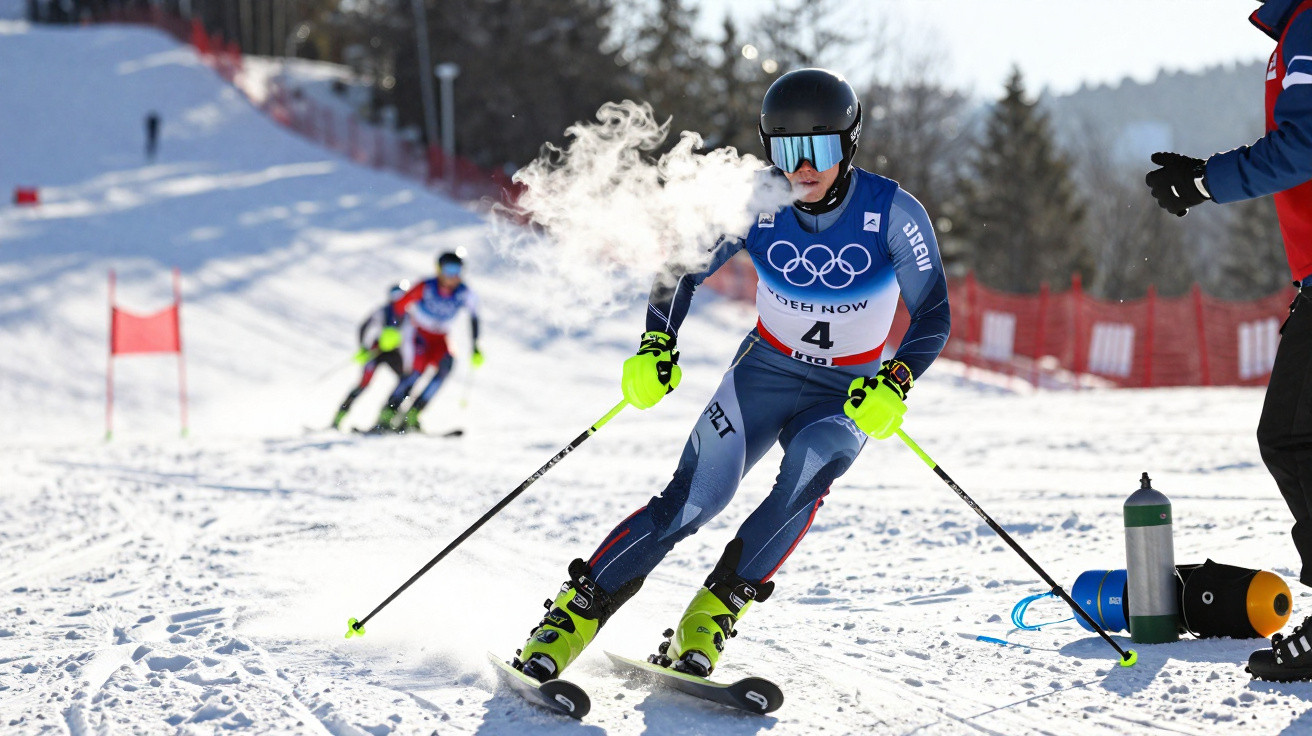
Winter Olympics athletes may appear effortless on television, yet every jump, spin and sprint is performed in conditions that test the body to its limits.
Cold air constricts blood vessels, rapid rotations disrupt balance signals, and fierce competition increases psychological pressure – but top winter athletes remain strikingly composed.
Scientists are beginning to identify the biological explanations. Research indicates that years of practice remodel the brain systems responsible for balance, increase muscles’ capacity to produce energy, and improve the body’s ability to cope with cold stress.
Combined, these adaptations show how trained athletes retain precision, stamina and control when cold, speed and pressure converge.
Why elite athletes remain steady
In winter sports, a loss of balance can happen in a fraction of a second, often while rotating fast enough to overwhelm an untrained nervous system.
Dr Kathleen Cullen, a biomedical engineer at Johns Hopkins Medicine, said that continual exposure to extreme movement rewires the brain circuits involved in balance.
A successful landing starts well before a blade meets the ice: the nervous system combines information about head movement and body position to preserve accurate timing.
Years spent rotating at high speeds make balance circuits less sensitive to clashing sensory signals, enabling athletes to remain stable as spins become more intense.
This retuning helps account for the steadiness of trained athletes during violent motion, when the body has virtually no time to correct an error.
Training the brain for spins
Rapid spinning challenges the cerebellum, the part of the brain that refines movement, to resolve differences between expected movement and movement that is actually sensed.
Elite skaters at the Winter Olympics can complete more than 300 rotations per minute during spins. Internal models – the brain’s predictions used to direct movement – help keep their reflexes settled.
“Years of training allow the cerebellum, the brain’s center for movement and balance, to build internal models that automatically recalibrate how motion-related sensory signals are interpreted, so what would make most people dizzy no longer throws elite skaters off balance,” Cullen said.
These models may deteriorate during illness or a break from training, meaning an athlete returning to competition can require weeks before feeling stable again.
Oxygen powers winter endurance
Extended cross-country skiing events require consistent output, and muscles provide it by converting oxygen into usable energy.
Muscle cells depend on mitochondria – small power plants that transform food and oxygen into energy – to prevent the strength of each stride from declining.
Endurance training creates bigger mitochondrial networks, helping athletes use more fuel before their muscles begin to slow. Genetics and recovery time, however, still limit the extent to which endurance can increase.
Mitochondria alone cannot create power – oxygen must also reach them rapidly, particularly in a sprint finish.
Active muscles rely on capillaries, the tiny blood vessels that carry oxygen, and training can gradually increase the density of this network.
Biopsies taken from ultramarathon runners reveal mitochondria gathered near the surface of cells, close to the point where capillaries release oxygen, reducing the distance it has to travel.
Nevertheless, dehydration or blood vessels constricted by cold can still limit that supply, showing athletes that endurance relies on both energy production and oxygen delivery.
The body’s response to cold survival
As air temperature falls, sensors in the skin quickly warn the brain and the body immediately begins conserving heat. Blood vessels in the skin constrict and direct warmer blood towards the body’s interior, reducing heat loss through exposed hands and faces.
The hypothalamus, a deep-brain thermostat and control centre for body temperature, triggers shivering when the body lacks sufficient warmth.
Although these automatic responses safeguard vital organs, they require energy and can deplete an athlete who begins a race already cold.
Athletes’ concealed source of heat
Some bodies generate warmth without shivering through non-shivering thermogenesis, producing heat without muscle trembling when cold threatens performance.
This process uses brown fat, a heat-producing form of fat rich in mitochondria, which burns stored fuel to release warmth.
Among adult humans, brown fat activity increases during colder weather, and scientists have associated larger amounts with lower body weight. People acclimatised to cold may retain more of it, although age, medication and climate continue to influence how much support it offers.
Pressure, fatigue and Winter Olympics athletes’ brains
Athletes taking part in the Winter Olympics can feel fatigued before their muscles have genuinely failed, and that feeling may affect how hard they continue to push.
Functional magnetic resonance imaging, a brain-scanning technique that measures activity through changes in blood flow, reveals how mental fatigue changes decision-making. When people become mentally tired, they more often select easier tasks, even if greater effort offers bigger rewards.
This change does not make performance collapse, but it increases the perceived cost of effort, which may be especially important during the last push of a race.
Moments of intense pressure can magnify this effect. If a medal rests on one run, the brain’s reward systems may react too strongly to what is at stake, shifting focus to the result rather than precise execution.
Experiments involving substantial incentives showed that value signals in these regions increased while performance occasionally fell, a pattern associated with “choking” under pressure.
Presenting a target as avoiding a loss rather than pursuing a gain improved performance stability, indicating that athletes’ mental framing of high-stakes situations can influence the choices they make when fatigue and pressure meet.
How athletes recover after mistakes
A missed edge or unsteady landing gives the nervous system fresh information, and elite athletes react before panic can take hold.
The brain interprets this discrepancy as a prediction error – the difference between what was anticipated and what was sensed. Cerebellar neurons can modify movement plans in real time, allowing the next jump to use revised timing and force.
This swift adjustment enables a snowboarder or skater to continue after an error, although it cannot immediately remove fear.
Across muscles, the brain and heat regulation, Winter Olympics training shapes systems that anticipate, provide and protect when conditions become severe.
These adaptations take years to form and may diminish with time, so future research will need to monitor how rapidly athletes acquire or lose them.






Comments
No comments yet. Be the first to comment!
Leave a Comment