
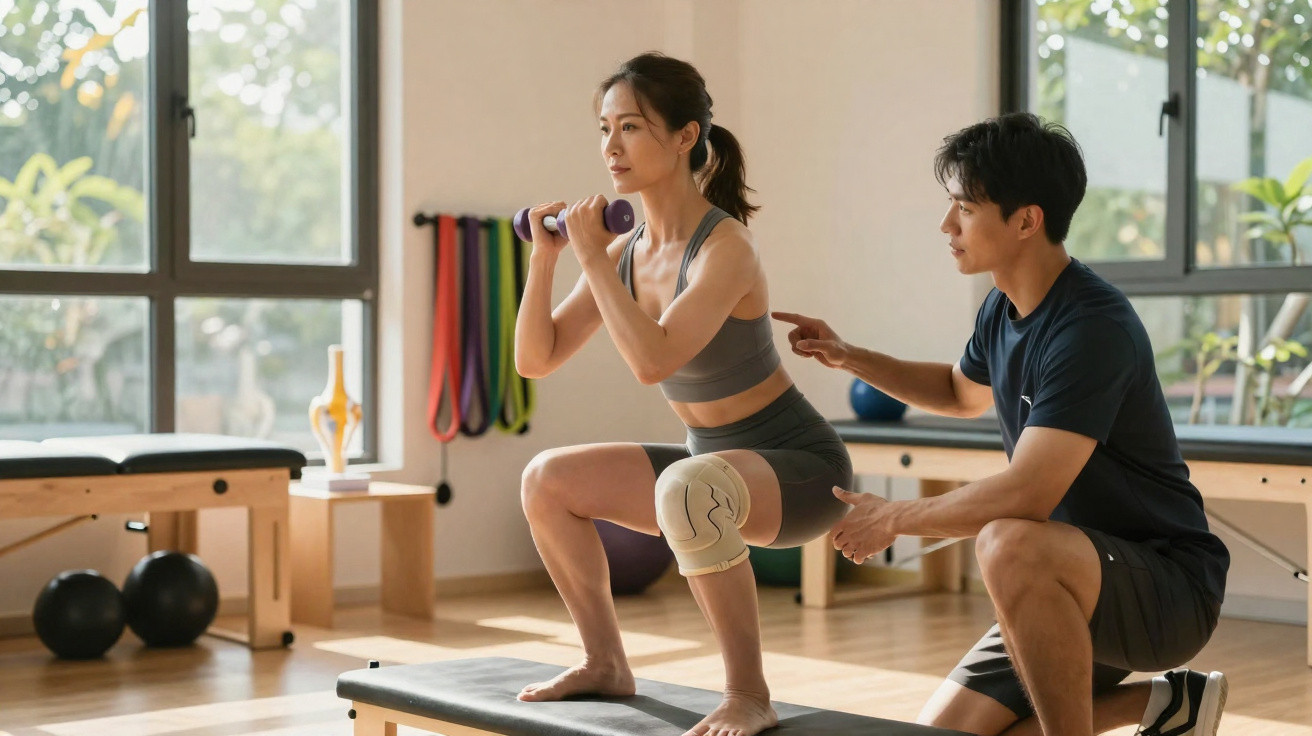
The physiotherapist asks Laura to raise her leg just ten centimetres from the treatment table. At 49, she presses her lips together. Her knee shakes, her expression tenses and, three seconds later, she drops her leg with a weary sigh. “I used to run for the bus in heels,” she says, half amused and half furious. Elsewhere in the rehabilitation room, the scene is familiar: a former footballer, a young mother recovering from a meniscus tear, and a retired person who simply wants to garden without flinching at every squat.
Each of them has received the same advice: “Do gentle exercise.” They have tried swimming lengths, mat-based Pilates and YouTube stretching sessions. A few have found some relief; others have been left unsure what to do. Beneath that imprecise recommendation lies one persistent, straightforward question: what truly helps painful knees?
The answer may not be what you expect.
Why your knee rejects some “good” exercises but responds to one in particular
When your knee is painful, a flight of stairs can feel like a mountain and chairs seem to get lower by the day. You begin arranging everyday life to avoid discomfort: no crouching to fasten your shoes, no kneeling to play with the children and no lengthy walk without locating the nearest bench first. Told to move “gently”, you join a swimming session or Pilates class, expecting the water or controlled movements to solve the problem.
It can offer a little help, certainly. But the next morning, the stiffness returns. You still feel grinding when rising after a film. Eventually, you start asking whether “gentle” is simply a polite way of saying “this is unlikely to make a real difference”.
Consider Marc, a 57-year-old office worker and former basketball player. His doctor diagnoses osteoarthritis in both knees. Alarmed, he gives up his weekly game and starts swimming three times a week because “everyone knows swimming is best for the joints”. After two months, his fitness is better and his lungs are pleased… but his knees? Less so. Getting into the car still hurts, while walking downhill continues to trigger a sharp pain beneath his kneecap.
At last, his physiotherapist observes his walking and assesses his strength, then calmly challenges his assumption: “You’re not weak because of osteoarthritis, you’re in pain because your thighs and glutes aren’t doing their job anymore.” They begin a new approach: less glamorous than front crawl, but far more effective.
The simple reality is that the knee does not operate in isolation. Positioned between the ankle and hip, it relies on the strength and control of the structures around it. Swimming and Pilates may be excellent for overall fitness or flexibility, but they do not always provide what a knee urgently requires: progressive, targeted muscle strengthening around the joint in a functional, weight-bearing position. The supposedly mysterious “best activity” repeatedly recommended by experts is remarkably straightforward: structured, low-impact strength training focused on the legs and hips, especially in closed-chain exercises like walking, sit-to-stands, mini-squats and step-ups. It may sound unexciting, but its effect can be substantial.
Low-impact strength training for knees without overloading your joints
Put aside the idea of heavy barbells and Instagram-style workouts. When physiotherapists and sports doctors discuss strength work for sore knees, they are often describing something quieter and almost dull: small, controlled repetitions that train the muscles to take the load before the joint has to. The starting point is usually basic, sometimes involving body weight alone.
A standard example is the sit-to-stand from a chair. Keep your feet flat and your knees aligned with your toes, lean forward slightly, then rise slowly before lowering yourself back into the chair over three seconds. That is all. Do it ten times, three times each week. As the weeks pass, use a lower chair, pause slowly halfway through the rise or hold a light weight to your chest. It may look almost absurdly simple, yet performed correctly, it can transform how your knee feels on stairs.
The major mistake is moving too quickly or copying exercises seen in the gym. You attempt lunges on the first day, your knee flares up and you abandon the whole idea, deciding that “strength work just isn’t for me”. Or, because you were once “strong”, you add too much weight too soon and spend the weekend relying on ice packs. This is the point where frustration can destroy motivation.
We have all experienced the moment when a new habit seems to punish rather than support us. That’s usually a sign the progression is wrong, not that your body is hopeless. Beginning with supported movements, reduced ranges or exercises performed beside a wall or table for balance is not weakness. It is the foundation for stronger knees in the future.
“People think they need to protect their knees by doing less,” explains Dr. Amélie Robert, sports physician. “What protects a painful knee long term is doing more of the right thing, at the right dose. That ‘right thing’ is targeted strengthening of the quadriceps, hamstrings, glutes and calves, ideally three times a week, with a slight but manageable effort. Pain can guide us, but it shouldn’t be the boss.”
- Wall sit (20–30 seconds): Place your back against a wall, bend the knees slightly and stay at a comfortable angle.
- Heel raises: Hold a chair, lift the heels slowly and lower them over three seconds; complete 10–15 repetitions.
- Step-ups: Use a low step, move slowly up and down, hold a rail if needed, and perform 8–10 repetitions on each leg.
- Glute bridge: Lie on your back with feet flat, raise your hips and squeeze your buttocks; complete 10–12 repetitions.
- Short daily walk: Walk for 10–20 minutes on level ground at a “conversation pace”, without pursuing performance.
Living with knee pain while staying active: a new view of your body
Once you learn that targeted strength work is the best activity for troublesome knees, another issue appears: how can it fit into real life, with work, children, tiredness and days when bending your leg feels like a negotiation? In truth, hardly anyone manages it every day. What makes the difference is consistency over several months, not flawless effort over one week. It is rather like brushing your teeth: occasionally hurried, occasionally missed, but always resumed.
For many people, knee strength training becomes less of a “programme” and more of a calm routine. Ten minutes while coffee brews. A wall sit before showering. Heel raises while cleaning your teeth. You do not need an immaculate home gym or expensive clothing. What you do need is the ability to hear pain without blindly following its every instruction, and to accept small, unremarkable progressions that may not look impressive… until the day you climb stairs without considering which leg should go first.
| Key point | Detail | Value for the reader |
|---|---|---|
| Strength beats “gentle” | Targeted, low-impact strength work around the knee is more protective than vague “gentle exercise”. | Helps you select activities that genuinely improve pain and function. |
| Start tiny, progress slowly | Begin with simple movements (sit-to-stand, wall sit, step-up) using low volume and small ranges. | Limits flare-ups and maintains motivation long enough for results to appear. |
| Function, not performance | Prioritise walking, stairs, sitting down and standing up rather than numbers or heavy weights. | Links training to everyday improvements that you can notice quickly. |
FAQ: Knee pain and low-impact strength training
- What is the single best activity if my knees hurt? Structured, low-impact strength training focused on the thighs, hips and calves, using exercises like sit-to-stands, mini-squats, step-ups and wall sits, two to three times a week.
- Can I still swim or do Pilates if I have knee pain? Yes, both can be great “bonus” activities for cardio and mobility, but they shouldn’t replace focused leg strengthening if your goal is to reduce knee pain and walk or climb stairs more easily.
- How much pain is acceptable during these exercises? A mild discomfort (around 3 out of 10) that settles within 24 hours is usually acceptable; sharp, sudden or increasing pain during or after the session is a sign to reduce range, load or volume.
- Do I need weights or machines to protect my knees? No, you can progress a long way with body weight, slow tempo, pauses and simple props like a chair, a wall or a small step; external weights can come later if needed.
- How long before I feel a real difference in my knees? Many people notice small improvements in daily actions within 3–4 weeks, with more noticeable changes in pain and confidence after 8–12 weeks of regular, adapted work.





Comments
No comments yet. Be the first to comment!
Leave a Comment