
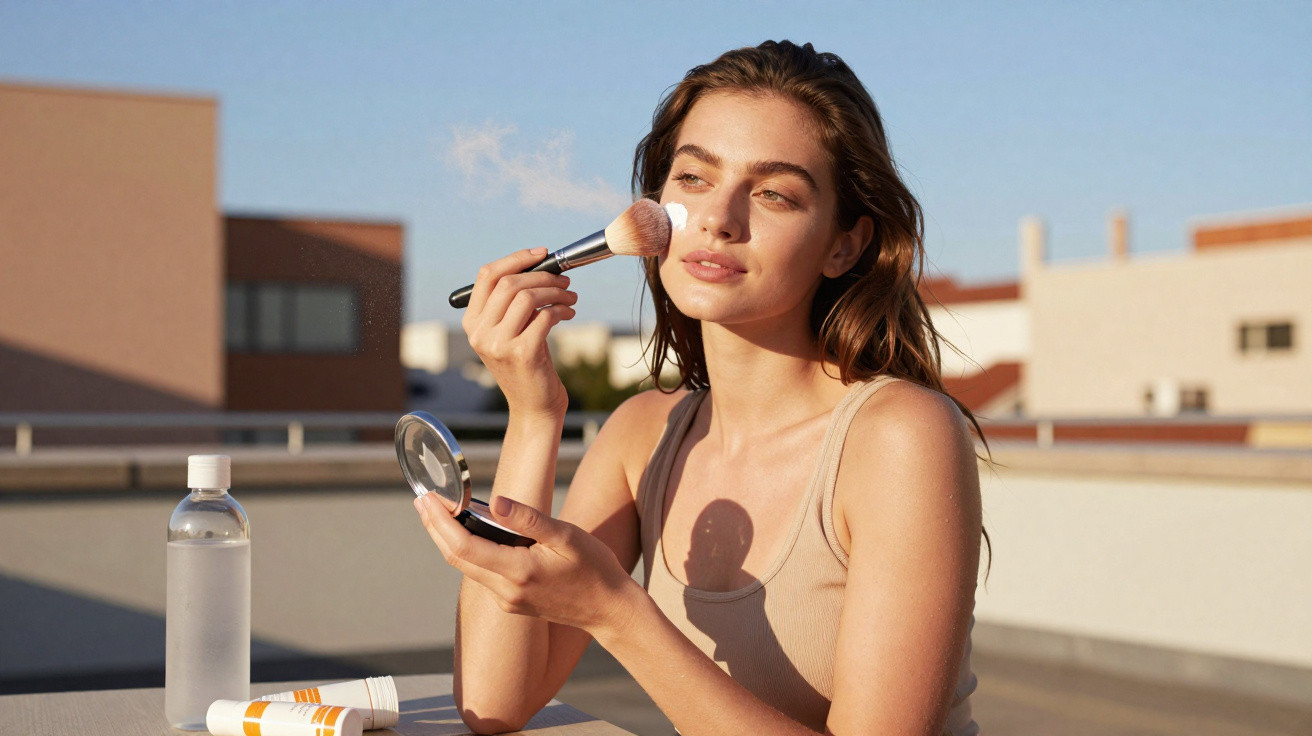
More and more people are turning their backs on traditional sunscreen: too many chemicals, a sticky feel on the skin, an oily sheen on the face, and white marks on clothing. At the same time, interest is rising in pared-back, more environmentally minded options. In that gap sits a product many have underestimated for years: a fine, white mineral powder that studies have confirmed can provide effective UV protection-at least, when it’s used correctly.
Why someone suddenly bins sunscreen
The story starts in a surprisingly ordinary way: sensitive facial skin that reacts to many sun-protection products with spots, redness and stinging. If you’ve experienced that, you’ll know how quickly a trip to the chemist can become maddening. Every new bottle promises “non-greasy” and “suitable for sensitive skin”-yet it still ends up with a shiny forehead and blocked pores.
That’s exactly where the hunt for alternatives begins. Instead of trialling one cream after another, two questions come to the fore:
- Is there UV protection that works without classic emulsions?
- Can sun protection be worked into a daily make-up routine, without adding another layer on the skin?
The trail leads to something many people previously filed away as a “setting powder” from the make-up aisle: a fine white powder featuring mineral filters such as zinc oxide or titanium dioxide.
How this white powder formula blocks the sun
Traditional chemical UV filters absorb UV rays and convert them into heat. Mineral filters take a different approach: they sit on the surface as a thin veil and reflect a large proportion of UV radiation. That same principle is what’s behind the powder formula described here.
The clever bit: the powder particles form a physical barrier that scatters and bounces back UV rays-without a rich cream base.
Many of the newer powders bring together:
- Zinc oxide: covers UVB as well as large parts of the UVA range
- Titanium dioxide: a very strong UVB filter that also creates a visible brightening effect
- A neutral base formula: no fragrance, often no alcohol, which can suit sensitive skin
Some of these powders have been assessed in laboratories and in clinical testing. The key takeaway is this: the level of protection depends heavily on how thickly the product is applied. If you dust on too little, the real-world SPF (Sun Protection Factor) drops sharply.
What science says about mineral sunscreen powder
Over the past few years, specialist literature has increasingly covered mineral filters used in alternative formats: sprays, sticks and powders. The central message across many papers is consistent: the filters themselves can protect reliably when they’re applied in sufficient quantity and spread evenly over the skin.
Studies show that zinc oxide and titanium dioxide particles refract and scatter UV radiation effectively-which is a particular advantage on the face for anyone with oily or acne-prone skin.
Researchers also highlight several practical points:
- The stated SPF only applies when the specified amount is used.
- Loose powders are often applied too sparingly-topping up is essential.
- Particles should not be highly inhalable; reputable brands use heavier formulations designed to stay on the skin.
So, if you assume one ultra-light dusting in the morning replaces full beach-day protection, you’re giving yourself a false sense of security. For the first sunny days of spring in town, short journeys and everyday office life, it’s a different picture.
Who benefits most from UV powder
The strengths of powder products show up most in situations where a conventional cream is annoying-or simply inconvenient. Common examples include:
- Oily or combination skin: no tacky film, less shine, and a lower risk of blemishes.
- People who wear make-up: the powder can be swept over foundation or BB cream without ruining the finish.
- Office and day-to-day settings: handy for reapplication on the go, without needing a sink or a bathroom mirror.
- Minimalist routines: one product for mattifying and sun protection rather than multiple jars and tubes.
The facial T-zone in particular-forehead, nose and chin-often gains the most, as it tends to get shiny faster and usually needs more frequent touch-ups than the cheeks.
How to apply the white powder properly
The most common mistake with sunscreen powder is always the same: too little product, not enough coverage, and reapplying too rarely. If you want meaningful protection, a few straightforward rules matter.
Preparing the skin
Skin should be clean and dry. If you use moisturiser or a serum, apply it as normal and wait a few minutes for it to absorb. Then move on to the powder:
- Use a large, dense brush or the built-in sponge.
- Load up the powder well, only tapping off excess very lightly.
- Work it over the forehead, nose, cheeks and chin using circular motions.
- Don’t forget the hairline, ears and the sides of the face.
How often you should top up
For everyday indoor life, one application in the morning plus a refresh in the early afternoon is often enough. If you’re outside a lot, reapply roughly every two hours-similar to how facial sunscreen is meant to be used.
If you apply it with the mindset of “a bit too much is fine”, you’ll get far closer to the SPF on the label.
For sport, a day by the lake, or anything involving sweating, powder has limits: water and sweat can shift the particles and reduce coverage. In those cases, a water-resistant cream on exposed areas is often the more dependable choice-while powder works better later on for mattifying and topping up.
Environmental angle: fewer tubes, fewer chemicals
Many people choose mineral powders not only for skin reasons but also for environmental ones. The thinking is straightforward:
- Less silicone and fewer liquid plastics in daily care, because the formulas are often very minimal.
- More product per pack: a small pot of powder commonly lasts much longer than a tube of cream.
- Lower pressure on waterways: mineral filters can still enter the environment, but many chemical filters face stronger criticism for damaging coral reefs.
If you also opt for refillable compacts or brands with recycling schemes, you can cut packaging waste in the bathroom cupboard even further. As a side benefit, you’re less likely to end up with half-used tubes that get binned after a season because they’ve passed their expiry date.
Limits and risks you should be aware of
As pleasant as the switch to powder-based sun protection can feel, it doesn’t solve everything. A few points are worth stating plainly:
- Full-body protection: arms, shoulders and legs are awkward to cover properly with powder; cream or lotion remains more practical.
- Intense midday sun: at the beach or in the mountains, powder alone is rarely enough-especially for very fair skin.
- Breathing in particles: when applying to the face, avoid leaning directly over the powder so less dust reaches the airways.
- Skin reactions: mineral filters can still irritate; patch-testing a small area (such as the neck) offers reassurance.
If you take medication that makes skin more sensitive to light, or you’re prone to pronounced pigmentation, it’s sensible to speak with a dermatologist before relying exclusively on powder.
Practical everyday strategies for living with sun
In practice it’s rarely a case of “either powder or cream”, but rather combining different protective building blocks. Many people mainly use mineral powder for the city, the office, short trips and spring days when radiation is still moderate. On very bright days, they’ll add a classic high-SPF cream on the most exposed areas.
A realistic everyday combination might look like this:
- Morning: light day moisturiser, then apply mineral powder generously over the face.
- Midday: reapply powder, focusing on the nose, forehead and cheeks.
- Longer spells in the sun: add extra cream on shoulders, décolletage and hands.
- Evening: cleanse thoroughly to remove all filter particles and clear the pores.
When you pair that routine with simple behaviour-seeking shade, wearing sunglasses, and using a cap or hat-you often need less product overall, easing the load on both skin and environment. That’s how an unassuming white powder becomes a practical part of smarter sun protection that slips into normal daily life without fuss.





Comments
No comments yet. Be the first to comment!
Leave a Comment