
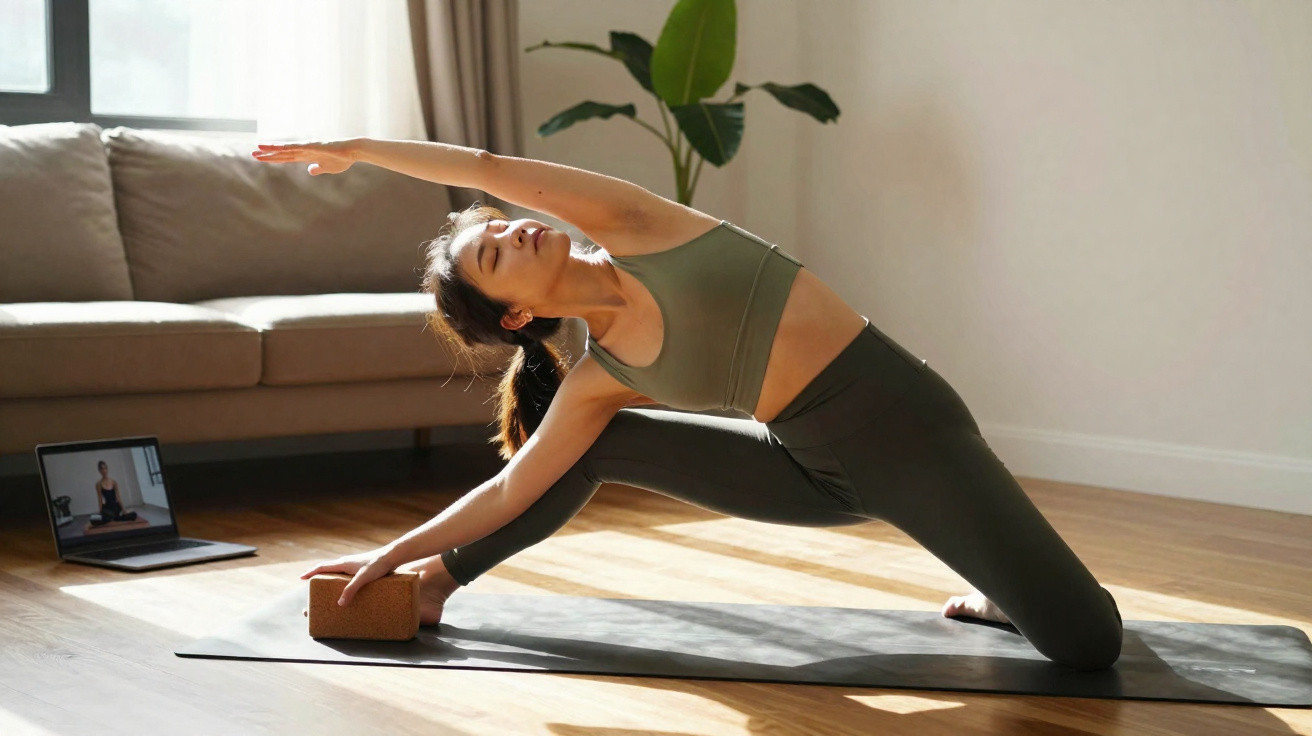
The first time you properly notice your body tightening up, it almost never happens in a yoga class.
It’s usually some ordinary moment instead: a random Tuesday morning when you bend to do up your shoelaces and your lower back offers a quiet objection. Or you turn your head to reverse the car and discover your neck now swivels like a garden gnome’s. You stop, mildly puzzled, then get on with your day - until it happens again.
Then, at some point, you realise you’ve started organising your life around stiffness. You avoid low, sinking chairs. You only sleep on one side. You stop getting down on the floor to play with your kids.
Your body adjusts.
The real question is what you want it to adjust to: tension… or ease?
Why your body feels like it’s “rusting” - and what yoga can change
It’s easy to assume stiffness is simply what happens with age, like wrinkles or grey hair.
In reality, much of it is repetition: the same chair, the same posture, the same walking pattern, the same stress responses running on loop. Muscles can behave like Velcro - stay in one position long enough and they start to stick there. Yoga poses act like gentle “un-sticking” tools, helping to peel you out of those well-worn shapes.
You don’t need a flawless practice or pricey equipment. What helps is a mat-sized patch of space, roughly ten quiet minutes, and the willingness to meet your body exactly as it shows up today.
Consider Maya, 42, who began yoga because she couldn’t comfortably reach the bottom shelf in her kitchen.
On day one she could barely reach her knees in a forward fold, hamstrings protesting after years at a desk and long car commutes. Three weeks into a straightforward routine of 12 poses, she messaged her teacher a photo: palms on the floor, with a grin you could practically feel through the screen.
Nothing mystical occurred in those 21 days. She simply gave her joints and muscles a different, daily input. Her body responded - and, little by little, rewrote the script.
The principle is uncomplicated: what you keep moving, keeps moving.
Holding a yoga pose isn’t only about stretching muscles. You’re also hydrating fascia, switching on underused stabiliser muscles, settling the nervous system, and taking your joints through a fuller, healthier range of motion than everyday life usually demands.
Over time, those 12 poses become a quiet, daily vote. Each one says: “Keep the shoulders open, keep the hips mobile, keep the spine awake.” One vote doesn’t swing an election - but thirty days of votes can change how you feel when you roll out of bed.
12 yoga poses that gently unstick your body (and how to use them)
This is the sort of mini-sequence that fits real life rather than wellness fantasy: 12 simple poses, held for 5–8 breaths each.
You can practise on a mat or on the carpet: Cat-Cow, Child’s Pose, Downward Dog, Low Lunge, Pigeon (or Figure Four on your back), Seated Forward Fold, Sphinx or Cobra, Supine Twist, Bridge, Happy Baby, Thread the Needle, and Legs Up the Wall.
Begin with Cat-Cow to rouse the spine, then move broadly from more standing-ish shapes into more grounded ones, and end with something settling such as Legs Up the Wall. Treat it less like a workout and more like a daily “oil change” for your joints.
The common mistake is approaching it like a flexibility test.
People haul themselves into Forward Fold, stop breathing in Downward Dog, then abandon Pigeon because their hips feel like concrete. The goal isn’t to resemble the photos. The pose should adapt to your body, not the other way round.
Use blocks or thick books under your hands in Downward Dog, place a cushion under your hips in Pigeon, and tuck a rolled towel under your knees in Forward Fold. Let your breath define the edge: if you can’t breathe smoothly, you’ve pushed too far. And, realistically, almost nobody does this every single day - but three or four sessions a week can already shift how your body behaves.
“If you treat these 12 poses like small daily negotiations with your body, not like a battle, stiffness stops being an enemy and starts being feedback.”
- A yoga teacher I met in a cramped, overheated studio, who moved like a cat and spoke like a physiotherapist
- Cat-Cow & Thread the Needle – loosen the spine and shoulders so turning your head while driving feels easy again.
- Child’s Pose & Downward Dog – lengthen the back line of the body, unwind desk posture, and gently wake up hamstrings.
- Low Lunge & Pigeon / Figure Four – release tight hip flexors and glutes, easing lower-back tension from long sitting.
- Seated Forward Fold & Sphinx / Cobra – create balance front-to-back, stretching hamstrings while giving the spine a safe backbend.
- Supine Twist, Bridge, Happy Baby, Legs Up the Wall – calm the nervous system, decompress the spine, and set the body up for proper rest.
Let your body be the conversation, not the problem
What catches most people off guard isn’t that yoga works - it’s how quickly small, unglamorous consistency beats heroic effort. Ten unhurried breaths in Bridge can do more for your lower back than a once-a-month intense class you dread, then avoid. Then one day you bend to pick something up and notice: no twinge.
Stiffness rarely vanishes in a dramatic, cinematic moment. It recedes around the edges, like fog lifting from a city street. You register it in doorways, in car seats, in the way you twist to grab your bag without thinking.
There’s a subtle emotional change as well. Moving through these 12 poses isn’t only a hunt for flexibility; it’s practice in treating your limits differently - with less judgement and more curiosity. You learn to soften when your hamstrings shout, to stay when your mind wants to bail, and to treat one extra centimetre of reach as if you’d earned a medal.
Most of us know that moment when it lands: your body has carried you through stress and neglect with almost embarrassing loyalty. A few minutes of deliberate movement starts to feel less like another task and more like a quiet thank-you note.
You may begin alone on a mat in your living room, but this kind of practice tends to spread. People share routines with friends who “hate stretching”, swap screenshots of awkward Pigeon attempts, or send each other photos of a first wobbly Downward Dog. There’s something oddly relieving about saying, out loud: “My body feels stiff and I’d like to change that.”
Those 12 poses won’t turn you into a gymnast. They will, steadily, change how you move through your day - how you get out of cars, reach shelves, sit on the floor, sleep, and wake. And that’s the flexibility that actually counts.
| Key point | Detail | Value for the reader |
|---|---|---|
| Small, regular sessions beat intensity | 10–15 minutes of 12 poses, several times per week, gradually reduce stiffness | Feels achievable in a busy schedule, increases chances of real change |
| Modify every pose without guilt | Use props, bend knees, and reduce range to match your current mobility | Reduces injury risk and perfection pressure, builds confidence |
| Focus on how you feel, not how you look | Use breath, comfort level, and ease of movement as your guide | Encourages a sustainable, body-friendly relationship with yoga |
FAQ:
Question 1 How often should I do these 12 poses to feel less stiff?
Three to four times per week is a solid starting point. Some people prefer a short morning session and notice changes after 2–3 weeks.Question 2 What if I’m very inflexible and can’t do half the poses “properly”?
That’s exactly who these poses are for. Use cushions, blocks, or a chair, and prioritise a gentle sensation rather than depth or aesthetics.Question 3 Can these poses replace my workout or strength routine?
They complement it. You’ll move better in any workout when your hips, spine, and shoulders aren’t locked up.Question 4 How long should I hold each pose?
Start with 5 slow breaths. As it becomes more comfortable, build up to 8–10 breaths or repeat a pose twice.Question 5 Is it normal to feel sore or emotional after stretching?
Mild soreness is normal when you wake up muscles you haven’t used much. Emotional waves can happen too as tension releases. Move gently, and rest if anything feels sharp or alarming.






Comments
No comments yet. Be the first to comment!
Leave a Comment