
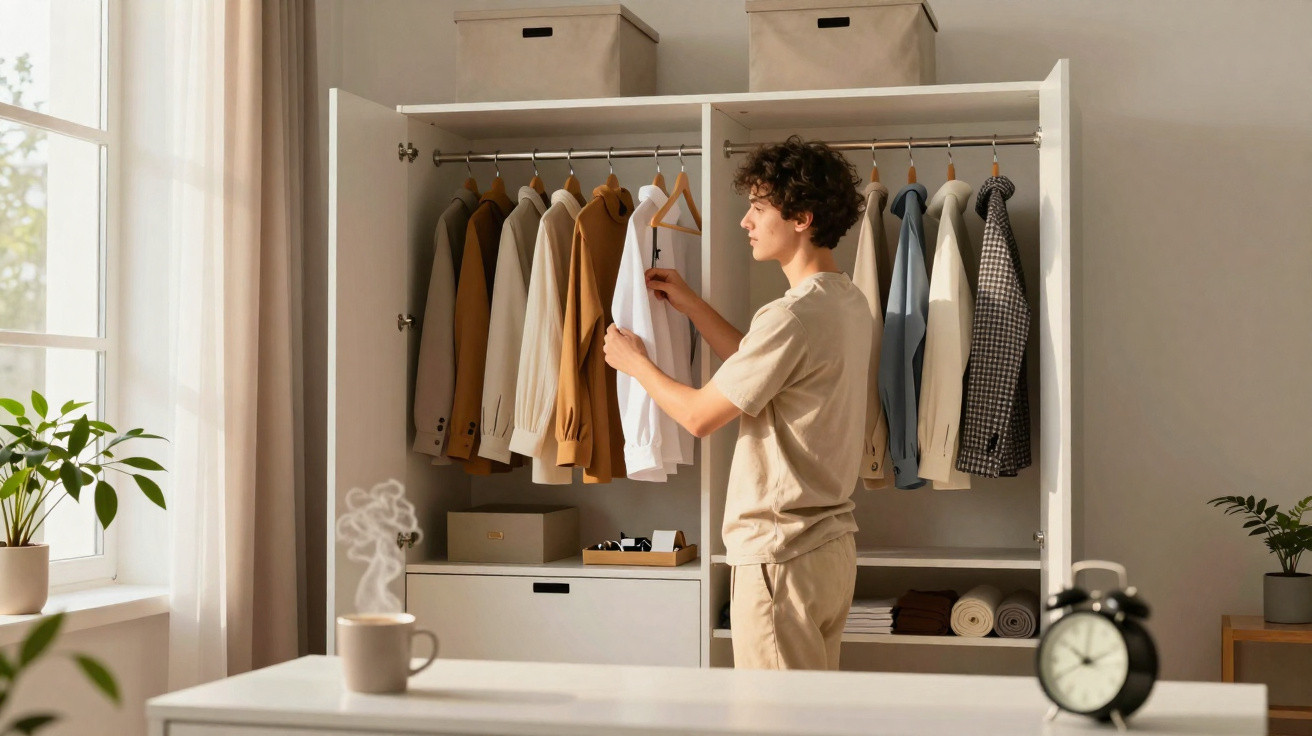
The alarm goes off, you tap snooze, and ten minutes later you’re half-dressed in front of your wardrobe with the clock already against you. Shirts slide off hangers, jeans vanish under a pile of “maybes”, and the one black T‑shirt you actually want has somehow disappeared. You grab something that “sort of works”, swear you’ll deal with it at the weekend, and leave the house slightly irritated at… clothes.
There’s a tiny window after a shower when the day still feels open-ended: steady and clear, or frantic and messy.
What if the difference isn’t discipline at all, but simply where your clothes sit on the rail?
The real reason your mornings feel cluttered
It’s easy to assume the issue is a “wardrobe that’s too small”, when for many people it’s really a “wardrobe that’s too scattered”. Everything is jumbled together: summer dresses crammed beside winter knits, night-out looks caught up with work basics, and sentimental items quietly occupying the best spots right at eye level. You’re not lost about your style - you’re just hit with visual overload at 7:15 a.m.
To find something wearable, your brain has to sweep past dozens of options before it lands on anything remotely suitable. That searching burns energy - tiny, invisible energy - but it accumulates before you’ve even had your coffee.
Take Clara, 34, with two children and a hybrid job. She’d decided she was simply “not a morning person”. Her rail was stuffed with office blazers she hadn’t touched since 2019, bridesmaid dresses, old university hoodies, plus a stack of leggings somewhere near the bottom. Every morning she’d thumb through it all, trying to work out what still fitted and what still felt like “her”.
One Sunday, she spent two hours reorganising just one thing: not decluttering, not arranging by colour - simply changing the order of what she saw first. The following day, she was dressed in under three minutes. By Friday, she texted a friend: “I swear my week has been calmer just because my black pants moved 30 cm to the left.”
There’s a straightforward reason this works. Our ability to make decisions - especially first thing - is surprisingly delicate. It’s why many top CEOs wear nearly the same outfit every day: not due to a lack of taste, but to shield their minds from a constant stream of tiny choices.
When your wardrobe displays everything at the same level of prominence, your brain treats every item as an equal contender. Too many contenders, not enough time. The solution isn’t necessarily owning fewer pieces (though that can help). The real trick is ensuring that when you open the door, one category is impossible to miss: what you actually wear on an ordinary day.
The one rearrangement that changes everything
The adjustment that quietly changes your mornings is this: build a “front row” containing only the outfits you genuinely reach for right now - your go‑to pieces for the next 30 days. No aspirational buys, no out-of-season items you won’t touch this month, and nothing reserved for “when I lose three kilos”. Just your real-life staples.
Start by pulling the pieces you’ve worn over the last two weeks, plus the outfits you know you’ll need over the next two (work essentials, school-run clothes, gym kit, that one smart blazer). Hang or fold them as one continuous block at eye level - like you’re packing for a four-week trip.
People often get stuck trying to create a year-round “capsule wardrobe”. That’s an enormous expectation. You don’t need a timeless, flawless collection for the rest of your life - you only need a clear, limited “capsule strip” for the month you’re in.
Think of it like curating the top shelf on Netflix for what you’re watching now, while everything else sits in “watch later”. A party dress for a wedding in three months? Off to the side. A heavy parka in June? Off to the side. The clothes haven’t vanished - they’ve just stepped off the main stage. Then, when you slide the hangers, you’re no longer choosing between “my entire identity in fabric”; you’re choosing between ten or fifteen pieces that already match today’s reality.
This works because it removes decision friction. You open the wardrobe and your eyes immediately meet the “now” section. Your brain stops asking, “What could I wear?” and shifts to, “Which of these few things feels right today?” That’s a much lighter question.
And let’s be realistic: hardly anyone maintains this perfectly every single day. But after the first set-up, keeping it going becomes almost effortless. Each Sunday evening or Monday morning, move anything you didn’t touch all week out of the front row, and pull in the pieces you actually wore from the “side” section. Your wardrobe quietly keeps pace with your real life.
How to set up your 30-day “front row” wardrobe
Begin with a simple, no-nonsense action: stand in front of your wardrobe and, without analysing it, take out everything you’ve worn in the last fifteen days. Tops, bottoms, dresses, jackets - even that one pair of “I only wear them at home” joggers. Put the lot on your bed.
Then look ahead to the next fifteen days: any meetings, dinners, travel, or events? Add what you’ll need for those. At this point you should have around 20–35 items. That set becomes your front-row zone, and it deserves the best location: the middle rail, eye level, or the top drawers you reach for first.
Everything else isn’t rubbish - it just changes position. Push occasional items to the sides or onto higher/lower shelves. Stack the thick jumpers you won’t wear this month separately. Put evening dresses together at the far right. You’re not penalising these clothes; you’re safeguarding your mornings.
One easy mistake is letting “fantasy self” pieces sit in the front row: the jeans you’re hoping to get back into soon, the ultra-structured blazer you love on other people but never choose yourself, or the dress that only works when your whole day goes perfectly to plan. Those items create little jolts of guilt every time your eyes pass them. You deserve a calm, neutral start - not a silent panel of judgement on hangers.
“Once I moved my ‘real life’ clothes to the center and pushed the rest to the sides, I stopped feeling like I was failing my wardrobe,” says Alex, 29. “I realized the problem wasn’t my body or my style. It was the order of the hangers.”
- Create the front row
Pull 20–35 items that reflect the last two weeks and the next two weeks of your life. - Give it prime space
Hang or fold them together, centre stage, where your hand naturally reaches first. - Demote the rest, don’t delete
Move occasional or “fantasy” pieces to the sides, top shelves, or the back of drawers. - Weekly mini-update
Slide out anything untouched that week, and slide in what you actually wore. - Seasonal reset
With each change of season, rebuild the front row for the new temperature and rhythm.
Living with a wardrobe that keeps up with you
Once your front row is established, a subtle shift kicks in. You stop beginning the day with a negotiation. You open the door, see only items that fit and suit your real schedule, and you get on with it. The small surge of stress that used to arrive between towel and T‑shirt simply… doesn’t.
You may also start to notice patterns: the clothes you genuinely wear versus the clothes you assumed you would. That can sting briefly - and then it becomes oddly freeing. Your wardrobe stops being a museum of past selves and almost-selves, and becomes a tool for the person who’s drinking their coffee right now.
This isn’t about becoming an extreme minimalist or binning memories. Some mornings you’ll still stand there feeling a bit blank, unsure what you fancy wearing. That’s normal. The difference is that the stakes are lower, because every option in front of you has already passed the “real life” test.
You might even hear yourself talk about clothes differently. Less “I’ve got nothing to wear”, more “Everything in here works - I’m just picking a vibe.” That small shift changes how you leave the house: a bit more grounded, a bit less behind. And all you did was move a few hangers 30 cm to the left.
| Key point | Detail | Value for the reader |
|---|---|---|
| 30-day front row | Keep 20–35 current, wearable pieces at eye level in one block | Faster decisions and calmer mornings |
| Side and back zones | Move occasional, seasonal, and “fantasy self” items away from the centre | Less guilt, less visual noise, more mental space |
| Weekly and seasonal tweaks | Rotate in what you wear, rotate out what you don’t, rebuild at each season | A wardrobe that stays aligned with your actual life |
FAQ:
- How many pieces should my front row include?
Most people end up with 20 to 35 items, including tops, bottoms, dresses and layers. It’s enough variety without leaving you stuck.- Do I need to declutter before rearranging?
No. Start by rearranging only. Once you can see what you truly wear, deciding what to declutter often becomes far easier.- What if I already have a very small wardrobe?
Use the same idea, just on a smaller scale. Put your true everyday items on the easiest-to-reach shelf or rail, and nudge occasional pieces slightly out of the way.- How do I handle work clothes versus weekend clothes?
Either combine them in one front row, or split the zone into two mini-blocks. The key is that both are visible and limited.- What about people who share a wardrobe?
Each person can create their own mini front row: a dedicated run of hangers or a main drawer that holds their current 30-day selection.





Comments
No comments yet. Be the first to comment!
Leave a Comment