
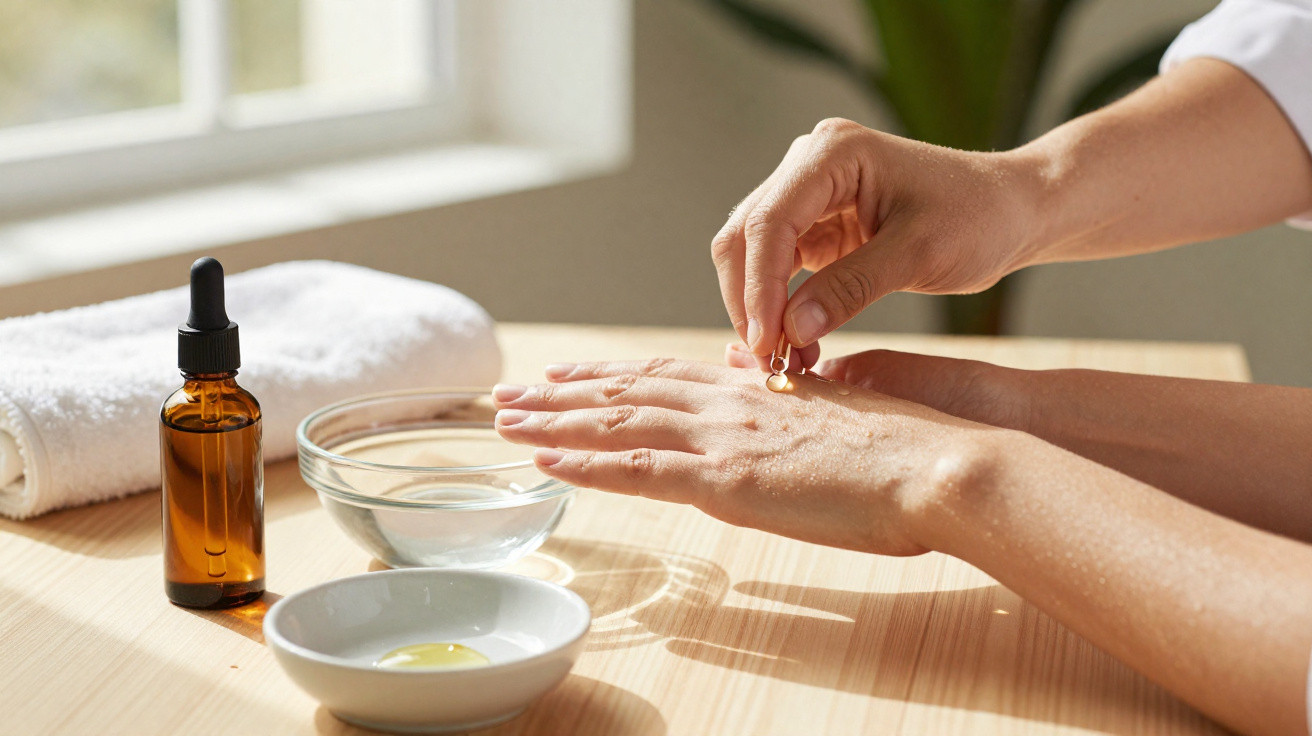
The esthetician doesn’t begin with your face.
She takes your hands instead, turning them slowly beneath the ring light. Her fingertip follows the dryness over your knuckles - the kind of touch that’s met thousands of cuticles and heard thousands of little life stories. Your nails look fine, but your skin feels different: tight, rough, and somehow older than the rest of you.
She gives a knowing smile, like she’s already seen this exact set of hands all day. “Do you cook a lot? Use sanitiser? Work on a laptop all day?” You nod to all three, expecting the usual pitch for pricey products. Instead, she picks up a plain, unlabelled bottle tucked behind the glossy creams: one ingredient, no fragrance, no shimmer, no grand claims.
She rubs a few drops warm between her palms, then presses them into your hands as though she’s locking the moisture in place. “Come back in a week,” she says. “You won’t recognize them.”
She’s not overstating it.
Why estheticians swear by a single-ingredient hero
Ask three estheticians what their “secret” is for hand care and you may get three different brands - but the same foundation beneath the labels: pure, medical-grade glycerin. No perfume. No tint. No 18-step ritual. Just a clear, slightly tacky liquid that looks the opposite of glamorous.
Among shelves of shea butter, elegant oils, and seasonal scents, glycerin can seem almost dull. Yet it’s the bottle that’s noticeably lighter, reaching half-empty because it’s used again and again throughout the day. It threads its way into salon routines without fanfare: stirred into masks, dabbed along cuticles, mixed with water before a massage.
Watch long enough and the pattern becomes hard to miss - this is the true workhorse.
One London esthetician keeps a tiny travel bottle of glycerin in her apron pocket. “I go through this faster than my moisturiser,” she laughs. Between clients, after every hand wash, she pats her hands dry and smooths in a single drop while her skin is still slightly damp - then she’s straight back to work. No performance, no fuss.
She told me that during the pandemic years, when constant sanitiser left hands in a state, the people who kept up this small habit ended up with noticeably different skin. Less cracking, fewer raw patches, and in winter almost no bleeding knuckles. The only shift? Glycerin twice a day - not a cupboard full of new creams.
Dermatologists tend to back this up, quietly. In one widely referenced review, glycerin repeatedly performed strongly as a humectant, drawing water into the outer layers of skin and helping it stay there for hours. It’s not an exciting headline, but it becomes very convincing when your hands sting every time you wash up.
When you strip away the marketing, hydrating hands comes down to a single task: get water into the skin, then slow down how quickly it escapes. Glycerin happens to be exceptionally good at that. As a humectant, it attracts water - like a tiny sponge sitting in the outer layer of your skin. Applied to hands that are still a little damp, it helps keep that moisture from evaporating.
Other ingredients play their part - oils and butters form a barrier, silicones add slip - but for deeply dehydrated skin, glycerin often does the heavy lifting. It’s small enough to move into the upper layers, stable enough to hold up over time, and generally gentle for most skin types.
That’s why so many professionals keep coming back to it: it just works, even when nothing else does.
The esthetician method: how to use glycerin so it actually transforms your hands
The biggest “trick” estheticians use with glycerin is simple: timing. They don’t smear it on at random. They apply it straight after water - freshly washed hands, after a shower, after doing the dishes. When skin is still slightly damp, glycerin turns effective rather than merely sticky.
In real life, the routine is almost laughably straightforward. Put one or two drops of pure glycerin into your palm. Add a quick splash or mist of water. Rub your hands together for 20–30 seconds, making sure you work between fingers and over knuckles. If your hands are extremely dry, finish by sealing it with a thin layer of a basic hand cream - or a bland ointment at night.
Stick with that twice a day for a week and your hands start to move from sandpaper back to normal skin.
The real obstacle is consistency. Many people can keep up a beautiful routine for three days, then life steamrollers it: a cold commute, a hot coffee, twenty emails before 9 a.m. - and suddenly your hands feel like cardboard again. Let’s be honest: almost nobody does this daily without at least a bit of organisation.
Estheticians make it easier by attaching the habit to something that already happens. The glycerin sits beside the soap, not buried in a drawer. A mini bottle goes in the same pocket as their keys. One client told me she stuck a tiny note on her kitchen tap that simply says “drops”, which is enough to remind her after washing up.
Another frequent misstep is overdoing it and then blaming the ingredient. Used neat in large amounts - especially on fully dry skin - glycerin can feel tacky. Professionals use far less than you’d think, pair it with a little moisture, and then layer something comfortable over the top at night. Small quantity, noticeable payoff.
A Paris-based hand-care specialist put it in a way that stayed with me:
“People think their hands are ‘just dry’. Most of the time, they’re actually thirsty. Glycerin is like giving them a drink, not just a coat.”
That framing has shifted how many of her clients approach skin care. Hand cream stops being a luxury extra and starts to look like basic maintenance. The goal changes from soft, pretty hands to comfortable, functional ones - hands that don’t sting when you pick up a lemon or step outside into the cold.
- Apply glycerin straight after water, while your skin is still damp.
- Aim for “two drops, not ten” to avoid that sticky feel.
- At night, seal it in with a simple hand cream or balm.
- Leave a small bottle by the sink so the habit becomes automatic.
- If your skin stings or reacts, stop and switch to a gentler option.
What changes when your hands finally feel hydrated
It’s easy to forget how much our hands communicate before we say a word - a handshake at an interview, a first date across a café table, passing a glass of water to a child. When your hands are rough and red, you can feel older, more tired, and less “together” than you really are.
On a subtle level, comfortable hands change how you hold yourself. You stop tucking them under the table or hiding them in your sleeves. You reach out more often. You gesture without thinking. And practically speaking, the tiny cracks and rough patches stop snagging on fabric or paper, stop burning in cold air, and stop waking you in the night when they split.
On a bad day, that matters.
Most of us know the winter-morning struggle: fumbling for keys with fingers that feel like dry wood. After a week or two of using glycerin the way estheticians do, that moment tends to vanish quietly. Skin bends without complaint. In the mirror, your knuckles stop looking a decade older than your face.
There’s also something surprisingly steadying about caring for one small, specific part of your body. It’s a pause from chasing perfect skin, perfect hair, perfect everything - just a few seconds and a few drops, a small commitment to comfort rather than appearance.
And once you’ve felt that relief, you start noticing other people’s hands too: the supermarket cashier with split cuticles from constant scanning, the nurse with sanitiser-worn palms, the parent at the playground whose hands are raw from washing bottles and wiping spills.
You want to pass on the secret.
| Key point | Detail | Why it matters to you |
|---|---|---|
| The role of glycerin | A humectant that attracts and holds water in the skin | Explains how one ingredient can genuinely change dry hands |
| When to apply it | Use on slightly damp skin, straight after water | Boosts effectiveness without a complicated routine |
| Keep it simple | A few drops of glycerin, then (optionally) a cream over the top at night | Visible results without expensive products or lots of steps |
FAQ:
- Can I use pure glycerin on my hands every day? Yes - provided you use a small amount on slightly damp skin. Daily use is exactly how many estheticians protect their own hands from frequent washing.
- Will glycerin make my hands sticky? It can feel tacky if you apply too much or put it on completely dry skin. Mix it with a little water in your palms, or add a light cream on top to reduce that sensation.
- What kind of glycerin should I buy? Choose vegetable or pharmaceutical-grade glycerin, ideally without fragrance or added colour. Pharmacies and online retailers often list it simply as “glycerin” or “glycerol”.
- Is glycerin better than hand cream? Not exactly - it’s different. Glycerin draws water in, while many creams focus on softening and sealing. For very dry hands, the most effective pairing is glycerin first, then cream.
- Can I use the same glycerin on my face or body? Yes, although many people prefer mixing it into their usual moisturiser. Start with a drop or two, see how your skin responds, and avoid applying pure glycerin to very irritated or broken skin.






Comments
No comments yet. Be the first to comment!
Leave a Comment