
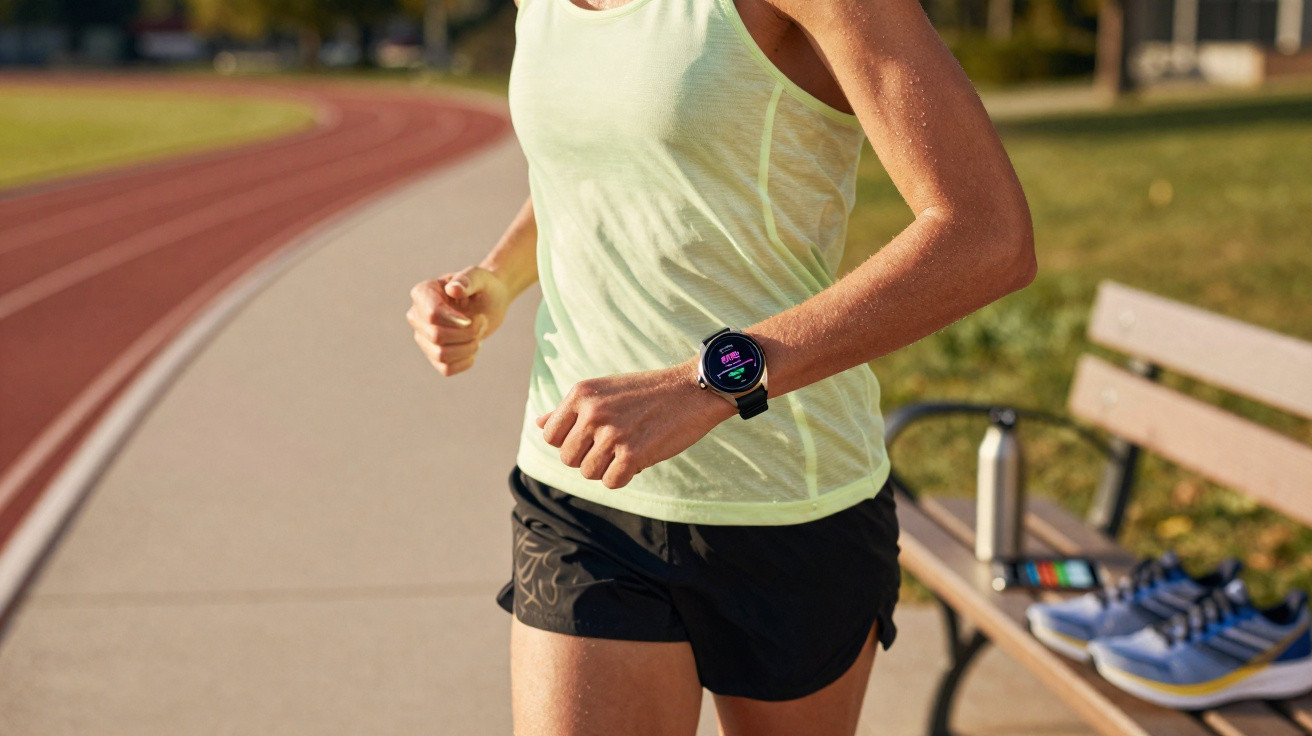
Coros, Garmin’s biggest challenger in the sports watch sector, has unveiled a new ultra-light model aimed at runners, cyclists and swimmers. It outclasses the Pace 3, puts the Pace Pro’s place in the line-up in doubt, and introduces an AMOLED display, a microphone and a cleaner, more understated look.
Coros first hinted at it quietly on Eliud Kipchoge’s wrist. In New York, as the marathon legend picked up the final bib he needed to complete the set of the world’s six most prestigious marathons, the new Pace 4 lit up-this time with an AMOLED screen. Coros’s latest launch of 2025 sits in the Pace family, and not just any Pace: it’s the range that has driven the brand’s success and helped it take market share from Garmin in the space for affordable, ultra-light sports watches-a segment the American leader has struggled to defend.
Sports watch: Coros replaces the Pace 3 with the Pace 4
The Coros Pace 4 takes over from the Pace 3, which arrived in August 2023. The price only nudges up-269 euros rather than 249 euros-but the list of upgrades is long, while the mission stays the same: precise tracking in an ultra-light case with excellent battery life. On paper, the Pace 4’s specifications make the Pace 3’s numbers look almost modest. With an AMOLED screen now built in, the Pace line is brought up to date and no longer has reason to envy the Pace Pro. In fact, the Pace Pro may well fade away, simply because it no longer has enough to justify its position.
The new Pace 4 doesn’t rely solely on its screen and endurance. Coros also wanted to push ahead with its plan to add a microphone to all of its new GPS sports watches. We’ll return to what that enables later, because it points to a new feature that should appeal to athletes who follow structured training plans on their watch and like keeping notes after each session. Beyond that, it’s worth stating upfront what the Pace 4 will not get: mapping, a cellular option (for making calls), or a torch (something Garmin is adding to more and more models).
Nor is Coros attempting to pack the Pace 4 with everyday lifestyle extras. One small disappointment is that Coros still isn’t committing to a contactless payment service, unlike Garmin with Garmin Pay and an NFC chip in its watches. It’s a shame, because this sort of feature can free you from carrying a phone or bank card while still letting you pay during an outing.
Design and screen of the Coros Pace 4
The Coros Pace 4 keeps roughly the same footprint as the Pace 3: a 43.4 x 43.4 mm case, 11.8 mm thick (versus 11.7 mm on the Pace 3), and a weight of 32 g with the nylon strap, or 40 g with the silicone strap. The display measures 1.2 inches. Visually, the design changes echo the Coros Pace Pro: the screen sits more seamlessly within the bezel. The overall build remains plastic, with a two-tone look between the bezel and the side section that also houses the buttons. Speaking of controls, there is now a new pusher on the left side of the watch case-something we’ll discuss again in the software section of the Coros Pace 4.
On the Pace 4, the display switches to AMOLED, marking the end of Coros’s transflective panel approach that helped keep costs and power use down. First seen on the Coros Pace Pro, AMOLED brings a wider colour range, stronger contrast (with true blacks because no LEDs are lit), and better legibility. Coros says the Pace 4’s resolution is 164% higher than the Pace 3’s. Specifically, it’s 390 x 390 pixels, with a maximum brightness of 1500 nits (the same as the Pace Pro). For protection, Coros continues to play it safe on the Pace range with mineral glass, prioritising price and low weight, as on the Pace 3.
Battery and battery life of the Coros Pace 4
Coros surprised many when it launched the Pace Pro: despite the usual assumptions, moving to AMOLED did not cause battery drain to skyrocket. Or, more accurately, Coros managed the new display by improving overall efficiency. The result was impressive-until the Pace 4 arrived. This new model lasts even longer than the Pace Pro: 41 hours of GPS use (all sensors active) versus 31 hours on the Pace Pro and 25 hours on the Pace 3. In dual-frequency GPS mode, Coros quotes 31 hours compared with 15 hours on the Pace 3. In everyday use (no GPS activity), it reaches 19 days, up from 15 days on the Pace 3.
Battery life drops if you enable Always-on mode, which keeps the screen continuously lit. You can choose to use Always-on only during activities or across the board, including outside workouts. The impact is a reduction of 10 hours, bringing GPS (all sensors) down to 31 hours. With dual-frequency GPS and Always-on, the Pace 4 is rated at 24 hours, matching the Pace Pro. These figures cannot be compared with the Pace 3 because it doesn’t have an AMOLED panel and therefore has no Always-on mode: its screen remains on, with brightness increasing only when you raise your wrist or press a button.
To market the Pace 4, Coros highlights these differences: 16 extra hours versus the Pace 3 in all-systems GPS, plus 4 more days for everyday use. Against the Pace Pro, it’s 3 extra hours in all-systems GPS. Coros told Presse-citron that the Pace 4’s advantage over the Pace Pro comes from a combination of battery capacity and the smaller screen (1.2 inches instead of 1.3 inches).
The action button and microphone on the Coros Pace 4
The other key upgrades on the Coros Pace 4 are the addition of a new action button on the case and the integration of a microphone. Starting with the button, it essentially adds an extra control to speed up navigation. Up to now, Coros’s interface focused on horizontal scrolling through menus and data screens. With a third button, it becomes possible to scroll left to right: moving between menus, or jumping to media controls, navigation, or the watch’s global settings.
Coros also spent time discussing the microphone during a briefing with Presse-citron. The company is not positioning it as a tool for phone calls, but rather as a way to make post-session notes easier. Coros believes that comments about how a workout felt are vital for remembering sensations and training phases-yet most people don’t want to sit down and type a few lines after finishing. The microphone is therefore intended to record you and transcribe your impressions, attaching them to the session as text (and an audio file), accessible in the app’s workout history.
Prices and release date for the Coros Pace 4
Two years after the Pace 3, the new Pace 4 goes on sale for 269 euros, an increase of 20 euros. It is available to buy in France from 10 November, and will arrive in shops at the start of December (at Decathlon, for example). At launch, only the black and white versions are offered, and only with the silicone strap-which is unfortunate, since it’s less comfortable and heavier than the nylon option. Coros says it ran into issues getting nylon straps delivered in time for the Pace 4 launch. Even so, we would still recommend the nylon strap for its low weight, comfort, and quick adjustment that fits your wrist precisely.
One other key detail: from 14 November, Coros will reduce the prices of the Pace 3 and Pace Pro. The Pace 3 drops by 20 euros to 229 euros, while the Pace Pro falls by 50 euros to 349 euros. Coros teams told Presse-citron that both older models will remain on sale until stocks run out, which strongly suggests the Pace Pro is also nearing retirement. That’s understandable: even though it includes mapping and an electrical heart-rate sensor not available on the Pace 4, it no longer stands far enough apart. Heavier and more expensive, it now overlaps with trail-oriented ranges that offer bigger battery figures and a tougher case.
It remains to be seen what Coros will have in store for 2026 after launching the Pace 4.





Comments
No comments yet. Be the first to comment!
Leave a Comment