
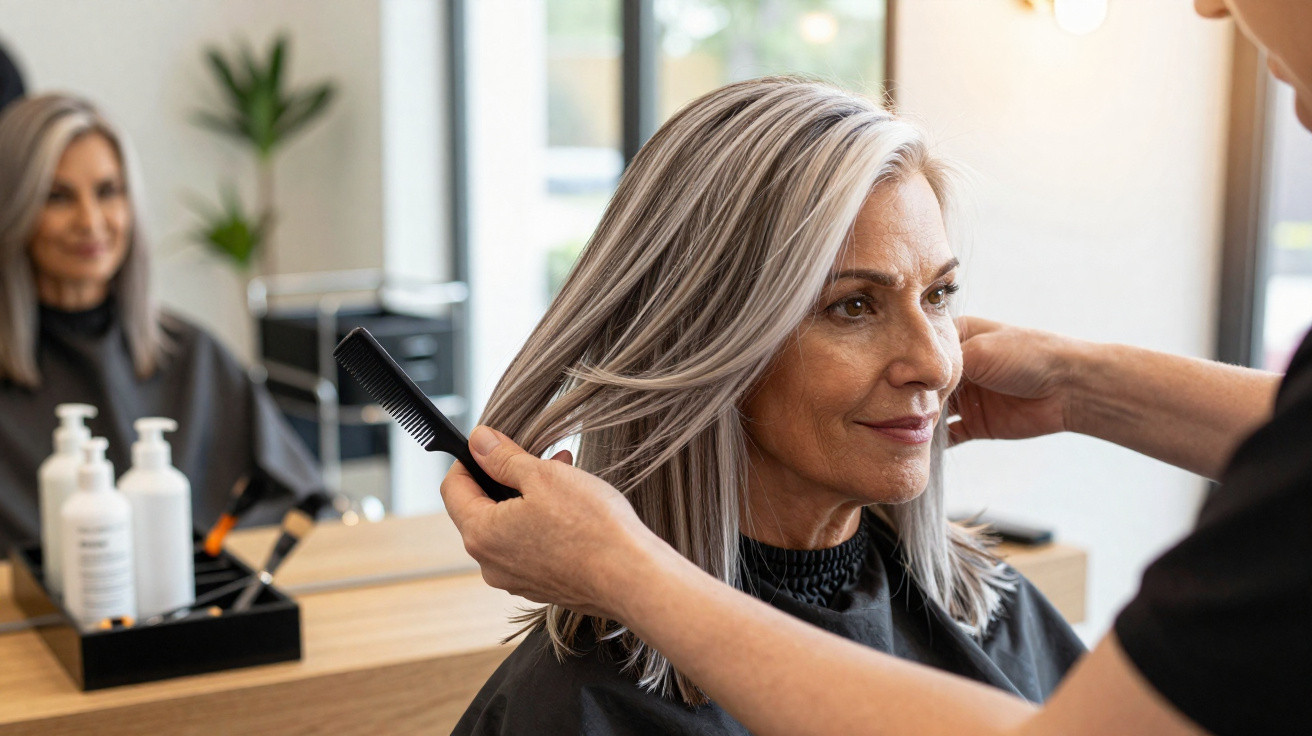
Soft silver strands, shaded roots and gleaming ends: one understated colour technique is discreetly turning “granny grey” into a statement look.
In salons from Paris to London and New York, women over 50 are leaving with cooler, brighter and more multi-tonal grey hair, with almost no obvious root line. The change is driven not by aggressive bleaching, but by a considered method that hairdressers call reverse colouring.
What reverse colouring really means
Conventional highlights lighten selected pieces of hair to create a sun-kissed effect. Reverse colouring takes the alternative route, introducing depth through slightly darker shades placed in chosen areas, particularly on fully grey or salt-and-pepper hair.
Instead of chasing every new white hair, reverse colouring works with your natural grey pattern and makes it look intentional.
The process uses “lowlights”: slim sections coloured a few shades darker than the natural grey. Positioned beneath lighter pieces or woven between them, these lowlights introduce shadow, contrast and a youthful-looking sense of density.
Colourists commonly combine the service with a gloss or toner, which reduces strong yellow undertones while bringing out silvery reflections. The finished shade is a luminous, cool grey that appears polished rather than washed out.
How a reverse colouring appointment works in the salon
Although each colourist will have a personal approach, most sessions follow broadly the same sequence.
The usual step-by-step process
- Clarifying shampoo: Hair is cleansed with a deep-cleaning shampoo that lifts product residue, pollution and minerals capable of dulling grey tones.
- Toning or glossing: A demi-permanent gloss or toner is applied to counter yellow or warm tones and cool the overall colour.
- Placement of lowlights: Extremely fine pieces, often referred to as “veils”, are subtly darkened in key zones, including under the parting or around the nape.
- Rinse and treatment: Once the colour has developed, hair is rinsed and given a hydrating mask to replenish softness.
- Tailored cut and styling: A well-shaped cut allows the fresh shadows and highlights to reflect light where they are most flattering.
The magic is not in a drastic colour change, but in deliberately uneven tones that mimic natural, youthful hair.
A gloss will generally deepen the overall shade by one to three levels. This modest adjustment can define silver strands, reduce root contrast and make hair seem fuller.
Why reverse colouring flatters grey hair after 50
Grey and white hair fibres tend to be more porous by nature, meaning they can appear flat or faintly yellow, particularly when exposed to city pollution or sunlight. Reverse colouring addresses several of these concerns simultaneously.
A soft-focus, “no roots” effect
Since both toner and lowlights are demi-permanent, they fade progressively over eight to nine weeks. This avoids a stark divide between coloured lengths and fresh growth.
As the gloss fades, the grey underneath simply resurfaces, so regrowth looks blended rather than striped.
For people who no longer want rigid four-week root appointments, it offers a middle ground between fully embracing natural grey and maintaining an all-over dye.
Greater depth, shine and less “flat” grey
Natural grey is often most pronounced around the temples and hairline, while the remaining hair may combine brown, silver and white. Reverse colouring works with this natural variation and enhances it:
- Lowlights create the visual impression of density in sparse or thinning sections.
- Toner neutralises brassy or yellow-toned areas that may make the complexion look sallow.
- Silver and white pieces look more radiant against a subtly darker base.
The result is gentler around the face, creating a soft frame that generally lifts features instead of weighing them down.
Maintenance: realistic expectations
Compared with permanent colour, reverse colouring requires less commitment, although it is not completely maintenance-free.
| Aspect | What to expect |
|---|---|
| Longevity of gloss | About 8–9 weeks before the toner has largely faded |
| Salon visits | Every 2–3 months for re-glossing and occasional lowlights |
| Root line | Soft, blurred regrowth with no sharp demarcation |
| Damage level | Generally low, especially with demi-permanent formulas |
People accustomed to monthly colour appointments often appreciate the more relaxed timetable. However, maintaining good hair condition between salon visits is as important as the colour service itself.
Caring for salt-and-pepper or white hair
With age, the scalp generally produces less sebum, so grey hair is often drier and more delicate. Its cuticle layers may sit slightly raised, leaving strands rougher and more susceptible to breakage.
Products that support reverse colouring
- Violet or blue shampoos: Their pigments offset yellow and orange tones, helping silver hair stay bright instead of looking nicotine-stained or dull.
- Rich masks and conditioners: Products containing argan oil, shea butter or ceramides can smooth the cuticle and limit frizz.
- Protein or keratin treatments: Used occasionally, protein-based formulas may strengthen weakened areas, especially where hair has been bleached previously.
- UV and pollution protectors: Leave-in sprays and serums help defend against sun damage and urban smog, two leading contributors to brassiness in grey hair.
Think of grey hair as a delicate fabric: the right care products preserve its colour, texture and natural sheen.
A weekly oil treatment using argan, coconut or jojoba oil can restore suppleness. Apply oil from the mid-lengths to the ends, leave it for at least 20–30 minutes, then wash it away with a mild shampoo.
Temporary colour tweaks for the adventurous
Anyone hesitant to commit even to demi-permanent lowlights can experiment with temporary alternatives.
Colour sprays, tinted mousses and pigmented masks can lay a wash of silver, pearl or soft pastel over existing grey. As they disappear after a few shampoos and mainly remain on the hair surface, they are unlikely to damage hair when used sensibly.
Ammonia-free glosses, or those without high-strength peroxide, are another suitable option. Rather than dramatically altering colour, they refine the tone and boost shine. Applied between full reverse colouring appointments, they revive the finish and help maintain a cool, luminous grey.
Who benefits most from reverse colouring?
The technique can work in many circumstances, though certain hair profiles tend to achieve particularly effective results:
- People with naturally salt-and-pepper hair who want a more intentional, styled appearance.
- Anyone moving away from permanent dye to embrace their grey and looking for an “in-between” stage.
- Those unsettled by vivid white streaks at the front but not prepared to choose a single dark shade.
- Women experiencing thinner hair who want colour placement to create the illusion of volume.
For very dark, coarse hair with only a handful of scattered grey hairs, stylists may modify the approach. They can introduce slightly cooler lowlights and apply toners that stop the natural base looking overly warm beside white strands.
Key terms worth knowing before you book
Salon terminology can feel confusing, particularly as fresh trends move quickly through social media. This short glossary can help when speaking with a colourist:
- Lowlights: Pieces coloured darker than the base shade to produce depth and shadow.
- Gloss / toner: A demi-permanent colour that alters tone and shine, frequently without powerful lightening ingredients.
- Clarifying shampoo: A deep-cleansing formula that removes build-up; it is helpful before colouring but can be drying if used daily.
- Demi-permanent colour: A gentler type of colour that gradually fades instead of producing a distinct grow-out line.
Knowing these terms makes it simpler to request a soft-focus result rather than severe streaks, while also asking for low-damage choices that safeguard delicate silver hair.
Risks, trade-offs and realistic scenarios
Reverse colouring is comparatively gentle, but there are still factors to consider. Excessive use of clarifying shampoo or regular salon glosses may dry the hair if they are not balanced with thorough care. Anyone with a highly sensitive scalp or a record of allergies should ask for patch tests before using toners or lowlights.
Consider a realistic example: a woman in her late fifties whose hair is predominantly grey with some darker strands opts for reverse colouring. At her first appointment, the mid-lengths are gently deepened and icy tones are introduced. She comes back every ten weeks for a refresh, uses violet shampoo weekly and applies hydrating masks twice. A year later, her hair has become healthier, she worries less about roots, and her grey looks like a purposeful style decision rather than an unwilling compromise.
For many people, this change - from concealing grey to sculpting it - is why reverse colouring has quietly gained a reputation as a contemporary, age-positive technique rather than merely another short-lived beauty trend.


Comments
No comments yet. Be the first to comment!
Leave a Comment