
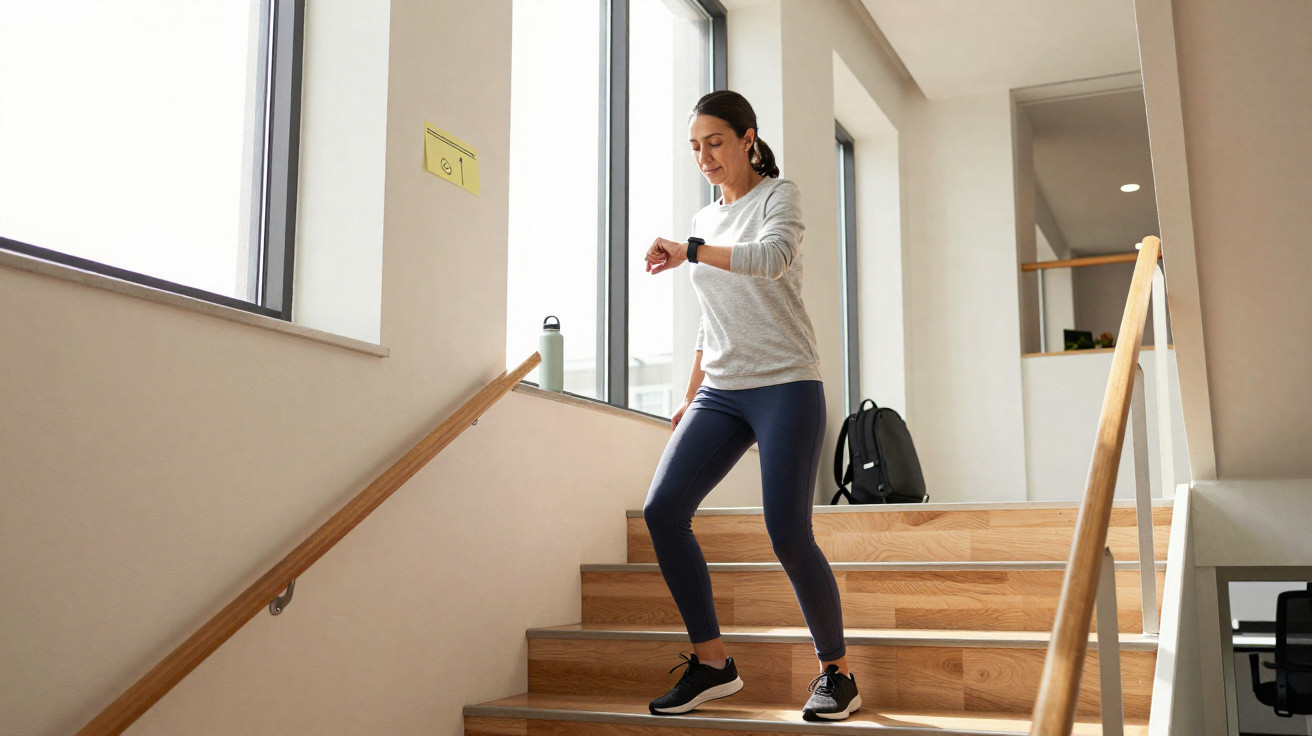
Choosing the stairs instead of the lift does not mean climbing ten floors in one go to achieve meaningful exertion. Research into so-called “exercise snacks” indicates that very brief bursts of vigorous activity, spread across the day, can improve cardiorespiratory fitness. In everyday terms, climbing a few flights in the morning, at lunchtime and at the end of the working day turns routine moments into short exercise sessions that add up.
Why can climbing a few flights several times make a difference?
Climbing stairs means lifting your own body weight against gravity. This quickly increases the workload on the leg muscles and makes the heart and lungs work harder than they would during an easy walk on level ground. Even a short climb can raise the heart rate substantially when done at a faster pace.
The benefit emerges when these efforts stop being occasional and become regular. One study involving sedentary young adults used three vigorous climbs of 60 steps per day, spaced a few hours apart, three times a week. After six weeks, the group showed a modest but measurable improvement in cardiorespiratory capacity.
- Each climb adds a few seconds or minutes of effort to the day;
- Repeating the activity increases the overall volume of movement;
- Stairs demand intensive work from the legs and hips;
- You do not need to set aside a long session to start being active;
- Regularity across the week matters for producing adaptation.
What are “exercise snacks”?
The term “exercise snacks” refers to small doses of exercise performed throughout the day rather than packed into one session. They may last only a few minutes, or even less when the intensity is high. Stair climbing has become one of the most studied forms because it does not require a gym, exercise bike or specialist equipment, and can fit between ordinary daily tasks.
How many times a day do you need to climb stairs?
There is no magic number. The three-times-a-day protocol examined in research shows that this frequency can work, but it does not mean that two climbs are useless or that four are necessarily better. Current physical-activity guidance recognises that movement of any duration can contribute to health, without requiring minimum blocks of ten minutes.
To make the stairs part of everyday life, it is more helpful to identify repeatable opportunities than to chase an exact number. The challenge can also be adapted according to fitness level and the number of floors available.
- Climb one or two flights when you arrive at work;
- Do another climb after lunch whenever the opportunity arises;
- Take the stairs again when you return home;
- Begin at a comfortable pace before attempting a faster climb;
- Use the handrail whenever you need greater stability.
Does stair climbing replace a walk or a complete workout?
Not necessarily. Stair climbing provides an intense, efficient stimulus for the legs and cardiorespiratory system, but a well-rounded routine may also include walking, upper-body strengthening, balance exercises and other forms of movement. These short bursts are particularly useful for people who spend many hours sitting down and struggle to reserve a longer period solely for exercise.
The real benefit comes from making stair climbing a repeated habit
The most appealing aspect of brief activity bursts is that they challenge the idea that exercise is only worthwhile when 30 or 60 minutes are available. Current guidance does not set a minimum duration for physical activity to count. This makes it possible to build up movement through small opportunities, although adults should still aim for an appropriate weekly amount of aerobic exercise and include regular muscle-strengthening activity.
Therefore, climbing stairs several times a day does not work because there is a secret frequency needed to trigger a particular bodily mechanism. It works because every climb adds exertion and, when repeated over successive days, increases the total amount of activity performed. Taking the stairs in a residential building, at work or in the Underground may seem insignificant in isolation, but making that choice routine is what turns a few flights from simple transport into something that contributes to fitness.





Comments
No comments yet. Be the first to comment!
Leave a Comment