
Your body has been in work mode for ages, but your hips are still stuck back in 2019-when you at least walked to the Tube. You shift your weight on the chair, pull one leg up, stretch the other out, and there it is: that dull tug deep in the pelvis. Not quite pain, more an irritating souvenir from years of sitting.
In a meeting, someone appears on camera, simply stands up and does a quick stretch. You watch, think, “I should do that again,” and then-inevitably-click straight into the next tab. Let’s be honest: hardly anyone actually does it every day.
But what if it only took two minutes to loosen that knot of tension in your hips?
Why your hips feel rusted - and what’s really going on
Most of us know the moment: you stand up after a long spell sitting down, and the first step feels like someone’s put invisible handbrakes on. Your hip joints seem to creak from the inside, your lower back pipes up, your legs feel heavy. The odd thing is that you haven’t done anything “wrong”. You’ve just sat. For hours. Every day.
In everyday life, the hip is your hinge. It supports you, stabilises you, absorbs load. When you sit a lot, the hip flexors at the front of the pelvis stay short and tight, while the glutes and deep stabilising muscles drift into a kind of half-sleep. A quiet imbalance builds up-one you often only notice once it has become genuinely uncomfortable.
Some people call it “stiffness”; others feel it as a dull pull in the lower back. For some it shows up when tying shoelaces; for others it appears when running, when your stride suddenly shortens. Hips rarely shout. They tend to whisper-and that’s exactly the problem.
A few months ago, I spoke to a physiotherapist who works in a large city-centre clinic. She said the stories are strikingly similar: “Working from home, fewer journeys, more stress, fewer real breaks.” One IT consultant told her he initially assumed his mattress was the issue because he was waking up with tired hips. Three screens, 10 hours of sitting-yet sure, it must be the mattress.
He was given a simple plan: a few minutes of hip mobility work each day-no gym, no equipment. After two weeks he noticed his walk to the station felt smoother. After four weeks, that vague pressure in the pelvis had almost disappeared. He hadn’t overhauled his life; he’d simply slipped tiny windows of movement into the day. It’s a good reminder that the body often responds faster than we expect.
The plain truth is that hips are designed to move, not to be parked on an ergonomic chair all day. The socket joint needs rotation, the muscles need alternating tension and release, and the fascia benefits from gentle pulling in different directions. When none of that happens, tissues start to stick and muscles gradually tighten.
That’s how these small shortenings develop-changes you can’t “stretch away” in a single session. You can, however, reduce them with a consistent, brief routine. For hips, small regular inputs are almost always more effective than a heroic stretching marathon once a month. That’s where the 2-minute stretch comes in.
The 2-minute hip stretch: simple, but surprisingly effective
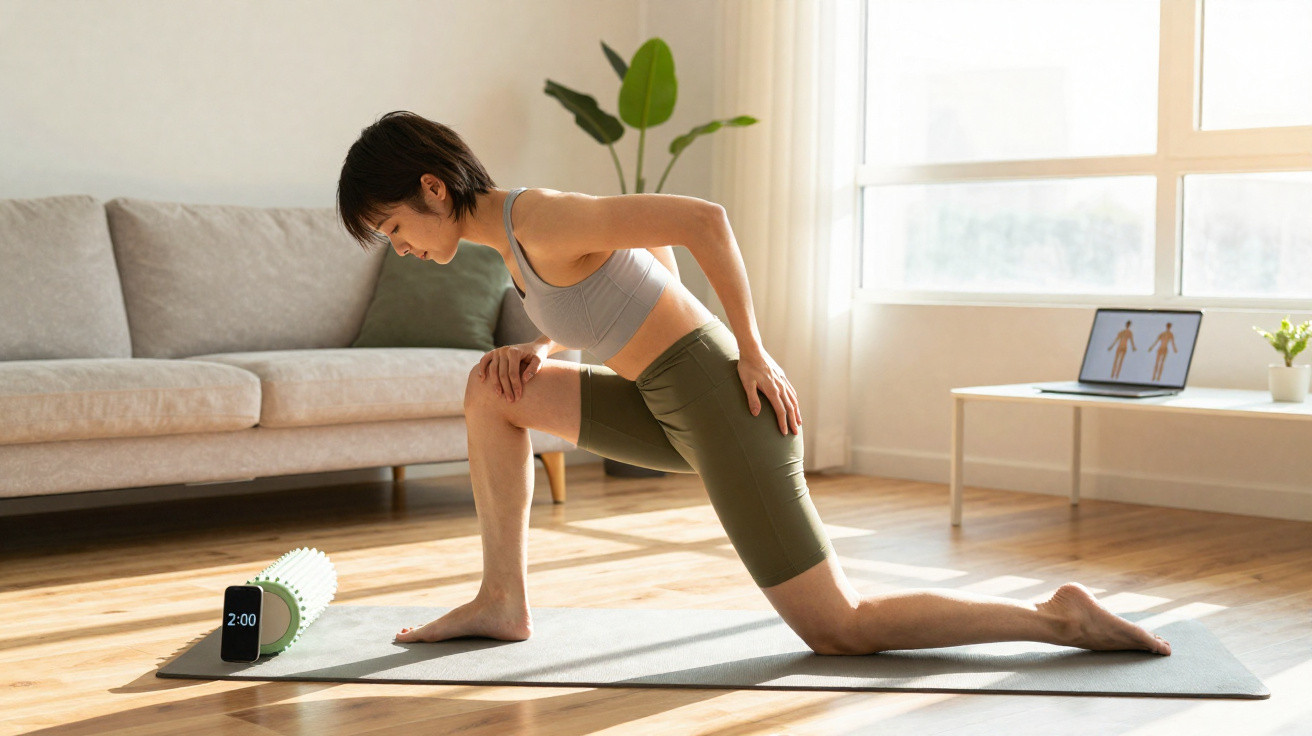
In yoga, this stretch is known as the “Low Lunge” (a half sprinter’s lunge)-here in a gentler, everyday-friendly version. You’ll need a stable surface and, if you like, a mat or a folded towel. Start standing. Step your right foot well forwards, keeping your left foot behind you on the toes. Then carefully lower your left knee to the floor, padding it if needed. Keep your torso upright and rest your hands on the front thigh.
Now for the key detail: don’t force your way forwards until something feels like it might tear. Instead, gently tilt your pelvis backwards, as if drawing your belly button in towards your spine. Then allow your hips to sink forwards slowly until you feel a stretch at the front of the left hip. It shouldn’t be sharp pain-more a clear, controlled pull. Hold for 45–60 seconds, breathing steadily. Then switch sides. Done. Two minutes.
People tend to make the same mistake with hip stretches: too much, too intense, too infrequent. We often operate in an all-or-nothing mode-either we do a 90-minute app workout, or we do nothing at all. Your body doesn’t work like that. It responds best to small, regular signals. If you build this 2-minute stretch in once or twice a day-after brushing your teeth, before bed, while the kettle boils-your movement system starts to recalibrate quietly.
One common stumbling block is confusing “a stretch in the hip” with a pull in the lower back. If you drop into an exaggerated arch because you lean your torso backwards, the load lands in the lumbar spine rather than the hip flexor. Picture gently drawing your ribs down towards your pelvis and keeping your spine neutral. Breathing helps too: lengthen on the inhale; on the exhale, sink a fraction deeper into the stretch. No competition, no heroic effort-just you and two minutes of attention.
A sports medicine doctor once put it like this:
“The hip responds extremely well to small rituals. Anyone who lengthens their hip flexors for 60 seconds per side each day often saves themselves months of back debates.”
To make the 2-minute stretch actually work, it helps to keep a quick checklist handy:
- A fixed time of day: for example, always after brushing your teeth
- Stretch only as far as you can still breathe calmly
- Hold at least 45 seconds per side
- Gently tilt the pelvis backwards-no excessive arching
- Better light and daily than “all the way” once a week
What those two minutes can do to your whole day
You rarely notice the effect in the first minute; it shows up more in the hours that follow. The walk to the station suddenly feels less heavy. Your stride lengthens slightly, and your lower back doesn’t complain every time you stand up. If you run or cycle regularly, you may find your legs work more freely-as if someone has quietly switched an internal setting to “unlocked”.
There’s also a subtle mental side to it. In a day that’s often driven by external schedules, two minutes of deliberately checking in with your body can feel like a small act of rebellion. No timer, no meeting, no notifications-just 120 seconds in which you release a very specific tension. Many people report feeling a touch clearer in the head after a hip stretch. The hip and the nervous system are more closely linked than most of us realise.
In the end, the bigger question is less “Does this stretch really help?” and more “Am I willing to give my body these two minutes each day?” No gym membership, no perfection pressure, no glossy workout plan-just a realistic agreement with yourself. And, quietly, it also asks how you want to treat yourself: with harshness, or with small, kind rituals that slip easily into the day.
| Key point | Detail | Benefit for the reader |
|---|---|---|
| Cause of tight hips | Prolonged sitting, inactive glutes, shortened hip flexors | Understands why the hip “sticks” and that it’s not a personal failure |
| 2-minute stretch | Modified Low Lunge, 45–60 seconds per side, once daily | Gets a specific mini routine that can be done immediately |
| Making it work day-to-day | A fixed trigger (brushing teeth, coffee, end of the workday), gentle execution | Learns how an exercise becomes a real ritual that pays off long term |
FAQ:
- How quickly will I notice effects from the 2-minute stretch? Many people feel a slight release after a few days; clearer changes typically appear after two to four weeks of regular practice.
- Can I do the stretch at the office? Yes. With something soft under the knee it works at work, too; if needed, you can do a slightly adapted version on carpet or even in a conference room.
- What if I get knee pain? Add more padding, shorten the step a little, and only go as far into the stretch as feels comfortable; if the pain persists, it’s best to have it checked by a doctor or physiotherapist.
- Is this one stretch enough to keep my hips healthy? It’s a strong starting point and can relieve a lot of pressure, but in the long term hips also benefit from walking, light strength training, and varied movement.
- Should I stretch before or after sport? For most people, the 2-minute stretch fits better after exercise or at calmer times of day, because the muscles are already warm and release more easily.




Comments
No comments yet. Be the first to comment!
Leave a Comment