
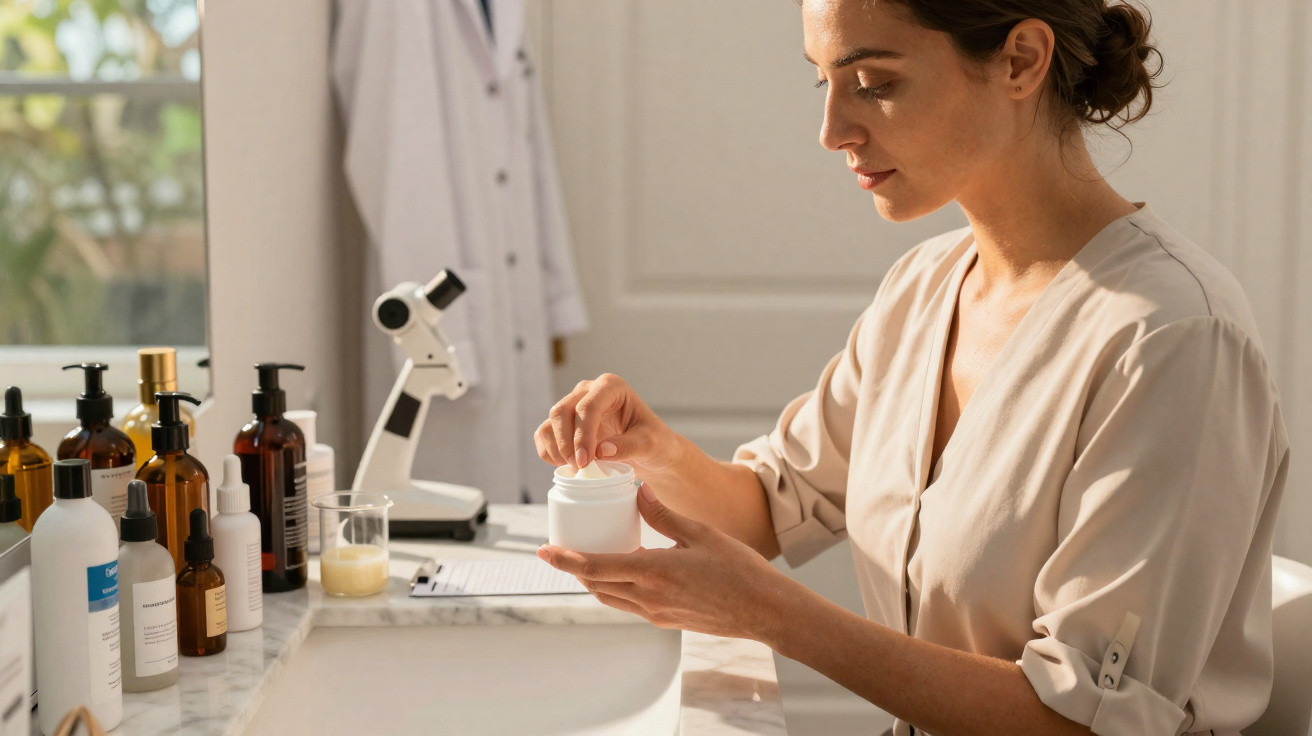
At 7:42 a.m., inside a cramped dermatology clinic in Brooklyn, the waiting area resembles a beauty counter after a small disaster. There are designer tote bags everywhere, “glow” serums lined up like trophies, and vitamin C drops priced at £98 a bottle. A young woman scrolls on her phone and stops-again-on an advert for a “next-gen” moisturiser, supposedly powered by microbiome tech and meteorite dust, or something not far off.
Across the corridor, her dermatologist calmly pulls open a drawer. There’s no rose-gold box, no influencer branding, no celebrity name. Instead: a squat, white-and-blue tub that looks as if it could have lived in your grandmother’s bathroom.
She shuts off the advert, steps into the consulting room, and hears something she wasn’t expecting: “Honestly? This old cream works better than most of what’s on your feed.”
The atmosphere changes.
Why derms are quietly going back to old-school creams
If you ask a few dermatologists-quietly-what they genuinely use at home, the answer is rarely a shiny jar that’s all over social media. More often, it’s a plain tube or a no-frills tub you’ve passed a thousand times in the chemist. Increasingly, dermatologists are conceding (usually with a knowing half-smile) that the real gold standard is often the least photogenic product in the aisle.
At closed-door conferences and in backstage corners of beauty events, they compare notes about patients who dropped complicated routines and, almost overnight, ended up with calmer, more resilient skin. The shared factor isn’t a “miracle” extract from a rare Amazonian plant. It’s a dense, slightly dull cream that simply… does its job.
A French dermatologist I spoke to described one patient who arrived with cheeks that stung and skin that was actively peeling. She’d been layering a prestige serum, a “DNA-repair” night cream, and a brightening essence that cost more than her electricity bill. Her face looked as though it had been through a minor war.
The doctor’s advice felt almost outrageous given the price tags. She told her to stop everything. No acids. No fragrance. No “glow” products in pump bottles. For four weeks, she was put on a basic, old-school cream: thick, from a pharmacy brand, and under £15. At the review appointment, the redness had mostly disappeared, and her skin barrier had recovered.
So why do these creams keep winning-quietly-year after year? The reasoning is bluntly straightforward: skin doesn’t need daily fireworks; it needs consistency. Many of the old-school creams dermatologists rate highly stick to short ingredient lists, rely on generous humectants such as glycerin, and use occlusives like petrolatum or mineral oil to slow down water loss.
No LED tricks. No “instant filter” promise. Just barrier support and hydration that stays in place for hours. Strip away perfume and unnecessary actives, and you reduce the chances of irritation while giving skin the breathing room to repair itself. The plain truth is that the skin barrier prefers peace over entertainment.
How to use a “boring” cream like a pro
If you imagine old-school moisturisers as sticky winter paste you only reach for in emergencies, dermatologists would disagree. When used well, a simple cream can be the backbone of your routine rather than a last-resort fix.
One technique many derms swear by is what they call “moisture sandwiching”. Lightly mist your face or leave it slightly damp, apply your treatment step if you use one (for example, a gentle retinoid), pause for a minute, then lock everything in with a thin, sensible layer of that unglamorous cream. It’s essentially putting a lid on the pot so the steam can’t escape.
At night, some people push it further and apply a very thin “slug” of cream only where skin is most dry and irritated-around the nostrils, the mouth area, and under the eyes.
The mistake many of us make is assuming that more products automatically equals better results. You pile on a hyaluronic serum, a peptide gel, a “glow” oil, and an expensive moisturiser-then act surprised when your skin starts to object. Realistically, almost nobody can keep that up every day without their face eventually complaining.
Dermatologists deal with the consequences all the time: tiny red bumps when too many actives compete on the skin; flaking caused by daily acids that never pause; sensitivity that escalates because nothing is allowed to settle. A single straightforward cream, used reliably, often beats a chaotic routine that reads like a chemistry paper. When skin is irritated, derms tend to simplify first-not as a last resort.
Several of them come back to the same phrase, nearly word for word:
“Trendy formulas come and go, but a well-formulated, plain moisturizer is like a good pair of jeans. You end up wearing it more than anything else.”
When they describe their quiet favourites, they usually run through a familiar checklist:
- Little to no fragrance (ideally fragrance-free)
- A richer texture that actually stays put on the skin
- Glycerin, ceramides or petrolatum to help repair the barrier
- Available in pharmacies/chemists rather than only at premium beauty counters
- Cheaper than the serum you saw on Instagram this morning
Once you’ve felt your skin settle on something this straightforward, the difference is hard to ignore.
An old cream, a new perspective on “good” skincare
A low-key rebellion is playing out in bathrooms right now. People are worn out by routines that feel like a part-time job and cost as much as a weekend away. Hearing a dermatologist call a 40-year-old cream their “gold standard” can genuinely rewire how you think.
You begin to wonder whether you need five different textures before bed. You start paying attention to how your skin behaves day to day, not just how it appears in a filtered selfie. And there’s an unexpected sense of relief in relying on one dependable jar that doesn’t perform-it simply supports.
Dermatologists aren’t saying you have to bin every serum you own. What they are saying is that the base layer matters more than the showy extras. A strong skin barrier makes every other product work better, and old-school creams are barrier bodyguards.
Imagine if the real flex wasn’t owning the newest launch, but having skin that stays steady when the weather changes, when you travel, and when life gets hectic. That kind of resilience rarely comes from novelty. It usually comes from repeating a small, almost boring action every day, even when no one’s watching.
Big brands will continue to launch. Algorithms will keep churning. And in small white consulting rooms, dermatologists will keep reaching-quietly-for the same unassuming cream that almost never trends, but never truly disappears.
| Key point | Detail | Value for the reader |
|---|---|---|
| Old-school creams are derms’ real “gold standard” | Simple, thick moisturisers with short ingredient lists often outperform flashy formulas | Helps you focus on products that actually work, not just those that advertise well |
| Skin barrier first, actives second | Hydration and protection calm irritation and make treatments more effective | Reduces redness, breakouts and sensitivity from over-complicated routines |
| Less can genuinely be more | Using one reliable cream consistently can beat a 10-step routine | Saves money, time and mental load while improving long-term skin health |
FAQ:
- Question 1 Which “old-school” creams do dermatologists actually recommend?
- Question 2 Can a basic cream replace my expensive anti-aging moisturiser?
- Question 3 Will a heavier cream clog my pores if I have oily or acne-prone skin?
- Question 4 How long should I use only a simple cream before expecting results?
- Question 5 Can I still use acids or retinoids if I switch to a basic moisturiser?



Comments
No comments yet. Be the first to comment!
Leave a Comment