
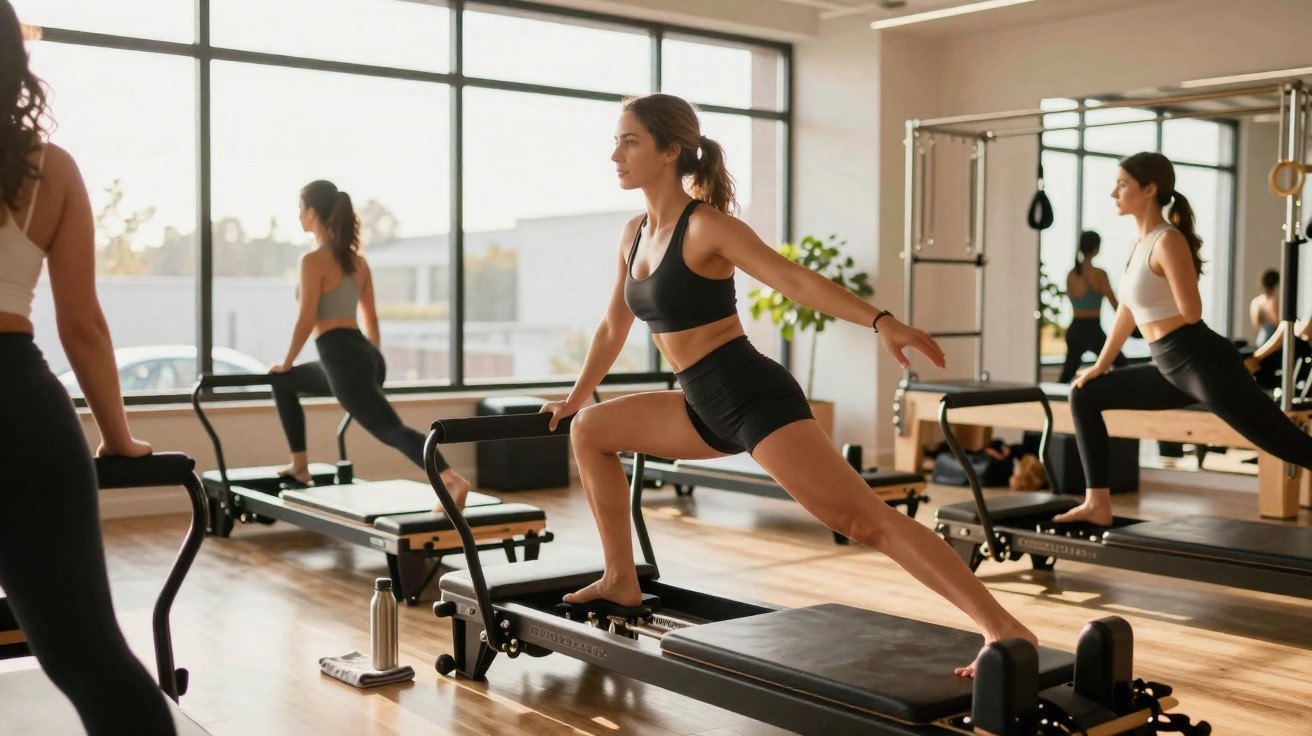
A new ultra-slow approach is promising visible results - no sprints, no jumping, and no need to completely exhaust yourself.
Plenty of people who train on the mat know the feeling: posture improves, the back feels more supported, absolutely - but at some point the body shape stops shifting. Instead of working ever harder or forcing yourself through painful HIIT sessions, a California-born method goes the other way: maximum muscular effort at minimum speed. That contrast is exactly why it’s currently so appealing to Pilates fans.
When Pilates stops being enough: why progress stalls
In the beginning, traditional Pilates can deliver big wins. You stand taller, you can actually feel your abdominal wall working, and your back becomes noticeably more stable. After a few months, though, the progress curve often levels out because the body adapts to the same familiar movement patterns.
If the challenge doesn’t increase, the muscles and nervous system become accustomed to what you’re doing. The exercises may still feel good, but they no longer demand enough to create visible change - and that’s where the “I’m not getting anywhere” frustration sets in.
"Without gradually increasing intensity, your physique stays the same - no matter how disciplined your training is."
If you then swing to extreme fixes such as hard interval training or CrossFit, you can quickly hit the next problem: lots of impact, a higher injury risk, and added strain on joints and the pelvic floor. What many people need is a middle ground that challenges you without breaking you down.
Lagree Training: more intense than Pilates, gentler than HIIT
That middle ground is what Lagree Training claims to offer. Created in California, the method is slowly gaining a foothold in European studios. Visually, it can resemble a sleek Pilates studio - but in practice the emphasis is firmly on strength and muscle definition.
The core idea is high intensity with low stress on the joints. In each movement, the goal is to take the muscle right up to its limit. You work with control until you can’t complete another clean repetition - with no jumping and no jerky momentum.
The Megaformer: the machine behind the hype
At the centre of the method is a piece of equipment that looks like a mash-up of a Reformer, a core trainer and a torture device: the Megaformer. It has a moving carriage, fixed platforms at either end, and multiple springs offering different resistance levels.
- Central carriage - creates instability and movement
- Platforms at both ends - for standing, bracing and varying angles
- Springs - adjust resistance from light to very heavy
- Handles and anchor points - allow pushing and pulling in every direction
Unlike a classic Reformer, which is often used in rehabilitation settings, the Megaformer doesn’t “help” you. It demands continuous resistance with virtually no downtime. You control the machine - not the other way round.
Full-body training in slow motion
Lagree Training blends strength, endurance and core work into a continuous flow. Rather than isolating one muscle group at a time, several areas work at full throttle simultaneously. A typical moment: a lunge on the unstable carriage while the arms pull on cables and the torso fights to keep balance.
Your heart rate climbs even though there are no sprint efforts. The challenge comes from how much muscle tissue is switched on - and from the feature that makes the method feel so punishing: the deliberately ultra-slow pace.
The power of slowness: why four seconds changes everything
The most surprising rule in this style of training is the insistence on moving extremely slowly. Each phase - down and up - lasts at least four seconds. No swinging, no bouncing, no “cheating” through the hard bits.
"Slowness isn’t a gentle option here - it’s the turbo for your muscles."
Take speed away, increase the stimulus
When momentum is removed, the muscle has to stay switched on every moment. The fibres remain under tension continuously, whether lengthening or shortening. The slow-twitch fibres in particular - linked to endurance and that “dry”, lean definition - are challenged intensely.
If four seconds sounds brief, it won’t once you try it. After only a few repetitions, the burn arrives. It can feel like isometric work, except the movement never stops.
Continuous tension instead of a break between reps
In traditional strength training, there’s usually a tiny reset between repetitions where the load eases. In Lagree Training, that relief almost disappears. A muscle can remain fully loaded for one to two minutes.
That uninterrupted tension temporarily reduces oxygen supply to the working muscle. The result is a strong burn, shaking and a powerful training signal. The body responds with adaptations in muscle and hormonal regulation, which can drive fat burning and support muscle building - while keeping the mechanical stress on bones and joints comparatively low.
Why everything starts shaking on the Megaformer
For many people - even those who are fit - a first session on the Megaformer is genuinely surprising. Movements that look harmless can trigger intense shaking in the legs, arms and abdominals within seconds.
Instability as a built-in training partner
The moving carriage is designed to create a controlled loss of stability. To avoid sliding forwards or backwards, the deep stabilising muscles are constantly engaged. The core, especially, works almost non-stop - without a single classic sit-up.
Instead of endless crunches, the method relies on hard, cross-body bracing. Your abdominal wall feels as if it’s pulling towards the spine; over time the waist can look narrower and the back more supported. The look is less “bodybuilder” and more “dancer-like”.
Fast transitions, slow movements
A distinctive feature is the mix of calm, slow repetitions with quick changeovers. Between exercises, you often get only a few seconds, helping to stop the heart rate dropping.
| Element | How it works |
|---|---|
| Slow execution | Maximum muscular tension, high stimulus through every centimetre of movement |
| Quick changes | Heart rate stays consistently high, fat burning continues |
| No impact | Kind to knees, hips and back |
You’ll sweat heavily even though nobody is jumping or sprinting. Many describe it as "cardio through pure muscle work" - breathing hard without that familiar treadmill sensation.
The famous muscle shake: a sign of real change
In Lagree studios, the muscle tremble - often called the “shake” - is almost treated as a badge of quality. When muscles start twitching uncontrollably, you’ve reached the point where the body has to adapt.
"The shaking shows your body is leaving its comfort zone - and that’s exactly where it reshapes itself."
The first time it happens, it can be unsettling. Over time, you learn to interpret it - and even aim for it. The neuromuscular system becomes more resilient and your control improves. Many also notice a mental training effect: learning to keep breathing calmly while shaking builds staying power.
Intense, but kind to the joints
Despite the high effort level, the workout is surprisingly joint-friendly. Hands and feet stay connected to the machine, and there are no landing forces like running and no jumps for the knees to absorb.
That makes it possible to strengthen sensitive areas such as knees, hips or shoulders without overloading them. For people coming from running, demanding class formats or injury-prone sports, that’s a compelling reason to try it.
How the body changes - and why many don’t want to go back
Those who train two to three times a week usually notice changes quite quickly: shoulders look more defined, posture appears taller, and the midsection feels “compact”. At the same time, the muscles tend to stay long and lean rather than bulky.
Common effects reported by participants include:
- firmer arms and shoulders without a “bodybuilder” look
- a noticeably tighter abdomen and less anterior pelvic tilt
- strong yet defined legs and glutes
- clearly improved everyday stability, for example when carrying shopping or climbing stairs
Many people finish a session feeling not drained but clear-headed and alert. Because there are no sprint intervals, there’s often still energy left for work, family and day-to-day life. That mix can become quickly “addictive”, making more conventional workouts feel underwhelming by comparison.
Who Lagree suits - and what to watch out for
In principle, the training works for beginners and experienced exercisers alike, because spring resistance can be adjusted very precisely. If you haven’t exercised in a long time or you’re dealing with symptoms, it’s still best to discuss your start with qualified instructors.
Key points for a safe introduction:
- choose smaller groups so corrections are possible
- prioritise clean technique rather than the highest resistance
- if you feel sharp pain, adjust immediately - don’t “push through”
- accept a learning phase - the machine feels unfamiliar at first
Lagree can also be an exciting add-on for Pilates fans who’ve hit a plateau: the body awareness from mat work helps hugely with form, while the Megaformer adds the extra stimulus the muscles have been missing.
How to fit the slow training into everyday life
If you’re intrigued, you don’t need to replace every Pilates session immediately. A practical starting point is one to two Lagree sessions per week, combined with walks, light cardio, or continuing with a classic Pilates class.
It helps to be clear about your goal: is the priority a firmer physique, better posture, or greater core strength? Depending on what you want, instructors can tailor the focus - for example towards legs, the shoulder girdle or the core.
It can also pair well with other gentle methods such as yoga, fascia-focused training or swimming. While Lagree provides the strong stimulus, these sessions support recovery, mobility and stress reduction, creating a mix that not only changes how you look but also keeps your body resilient over time.





Comments
No comments yet. Be the first to comment!
Leave a Comment