
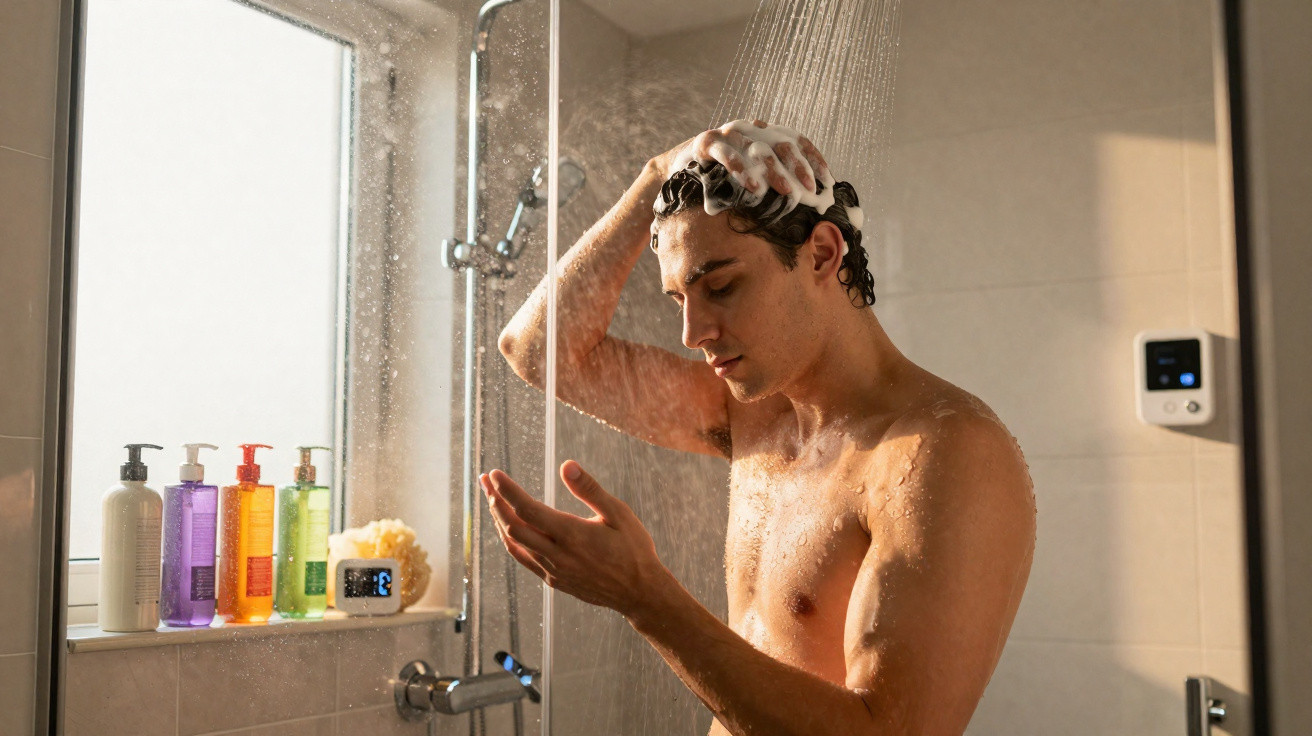
Different people can take wildly different amounts of time in the shower - and it is unlikely to be down to age, gender, or how many people live in the home.
A new study suggests the real explanation sits in the shower routine itself.
To investigate, researchers installed small sensors in the showers of 319 German households and kept them in place for one winter. Across 40 days, the devices captured 8,550 individual showers.
Factors that predict longer showers
The sensors tracked the total time the water was running, how often it was paused, and the conditions inside the bathroom.
Participants were not monitoring their own shower times: the display that would have shown the running count was covered.
For 958 of the showers, the research team linked the sensor data to a follow-up questionnaire in which participants reported their age, household dynamics, and which products they used.
Researchers at the University of Surrey then built a comprehensive model to identify what predicts a longer shower. The model considered 14 factors simultaneously, allowing each one to be assessed while holding the others constant.
When shampoo applications add up
The strongest pattern was tied to shampoo use. When people applied shampoo twice or more, showers were around 27% longer than when they shampooed with a single lather.
In simple time terms, that worked out at roughly five minutes for one wash and six and a half for two. More than one in five hair-washing showers included a second application.
“It turns out the biggest drivers of water use are not who you are or where you live. What matters most is what you actually do in the shower,” said Dr. Pablo Pereira-Doel.
“Small routines such as applying shampoo twice or letting the water run while lathering can extend shower time far more than people realize.”
Pausing the water can backfire
Switching the water off while soaping up might seem like an obvious way to reduce water use.
Showers with a single pause were marginally shorter, but the difference was too small to be confident about.
However, showers that included three or more pauses moved in the opposite direction. They were about 20% longer than showers with no pause at all, and 28% longer than showers with one pause.
The researchers interpreted frequent pausing less as careful saving and more as a sign of a leisurely, unhurried shower.
Soft water and younger people
Water softness also appeared to matter. In areas with soft water, showers were about 23% longer than in hard-water areas.
Because soft water produces a fuller lather, it may simply make the experience more pleasant.
The longest shower times were seen among younger and middle-aged adults.
People aged 18 to 29 showered about 29% longer than those over 50, while people in their 40s showered about 31% longer.
What made showers longer
Water-saving showerheads are designed to reduce usage by lowering the flow rate - yet in these households, they were linked to higher use.
A flow restrictor was present in only 13% of showers. Those showers averaged 5:51, compared with 4:38 for showers without a restrictor.
When water flows more slowly, people may stay under it for longer to feel just as warm or as clean.
The research team describes this as a rebound effect, and suggests it may affect any intervention that reduces flow without changing the underlying habit.
Products could help reduce water waste
The work was funded by L’Oréal Research and Innovation and by Ipsos, the market-research firm that recruited participating households.
That support is relevant because the paper’s recommendations point towards product-related changes. The findings indicate that switching products could matter as much as changing behaviour.
The study suggests single-use formulas, clearer dosage instructions, and prompts that indicate when washing is complete could all help cut water waste in the shower.
According to the study, rinsing shampoo from hair uses roughly 7.1 litres (1.9 gallons) of heated water. Rinsing conditioner uses about 6.3 litres (1.7 gallons).
Designing solutions with habits in mind
All showers were recorded during one cold period, so the results cannot show how routines shift across different seasons.
Participants may also have altered their washing slightly because they knew a sensor was installed, although the researchers note that this effect likely faded over time.
For the hair-washing analysis, the team focused on one person per household, meaning the shower habits of teenagers and younger children in the same home were not captured.
The survey did not ask about stress, mood, or feeling cold - any of which could lengthen a shower independently. And because every household was in Germany, the same patterns may not apply in other countries.
“If we want to reduce household water consumption, we need to design solutions that work with people’s habits rather than against them,” said Pereira-Doel.
“Behavioral nudges, smarter feedback devices and better product design could all play a role in helping people use less water without sacrificing comfort.”


Comments
No comments yet. Be the first to comment!
Leave a Comment