
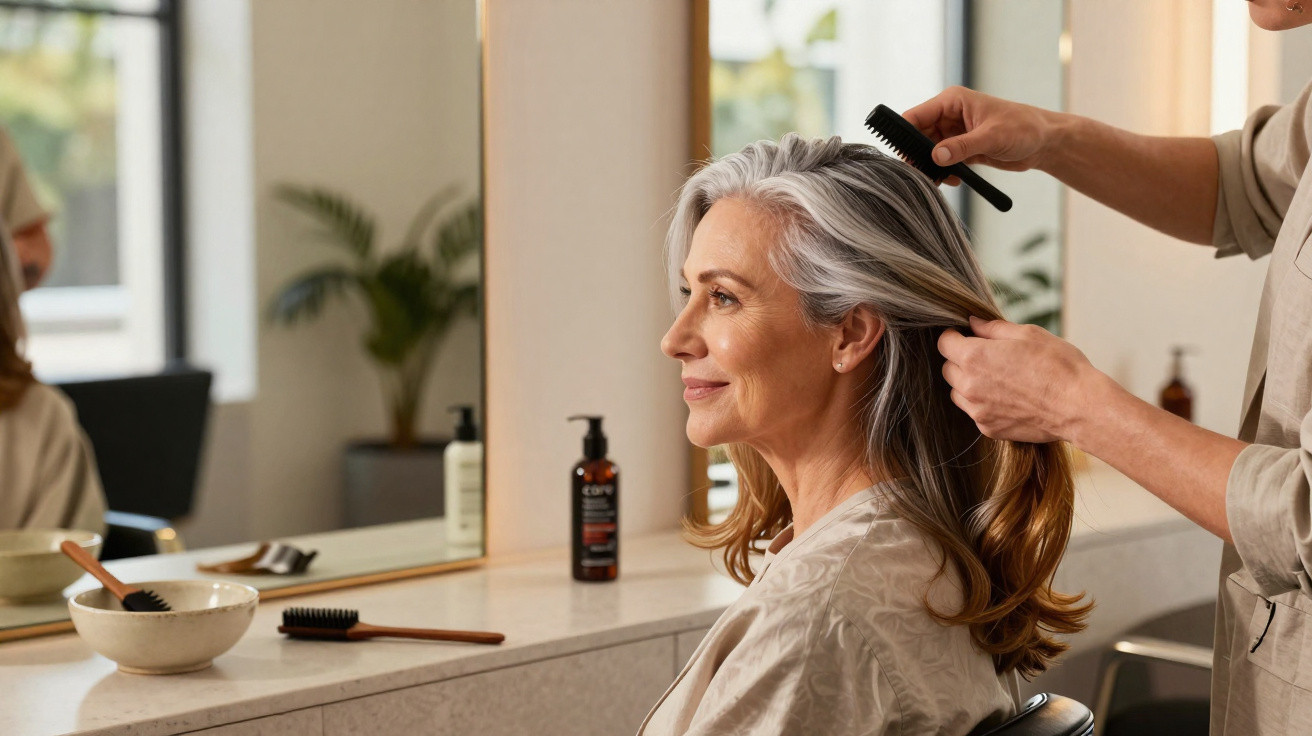
Grey hair no longer needs to be hidden under a solid, dark all-over dye to look well cared for. The trend often called grey hair camouflage uses gentle demi-permanent colour, ultra-fine highlights and a smudged root to blend lighter strands into your natural shade, so regrowth creates far less contrast.
What is the trend that camouflages grey hair?
This approach doesn’t aim to conceal every single grey. Instead, it focuses on building a soft, gradual transition between a white/grey root, a tinted mid-length and the ends, using tones close to your original colour. The finish looks more translucent and avoids the harsh line that commonly appears after full-head colouring.
A luminous grey-hair camouflage can be adjusted to match how much grey you have, your root colour and the condition of your hair. The most common tools include:
- A demi-permanent colour to deposit tone without creating fully opaque coverage;
- Fine highlights placed among grey strands;
- A smudged root to reduce obvious regrowth lines;
- Beige, honey or ash-toned reflects depending on the base;
- A hair gloss to boost shine and even out the look.
Why does demi-permanent colour look more natural?
A demi-permanent colour provides partial coverage and fades little by little with each wash, which makes the difference between new root growth and the coloured lengths less noticeable. It is not automatically free from ingredients that can trigger sensitivity, so the patch test recommended by the manufacturer still matters before application.
- Keeps some of the hair’s natural tonal variation;
- Prevents an overly uniform, flat result;
- Can counteract yellow or orange undertones;
- Lets you refine the finish without darkening the entire head of hair;
- Fades more softly than some permanent dyes, which can leave a sharper regrowth line.
Which techniques blend grey hair into the rest?
Very fine highlights add lighter points close to the grey strands, reducing the visual gap between them and the natural base shade. On darker hair, stylists may also add deeper pieces-often called lowlights-to bring back dimension without fully covering the silver.
A smudged root strengthens the effect by softening the shift between shades. Rather than applying a single solid colour straight from the scalp, the stylist works with neighbouring tones and avoids hard, separated bands. This mix usually means fewer appointments purely for coverage, although highlights that involve lightening can still stress hair that is already fragile.
How to ask for this natural effect at the salon
When you book, make it clear you want to integrate greys rather than achieve total coverage. Assessing the percentage of grey strands, previous chemical services and the fibre’s strength helps decide whether to use demi-permanent colour, highlighting, or a blend of both.
- Ask for a grey blend with minimal root marking;
- Bring reference photos that match your base colour;
- Disclose any previous dyes, straightening treatments and bleaching;
- Ask which areas truly need highlights;
- Request a maintenance plan before the service;
- Follow the recommended precautions for using hair colour products.
Maintenance determines shine and how long it lasts
A shampoo designed for colour-treated hair, a hydrating mask and heat protection can help limit dryness and dullness. Very hot water, heat styling without protection and washing too often speed up the fading of demi-permanent colour and can leave highlights looking less bright.
Grey hair camouflage works best when it respects the way grey hair grows in, instead of trying to erase it at every sign of regrowth. With close-matching tones, well-placed light pieces and planned touch-ups, greys become part of the colour design-creating a brighter look without relying on heavy, all-over coverage through the lengths.





Comments
No comments yet. Be the first to comment!
Leave a Comment