
Friday evening: the bathroom mirror light is a touch too yellow, and your hairbrush is teetering on the sink. You’re not technically running late-yet-but it’s getting close. Your curtain bangs are pulling their usual stunt: flawless on the right, and a strange little ledge on the left. You reach for the round brush, switch on the hairdryer, and attempt that salon swoosh… only to end up, three minutes later, with a damp forehead and a fringe that looks like it’s time-travelled from another era.
Over on TikTok, the mood has already shifted. That glossy, perfectly swooped bang is quietly giving way to something airier, less precious, and almost… deliberately imperfect.
It’s being called the “shattered fringe”.
What exactly is a shattered fringe – and why is everyone asking for it?
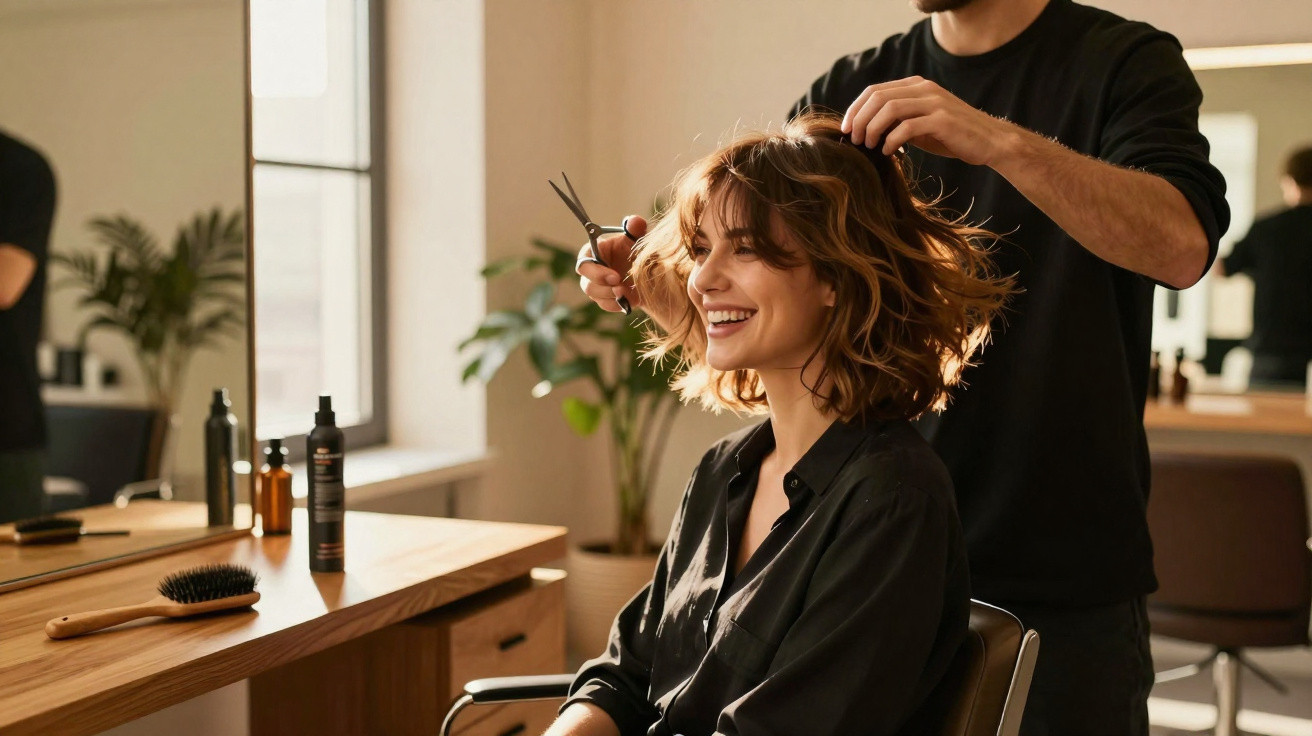
At first look, a shattered fringe reads like bangs that have finally stopped trying so hard. The outline is blurred, the tips are light and feathery, and there isn’t a clear “curtain” shape or a blunt strip of hair cutting across the face. Instead, it’s separated and slightly undone, with small spaces where your skin and brows can show through.
Picture the opposite of a helmet fringe. It shifts as you move, it breaks apart in a breeze, and when you rake it back with your fingers, it drops differently each time. That unpredictability is the point.
Scroll through beauty accounts and you’ll spot what’s changing. The image people save again and again isn’t the ruler-straight curtain bang; it’s the soft, shattered edge that sits around brow level and blends into the rest of the haircut.
In salons, the same line keeps coming up: “I want bangs, but not… bangs-bangs.” A Paris stylist I spoke with called it “the fringe for people who hate committing.” She added that, over the past six months, roughly four in ten new clients have asked for some version of this softer, choppier front-subtle, but unmistakably a shift.
There’s a straightforward reason it’s catching on. Curtain bangs required commitment: round-brushing, carefully placed oil, and frequent trims to maintain the curve. A shattered fringe works the other way around, relying on lived-in texture and relaxed imperfection.
We’re in a moment where hair is allowed to look like it belongs to an actual person, not a blow-dry bar mannequin. A shattered fringe frames your face in the way phone filters do: it softens lines, blurs edges, and draws the eye to your eyes without making a big announcement. After years of ultra-glossy, TikTok-perfect styling, it feels like the next logical step.
How to ask for – and actually style – a shattered fringe in real life
Before you even sit down in the chair, do one thing: collect screenshots. They’re the most useful reference-so long as you’re realistic about them. Choose examples on people with similar hair texture and face shape, rather than only the influencer version of yourself you’d like to be at 8 a.m. on a Monday.
Once you’re in the salon, keep your wording clear and simple: “soft, piecey fringe,” “no straight line,” “feathered ends,” “lots of movement.” Ask for the middle to be kept slightly shorter, with the sides blending into your layers or the overall length of your cut. You’re aiming for a fringe that can be worn forward, nudged to either side, or nearly vanish when it’s tucked away.
The challenge usually isn’t the haircut-it’s what happens afterwards. Most of us know the feeling: you try to “sort” one odd bit, and suddenly you’re restyling your entire head.
Stylists keep coming back to the same advice: start by drying your shattered fringe with your fingers. Skip the round brush. Avoid a flat iron cranked up to maximum heat. Rough-dry it forward, moving slightly side to side, then define a few sections using the tiniest amount of texture spray or a lightweight wax. And, honestly, hardly anyone does this perfectly every day-which is exactly why this fringe works. It still looks good when you haven’t tried that hard.
A London hairstylist put it like this:
“Curtain bangs are a style. A shattered fringe is a feeling. You don’t see the cut first, you see the person.”
To keep that ‘feeling’, stick to a handful of practical moves:
- Ask for soft, razor-like texturising through the ends rather than a blunt chop.
- Keep the length somewhere between mid-forehead and just below the brows, depending on what feels right for you.
- Choose a dry texture spray or styling powder instead of heavy serums that stick strands together.
- Book micro-trims every 6–8 weeks to revive the shape without starting over.
- On “bad hair” mornings, lean into it: a messy clip or a low bun with the fringe left out looks intentional with this cut.
Why the shattered fringe might finally be the bang you don’t regret
This fringe matches where many of us seem to be right now. We still want the face-framing effect that bangs give, but we’re worn out by feeling like we need a tutorial-level finish just to leave the house. The shattered fringe manages both: it looks styled without looking overdone; it’s noticeable without demanding attention.
It also adjusts to you, quietly. With a full face of make-up, it reads as part of the overall look. With a hoodie and a rushed start, it simply softens everything a little when you catch yourself in the mirror. It’s the kind of detail that changes how you feel about your whole reflection, without anyone really knowing why.
| Key point | Detail | Value for the reader |
|---|---|---|
| Shattered fringe is softer than curtain bangs | Feathered, piecey, with no hard line across the forehead | Looks modern and effortless, less risk of looking “over-styled” |
| Low-maintenance styling | Finger-drying, light texture products, works with natural movement | Saves time and stress on busy mornings while still looking put-together |
| Highly adaptable | Can be worn center, off-center, blended into layers or tucked back | One cut that suits different moods, outfits, and makeup levels |
FAQ:
- Question 1 Will a shattered fringe work on naturally wavy or curly hair?
- Answer 1 Yes, and it can look incredible. Ask your stylist to cut it dry or at least check the shape dry, so they see your curl pattern. The fringe will sit looser, more romantic, with soft tendrils rather than strict pieces.
- Question 2 Is a shattered fringe suitable if I have a small forehead?
- Answer 2 It can be, if the length is tailored. Go a bit shorter and lighter, with more gaps so your skin shows through. Avoid heavy, thick sections; think whisper of fringe rather than full coverage.
- Question 3 How do I explain “shattered fringe” to a stylist who hasn’t heard the term?
- Answer 3 Describe it as a soft, textured, piecey fringe with no blunt line, and show two or three reference photos. Say you want movement, feathered ends, and the option to push it to the sides.
- Question 4 Do I need special products to style it?
- Answer 4 Not necessarily. A light texture spray, a bit of mousse, or a dry styling cream is usually enough. Focus on keeping the hair light and touchable, not stiff with hairspray.
- Question 5 What if I regret it and want to grow it out?
- Answer 5 Because the shattered fringe is already soft and blended, it grows out more gracefully than blunt bangs. Your stylist can keep melting the ends into face-framing layers until it just becomes part of your haircut.




Comments
No comments yet. Be the first to comment!
Leave a Comment